


Bu içerik Türkçe olarak yazılmış olup yapay zeka ile otomatik olarak İngilizceye çevrilmiştir.
+2 Daha
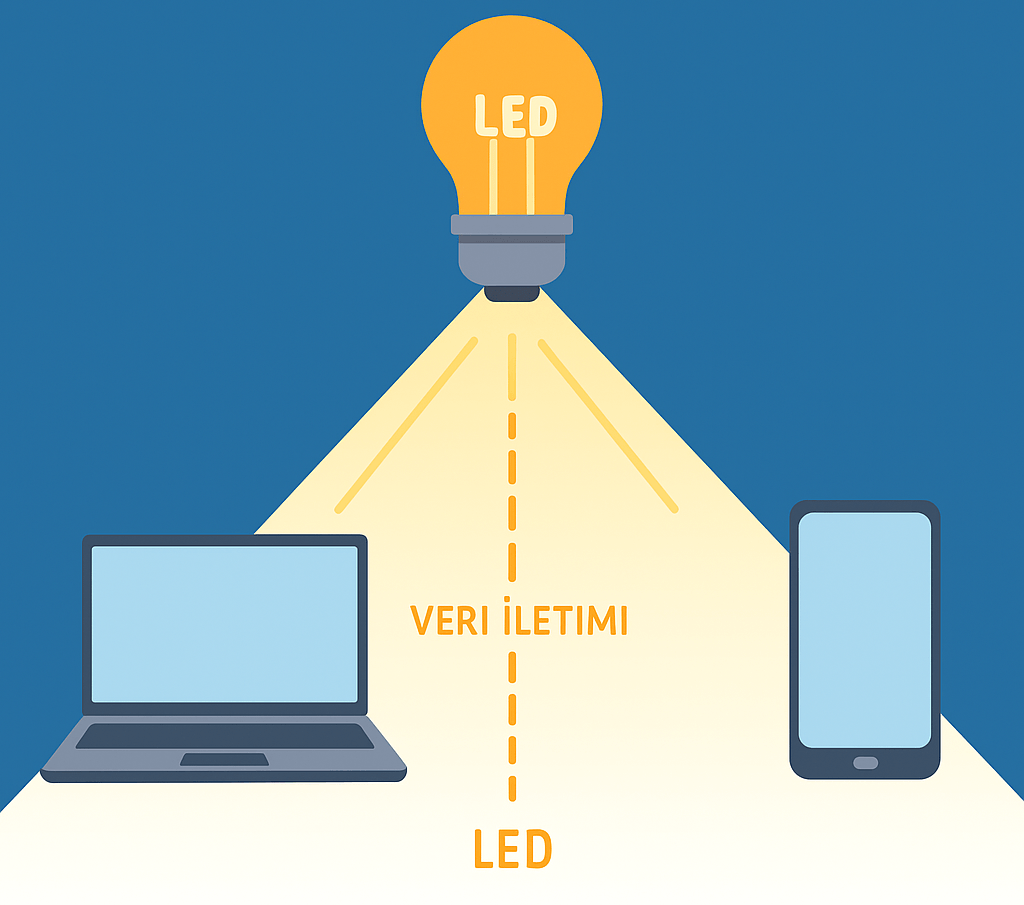
Li-Fi (Light Fidelity) is a wireless communication technology that transmits data through the visible light spectrum. Information is transmitted by rapidly turning on and off LED (Light Emitting Diode) light sources at speeds imperceptible to the human eye. In this regard, Li-Fi offers higher bandwidth, lower energy consumption, and more secure communication compared to technologies such as Wi-Fi that rely on radio frequencies.
The Li-Fi technology was first introduced in 2011 by Professor Harald Haas from the University of Edinburgh. During a presentation at the TED Conference, a video was successfully transmitted at a speed of 10 Mbps through a single LED. This advancement pioneered a new dimension in communication technologies by establishing Visible Light Communication (VLC) as a viable alternative.

Li-Fi technology (generated by artificial intelligence)
Li-Fi systems consist fundamentally of a transmitter made up of LEDs, a receiver containing a light sensor such as a photodiode or LDR, and a transmission channel based on line-of-sight (LoS) between the two. Data transmission occurs by modulating the LEDs to represent binary code ‘1’ and ‘0’ through rapid on-off switching. The photo-sensor in the receiver converts these light pulses into electrical signals, which are then decoded into digital data.
Li-Fi technology offers several advantages over Wi-Fi systems:
However, Li-Fi also has disadvantages:
While Li-Fi’s physical limitations enhance its security, they also restrict its usability to specific environments. Nevertheless, these constraints make it ideal for secure data transmission in institutional settings such as office rooms, conference halls, and banking systems. Additionally, because visible light technology does not add any load to the electromagnetic spectrum, Li-Fi systems become particularly attractive in environments where reducing electromagnetic pollution is essential.
Li-Fi technology stands out especially in environments where radio waves are undesirable or pose security risks:
Academic research on Li-Fi has demonstrated its feasibility and efficiency. Prototypes built using embedded systems have successfully transmitted data via LEDs and received it using LDR sensors. Some studies have shown that data sent using a smartphone’s flash can be successfully received by Arduino-based systems. Tests conducted with protocols such as ZMODEM and XMODEM revealed that ZMODEM offers superior transmission performance.
The widespread adoption of Li-Fi technology will greatly facilitate applications in smart cities, IoT devices, Industry 4.0 systems, and real-time data transfer environments. The capacity of this technology can be further enhanced through the use of more sensitive receivers such as LED arrays and solar cells, as well as laser-based directional systems. Hybrid systems combining Wi-Fi and Li-Fi can be developed to provide broader coverage and enhanced security. Increasing light intensity will also enable communication over longer distances. Li-Fi is regarded as one of the key future technologies for meeting the demands of secure, low-cost, and high-speed communication.

Henüz Tartışma Girilmemiştir
"Li-Fi Technology" maddesi için tartışma başlatın
Technological Background and Development Process
Working Principle
Comparison with Wi-Fi
Application Areas and Use Cases
Experimental Studies and Prototypes
Future Expectations