


This article was automatically translated from the original Turkish version.
+4 More
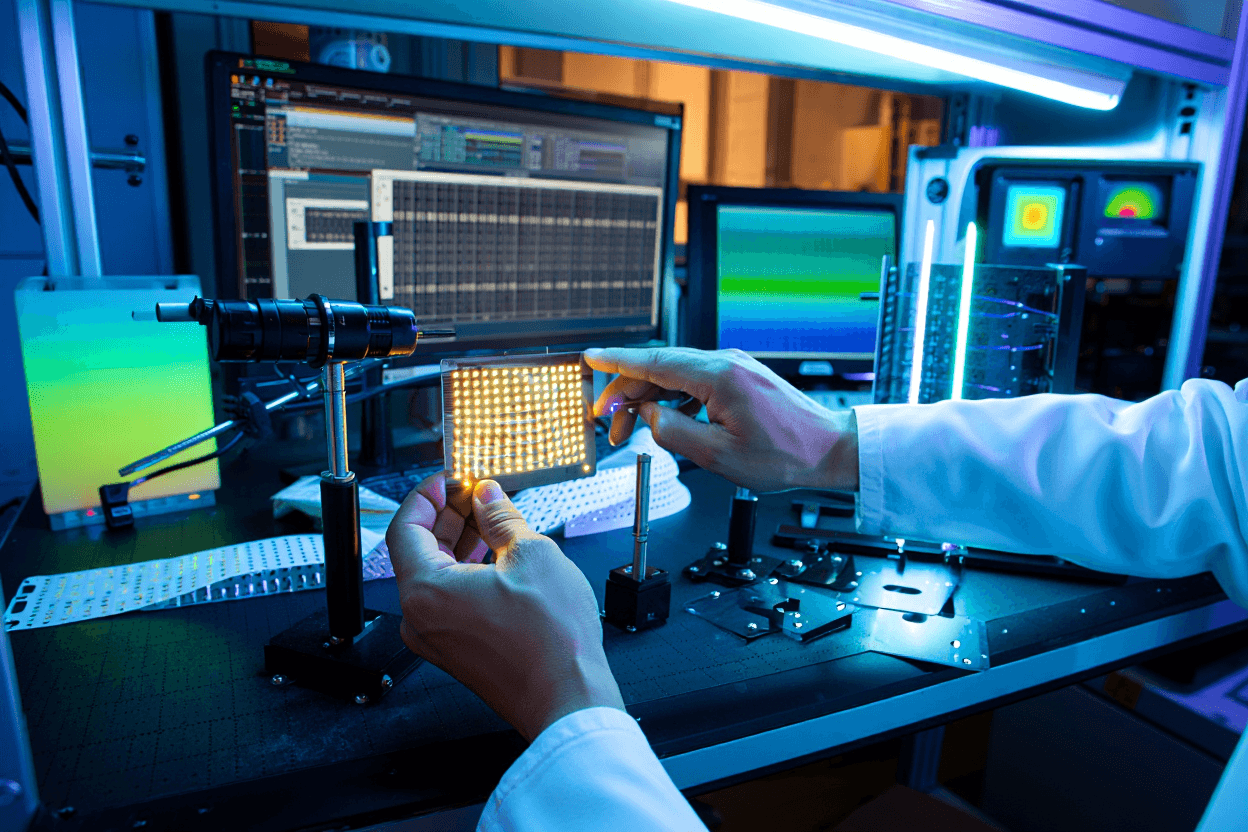
LED Technology (Generated with Artificial Intelligence)
Invention | 1920 (Russia), 1962 (practical application in the USA) | ||||||||
|---|---|---|---|---|---|---|---|---|---|
Working Principle | Electroluminescence | ||||||||
Main Material | Semiconductor diode | ||||||||
Energy Efficiency | Up to 80% savings compared to traditional bulbs | ||||||||
Average Lifespan | 35,000 - 100,000 hours | ||||||||
Basic Type(s) | COB (Chip on Board) SMD (Surface Mounted Device) | ||||||||
LED (Light Emitting Diode – Işık Yayan Diyot) is a semiconductor electronic component that directly converts electrical energy into visible light. Due to advantages such as high energy efficiency, long lifespan, durability, and design flexibility compared to traditional lighting methods like incandescent, halogen, and fluorescent lamps, LED has become the primary lighting source today. LED technology is used across a wide range of applications, from residential lighting to industrial facilities, automotive to agriculture.
Although the fundamental principles of LED were first discovered in Russia in the 1920s, it was not until 1962 in the United States that LED became a practical electronic component. Early LEDs could only emit weak red light and were primarily used as indicator lights in electronic devices. In recent years, rapid advances in semiconductor technology have enabled modern LEDs to produce high-intensity light across the entire visible spectrum as well as in other wavelengths such as ultraviolet (UV – Ultraviolet) and infrared (IR – Infrared). This development has allowed LEDs to establish themselves in the general lighting market.
The light generation process in LEDs is based on the principle of electroluminescence. Unlike traditional incandescent bulbs, which produce light by heating a filament, LEDs generate light through a cold process. An LED chip is a semiconductor diode composed of a p-type layer, which contains positive charge carriers (holes), and an n-type layer, which contains negative charge carriers (electrons). The region where these two layers meet is called the p-n junction. When a forward voltage is applied to the diode, electrons from the n-type layer move toward the holes in the p-type layer. During this recombination, electrons drop to lower energy levels and release the energy difference as photons, or particles of light. The color of the emitted light depends on the type of semiconductor material used and its bandgap energy. Because minimal heat energy is produced during this process, LEDs operate with high efficiency.

LED Technology (Generated by Artificial Intelligence)
The performance, quality, and lifespan of an LED lighting fixture depend on the compatibility of its various components. These fundamental components are:
LED chips, the heart of lighting, are structurally divided into two main categories:
LEDs generate a certain amount of heat during operation. If this heat is not effectively dissipated, the junction temperature of the LED rises, leading to reduced light output and shortened lifespan. Heat sinks made from highly thermally conductive materials such as aluminum maintain the LED chip at its ideal operating temperature, ensuring long-term and stable performance.
LED drivers are power supplies that convert alternating current (AC) from the grid into the direct current (DC) required by LEDs and regulate current and voltage. A high-quality driver protects the LED from voltage fluctuations and harmonic distortions in the power grid, which is critical for extending the LED’s lifespan.
Reflectors and lenses are used to control, direct, and distribute the light emitted by LEDs. Reflectors focus light onto specific areas to create accent lighting, while lenses control the beam angle (narrow or wide) to produce a uniform lighting distribution. In applications such as street and industrial lighting, proper optical design ensures efficient use of light.
LED technology offers numerous advantages over traditional lighting solutions:
LEDs convert a large portion of the energy they consume directly into light rather than heat. As a result, they consume 80 to 90 percent less energy than incandescent lamps. High lumen-per-watt values enable more light output with less energy.
The lifespan of LED lamps ranges from 35,000 to 100,000 hours depending on usage conditions. This represents a 20 to 25 times longer operational life compared to traditional bulbs, significantly reducing maintenance and replacement costs.
Due to their semiconductor structure, LEDs are not fragile like glass bulbs. They are highly resistant to shock, impact, and vibration.
Unlike fluorescent lamps, LEDs do not contain harmful heavy metals such as mercury or halogen gases. Their low energy consumption reduces carbon emissions, and even at the end of their life cycle, their environmental impact remains minimal.
LEDs reach full brightness instantly. Light levels can be easily adjusted using dimmer switches. Additionally, they offer various color temperatures (warm white, natural white, cool white) and colors (RGB), enabling the creation of desired atmospheres.
Their small and compact size provides lighting designers and manufacturers with the opportunity to develop thin, elegant, and innovative fixtures.
Due to their low heat output, LEDs reduce the risk of burns and fire. Additionally, general-purpose LED lighting does not emit harmful ultraviolet (UV) radiation.
The advancement of Internet of Things (IoT) technology has elevated LED lighting to a new level by introducing the concept of smart lighting. Smart lighting systems are modern solutions that can be controlled, programmed, and automated via the internet or other wireless networks such as Wi-Fi, Bluetooth Mesh, Zigbee, and Z-Wave.
These systems are managed through mobile applications, voice assistants (such as Alexa and Google Assistant), or sensors. Users can remotely adjust the brightness and color of lights, create scheduling scenarios (for example, turning lights on or off at specific times), and make automatic adjustments based on environmental conditions. Motion sensors ensure lights are only activated when needed, providing additional energy savings. Daylight sensors reduce artificial lighting based on the ambient natural light level, maximizing efficiency. Smart lighting delivers comfort, security, and energy efficiency across a wide range of applications, from homes and offices to commercial buildings and smart cities (smart street lighting).
The flexibility and efficiency offered by LED technology have made it an ideal solution for countless applications:
"Akıllı Tünel Aydınlatması." Philips Lighting. Accessed July 23, 2025. https://www.lighting.philips.com.tr/uygulama-alanlari/public-spaces/tunnelogic.
"Geleceğin Aydınlatma Teknolojileri: Akıllı ve Sürdürülebilir Çözümler." Bigis & Elf Fuarı. Accessed July 23, 2025. https://elffuar.com/gelecegin-aydinlatma-teknolojileri-akilli-ve-surdurulebilir-cozumler/.
"Muwoco LED'li Aydınlatma." *Muwoco*. Accessed July 23, 2025. https://muwoco.com/muwoco-ledli-aydinlatma/.
"Technical Information - PEDAŞ LED Lighting Technologies." *PEDAŞ*. Accessed July 23, 2025. https://pedas.com.tr/teknik-bilgi/led-aydinlatma.
Bhattarai, Trailokya, Abasifreke Ebong, and Mohammad Yasin Akhtar Raja. "A Review of Light-Emitting Diodes and Ultraviolet Light-Emitting Diodes and Their Applications." *Photonics* 11, no. 6 (2024): 491. https://doi.org/10.3390/photonics11060491.
Chinchero, Héctor F., J. Marcos Alonso, and Hugo Ortiz T. "LED Lighting Systems for Smart Buildings: A Review." *IET Smart Cities* 2, no. 3 (2020): 126–134. https://doi.org/10.1049/iet-smc.2020.0061.
Erkin, Emre, and Sermin Onaygil. "Yeni Nesil Akıllı Aydınlatma Sistemleri ve Geleceği." Elektrik Tesisat Portalı. Accessed July 23, 2025. https://www.elektriktesisatportali.com/yeni-nesil-akilli-aydinlatma-sistemleri-ve-gelecegi.html.
Van, Martin. "LED Aydınlatmanın Avantajları ve Dezavantajları." *LEDYi Aydınlatma*. December 2, 2022. Accessed July 23, 2025. https://www.ledyilighting.com/tr/advantages-and-disadvantages-of-led-lighting/.
Weinold, M. P., S. Kolesnikov, and L. D. Anadón. "Rapid Technological Progress in White Light-Emitting Diodes and Its Source in Innovation and Technology Spillovers." Nature Energy 10 (2025): 616–629. https://doi.org/10.1038/s41560-025-01757-1.

LED Technology (Generated with Artificial Intelligence)
Invention | 1920 (Russia), 1962 (practical application in the USA) | ||||||||
|---|---|---|---|---|---|---|---|---|---|
Working Principle | Electroluminescence | ||||||||
Main Material | Semiconductor diode | ||||||||
Energy Efficiency | Up to 80% savings compared to traditional bulbs | ||||||||
Average Lifespan | 35,000 - 100,000 hours | ||||||||
Basic Type(s) | COB (Chip on Board) SMD (Surface Mounted Device) | ||||||||
No Discussion Added Yet
Start discussion for "LED-Based Lighting Technologies" article
History and Development
Working Principle
Key Components of LED Technology
LED Chips
Heat Sink
Driver
Optical Components (Reflector and Lens)
Advantages
Energy Efficiency
Long Lifespan
Durability
Environmentally Friendly
Light Quality and Control
Design Flexibility
Safety
Smart Lighting Systems
Application Areas