

Bu içerik Türkçe olarak yazılmış olup yapay zeka ile otomatik olarak İngilizceye çevrilmiştir.
+1 Daha
Logotherapy, is a philosophically grounded school of psychotherapy based on the principle of healing through meaning. It derives from the Greek words logos, meaning meaning, and therapeúein, meaning to heal. This approach was initially developed in the 1920s by the Viennese neurologist and psychiatrist Viktor Emil Frankl and later entered the literature as the Third Viennese School of Psychotherapy, following psychoanalysis and individual psychology.【1】
In 1933, Frankl expanded the conceptual framework of logotherapy by incorporating Existential Analysis, aiming to support its anthropological philosophy and establish a diagnostic application. The global recognition and academic institutionalization of logotherapy gained momentum through Joseph Fabry, who was deeply influenced by Frankl’s philosophy and founded the Viktor Frankl Institute of Logotherapy in California in 1978. Thanks to this institute, logotherapy has spread to over thirty countries and become a well-established discipline practiced on six continents.【2】
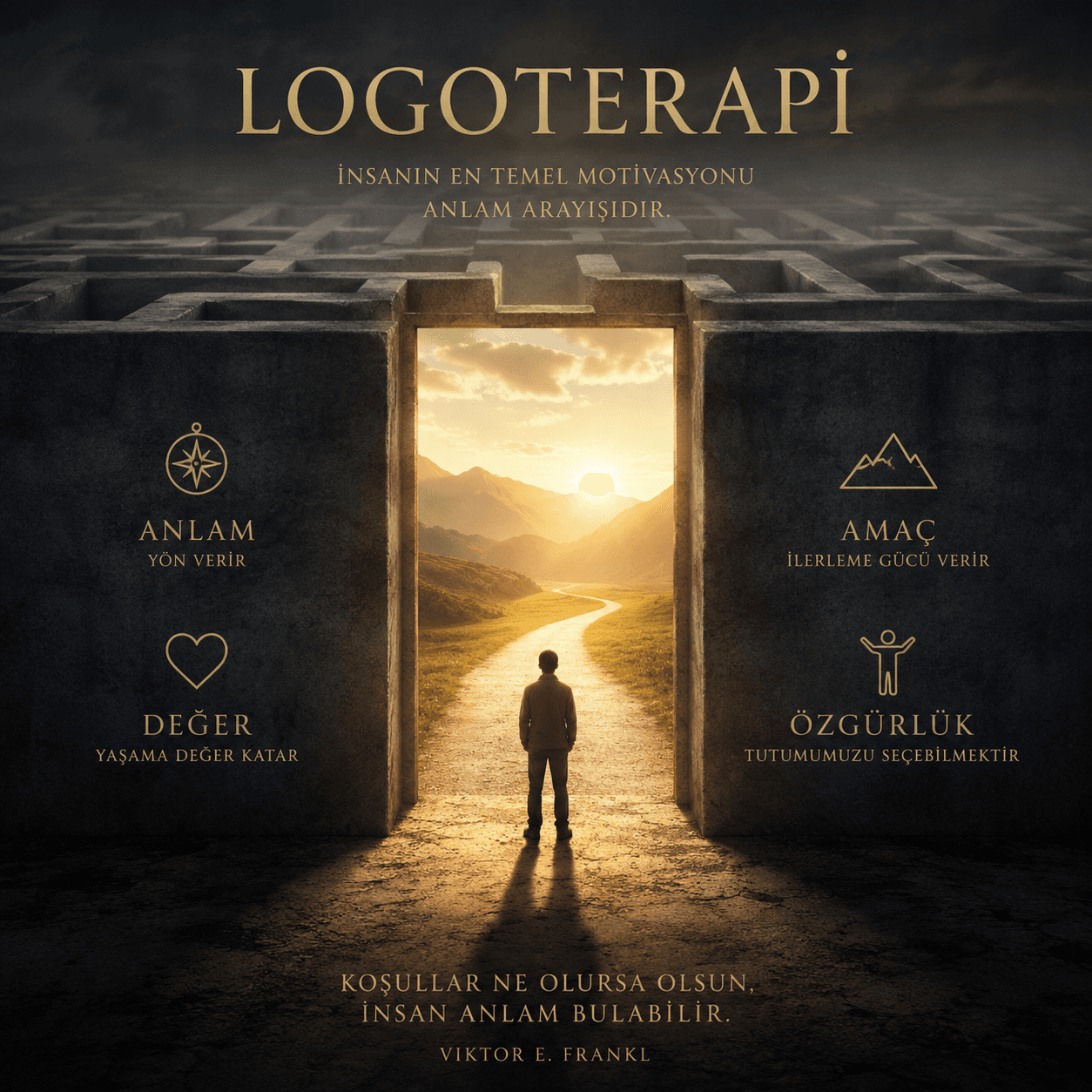
Visual representing logotherapy (generated by artificial intelligence)
Logotherapy draws inspiration from the ideas of existential and phenomenological philosophers such as Søren Kierkegaard, Friedrich Nietzsche, and Martin Heidegger, challenging the deterministic nature of traditional psychology. Frankl rejected views that reduced human beings to mere products of drives or environmental conditions and instead defined the human being through three fundamental dimensions, which he called Dimensional Ontology:【3】
The clinical and theoretical framework of logotherapy is built upon three foundational pillars:
Freedom of Will: Although humans cannot always choose the circumstances they face, they retain the freedom to choose their attitude toward those circumstances. This freedom also entails taking responsibility for one’s own destiny; freedom and responsibility are inseparable.
Will to Meaning: According to logotherapy, the primary driving force in human nature is not the pursuit of pleasure or power but the will to find a meaning in life. Humans are motivated by the search for meaning; when this desire is suppressed, destructive neurotic behaviors and psychological distress emerge.
Meaning of Life: The meaning of life is not universal; it varies from day to day, situation to situation, and person to person. Yet it never ceases to exist, even under the heaviest suffering.
In logotherapy, individuals are not given a ready-made recipe for meaning. Instead, they are guided to discover their personal meaning by listening to the voice of their conscience. This discovery is made possible through three distinct categories of values:
Creative Values: Values realized through creating a work, performing an action, or offering service—through one’s labor or creative endeavors.
Experiential Values: Finding meaning through experiencing beauty in the world, such as in art or nature. The highest experiential value is loving another person deeply for their uniqueness; logotherapy regards love as the only path to reaching the deepest core of the human being.
Attitudinal Values: The courageous, dignified, and upright stance a person adopts in the face of unavoidable fate, such as an incurable illness or death. Frankl summarized this as: “When we are confronted with a fate we cannot change, we are tested in our capacity to change ourselves.”
In logotherapy, suffering, guilt, and death—the inevitable aspects of human life—are referred to as the Tragic Triad. Rather than viewing these as pathologies, logotherapy sees them as turning points in human growth. The feeling of guilt enables individuals to learn from their mistakes and seize opportunities for development, while the reality of death reminds people of life’s finiteness and encourages them to use their time meaningfully. However, when the human will to meaning is blocked, an inner void emerges, known as the Existential Vacuum. This vacuum leads to boredom, apathy, depression, and aggression. In the modern age, this mass neurosis manifests primarily as addictions, an insatiable desire for fleeting experiences, and conformity to herd psychology. The mental disorders arising from such crises, fueled by meaninglessness and value conflicts, are termed Noogenic Neuroses in logotherapy.【4】
Logotherapists do not view clients as passive victims but as unique individuals endowed with spiritual strength capable of shaping their lives. They employ the following primary techniques in therapy:

Visual representing logotherapy (generated by artificial intelligence)
Paradoxical Intention: Used for phobias and obsessive-compulsive disorders triggered by anticipatory anxiety about the feared situation. The client is encouraged, often with humor, to deliberately confront or even exaggerate the feared outcome, thereby breaking the vicious cycle created by fear.
Dereflection (Shifting Focus): Applied in cases of hyper-reflection, where the individual is excessively focused on their problems, anxieties, or physical symptoms. The goal is to redirect the patient’s attention away from themselves toward a meaningful external goal, value, or person.
Socratic Dialogue: Inspired by Socrates’ philosophical method, this conversational technique avoids giving advice or ready answers. Instead, the therapist uses open-ended questions to help the client uncover their own latent potential and personal truths.
Attitude Modulation: A method aimed at reframing rigid, negative, or learned helplessness-based belief systems, particularly during crises, to foster more positive attitudes.
Originally developed to address neurotic and psychotic disorders, logotherapy, due to its philosophical universality, has now been integrated into many diverse fields:
Genetic Counseling: Logotherapy plays a major role in managing traumatic processes such as unexpected carrier status, guilt related to inherited genetic conditions, risk factors, and terminal diagnoses. For example, in helping a parent with a genetic illness cope with guilt toward their child, the Socratic Dialogue is used; to break the spiral of anxiety caused by uncertainty surrounding the illness, the technique of Dereflection is applied to prevent indecision and strengthen the patient’s spiritual resilience.
Refugees and Migrants: Logotherapy is effective in addressing the isolation, racism, post-traumatic stress disorder, identity loss, and helplessness experienced by migrants who have left their homelands due to war, oppression, or poverty. It helps individuals recognize that their unbearable suffering is not a random tragedy but an experience that can make them more resilient toward life, thereby reestablishing their connection to existence.
Social Services: For disadvantaged groups such as victims of violence, substance abusers, and those who are marginalized, fragmented, or questioning their identity, logotherapy fulfills a holistic, empowering, and autonomy-enhancing guiding role where traditional interventions have failed to address the existential vacuum.
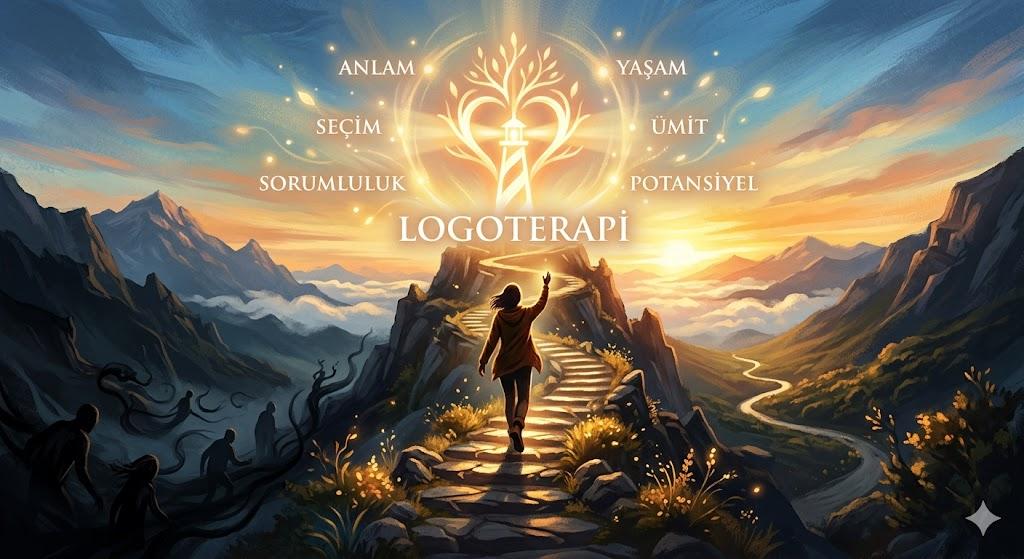
Visual representing logotherapy (generated by artificial intelligence)
Unlike modern psychology, which often ignores or classifies religious beliefs and rituals as neuroses, logotherapy regards spirituality as an inseparable and vital part of the human being. Concepts such as the Unconscious God and the Unconscious Religion support the view that individuals possess an intuitive connection to the divine and spiritual within their inner world.
Within the framework of Spiritually Oriented Logotherapy, religion is used therapeutically without imposing any doctrinal beliefs. It draws on the potential of faith systems such as Islam, Christianity, and Judaism to reduce fear of death, foster resilience, and lead to Ultimate Meaning. Spiritual resources such as prayer, trust, and hope provide healing energy even in the most helpless and unchangeable illnesses or existential crises.【5】
In the contemporary world, where human beings are often reduced to machines or mere products of genetic inheritance and environmental conditions, logotherapy serves as a shield. This teaching emphasizes that every life and experience is unique and singular. It is a dynamic and universal movement of psychotherapy and philosophy that reminds the human being, even in helplessness, suffering, and emptiness, of the capacity to reclaim responsibility, listen to conscience, and transform pain into triumph.
Chanouha, Nour, Anna Chassevent, Ellen F. Macnamara, Kendra Schaa, Renata Thoeny, and Janeta Tansey. "Exploring the principles of logotherapy in genetic counseling: Enhancing decision-making, adaptation, and justice." *Journal of Genetic Counseling*. Accessed May 21, 2025. https://pmc.ncbi.nlm.nih.gov/articles/PMC12771065/pdf/JGC4-35-0.pdf.
GoodTherapy. "Logotherapy: Benefits, Techniques & How It Works." GoodTherapy. Accessed May 21, 2026. https://www.goodtherapy.org/learn-about-therapy/types/logotherapy.
Logoterapi Enstitüsü Türkiye. "Logoterapi Nedir?." Logoterapi Enstitüsü Türkiye. Accessed May 21, 2026. https://www.logoterapi.org/logoterapi-nedirm.
Okan, Nesrullah, and Halil Ekşi. 2017. “Spirituality in Logotherapy”. Spiritual Psychology and Counseling 2 (2): 143–64. https://dergipark.org.tr/en/pub/spiritualpc/article/345638
Rahgozar, Shirin, and Lydia Giménez-Llort. "Foundations and Applications of Logotherapy to Improve Mental Health of Immigrant Populations in the Third Millennium." *Frontiers in Psychiatry*. Accessed May 21, 2025. https://pmc.ncbi.nlm.nih.gov/articles/PMC7290245/pdf/fpsyt-11-00451.pdf.
Viktor Frankl Institute of Logotherapy. "The Founder of the Viktor Frankl Institute of Logotherapy." Viktor Frankl Institute of Logotherapy. Accessed May 21. https://www.viktorfranklinstitute.org/history-of-the-viktor-frankl-institute-of-logotherapy/.
Çelik, Gizem. 2017. “LOGOTERAPİ: TEMEL BİLEŞENLERİ VE TERAPİ TEKNİKLERİ”. Toplum ve Sosyal Hizmet 28, no. 2: 70–97. https://dergipark.org.tr/tr/pub/tsh/article/448483
[1]
Logoterapi Enstitüsü Türkiye"Logoterapi Nedir?," Logoterapi Enstitüsü Türkiye, Erişim Tarihi 21 Mayıs 2026, https://www.logoterapi.org/logoterapi-nedirm.
[2]
Viktor Frankl Institute of Logotherapy,"The Founder of the Viktor Frankl Institute of Logotherapy," Viktor Frankl Institute of Logotherapy, Erişim Tarihi 21 Mayıs 2026, https://www.viktorfranklinstitute.org/history-of-the-viktor-frankl-institute-of-logotherapy/.
[3]
Gizem Çelik, 2017. “LOGOTERAPİ: TEMEL BİLEŞENLERİ VE TERAPİ TEKNİKLERİ”. Toplum ve Sosyal Hizmet 28 (2): 5. https://dergipark.org.tr/tr/download/article-file/514793
[4]
Logoterapi Enstitüsü Türkiye"Logoterapi Nedir?," Logoterapi Enstitüsü Türkiye, Erişim Tarihi 21 Mayıs 2026, https://www.logoterapi.org/logoterapi-nedirm.
[5]
Nesrullah Okan and Halil Ekşi. 2017. “Spirituality in Logotherapy”. Spiritual Psychology and Counseling 2 (2): 143. https://dergipark.org.tr/en/download/article-file/353210

Henüz Tartışma Girilmemiştir
"Logotherapy (Meaning Analysis)" maddesi için tartışma başlatın
Philosophical Foundations and Dimensional Ontology
Three Fundamental Assumptions of Logotherapy
Paths to Meaning and the Triple Value Framework
The Tragic Triad and Existential Vacuum
Clinical and Therapeutic Techniques
Applications in Various Disciplines
Relationship with Religion and Spirituality