


Bu içerik Türkçe olarak yazılmış olup yapay zeka ile otomatik olarak İngilizceye çevrilmiştir.
+4 Daha
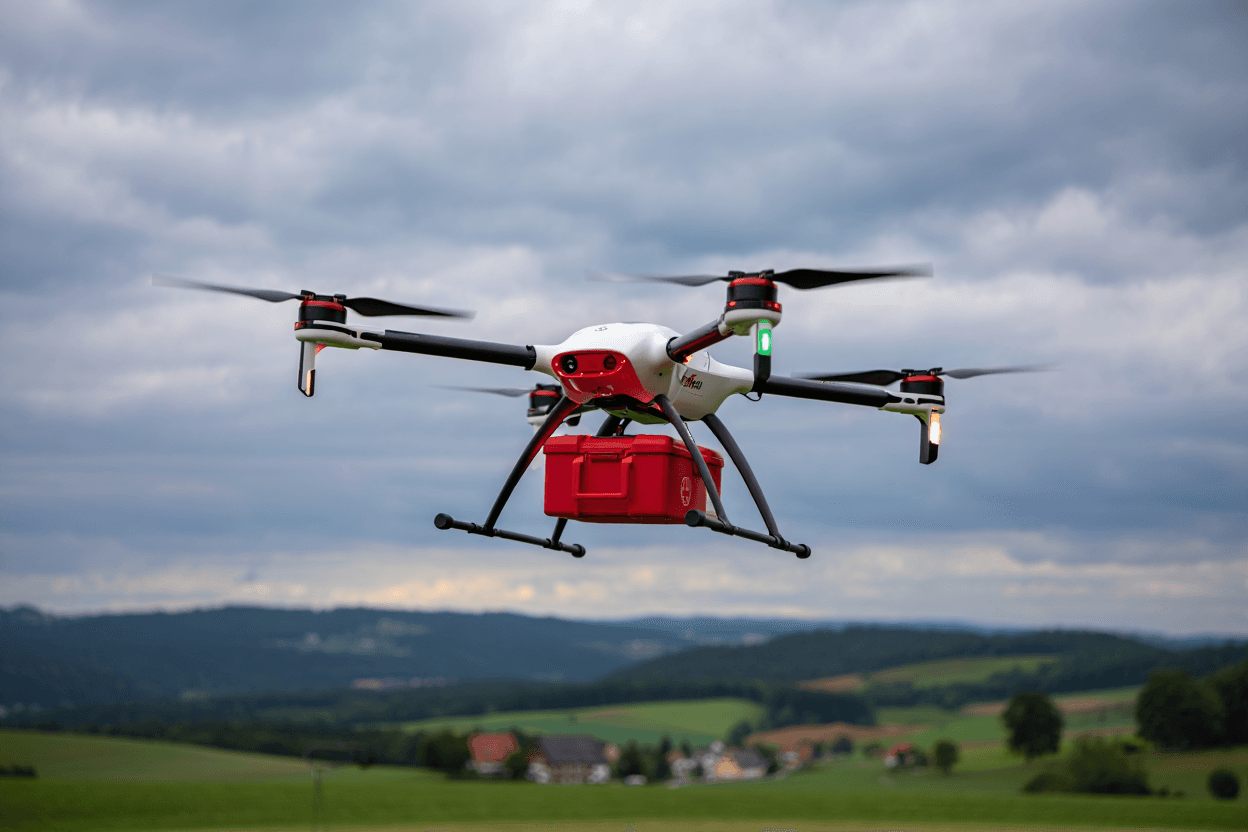
Medical Drone Technology
Also Known as | Unmanned Aerial Vehicle (UAV) | ||||||||
|---|---|---|---|---|---|---|---|---|---|
Primary Application Areas | Emergency Response, Medical Logistics, Telemedicine, Search and Rescue | ||||||||
Materials Transported | Blood Products, Vaccines, Medications, Organs, AED, Trauma Kits | ||||||||
Key Advantage | Rapid access to hard-to-reach areas | ||||||||
Future Technology | Telesurgery, AI-Assisted Triage | ||||||||
Security Technology | Delivery tracking with blockchain | ||||||||
Medical drone applications involve the use of unmanned aerial vehicles (UAVs) for purposes such as emergency response, medical supply transport, remote diagnosis, and search and rescue within the healthcare system. Originally developed for military use, drone technology has in recent years been integrated into civilian healthcare systems, providing significant advantages especially in geographically inaccessible areas and time-critical situations. These devices enhance efficiency in the pre-hospital and inter-hospital stages of the healthcare chain and hold life-saving potential.
One of the most common applications of medical drones is in pre-hospital emergency response. In cases such as cardiac arrest, rapid delivery of an Automated External Defibrillator (AED) to the scene is critical for patients with shockable rhythms. Studies show that drones can deliver AEDs 32% faster than traditional emergency vehicles in urban areas and 93% faster in rural areas. This speed is a direct factor influencing survival rates. Similarly, trauma kits needed to control catastrophic bleeding can also be rapidly dispatched to incident sites via drones.
Search and rescue operations represent another key area where drones demonstrate high effectiveness. In situations such as locating missing persons in mountainous terrain or responding to drowning incidents, drones provide rapid access to areas that are difficult or dangerous for human teams to reach. Equipped with technologies such as thermal imaging cameras, drones can detect victims even at night or under adverse weather conditions, accelerating rescue efforts. Additionally, “rescue drones” capable of delivering life-saving equipment such as life rings to individuals at risk of drowning at sea are also being developed.
Medical logistics is another critical area where drones show innovative potential in healthcare. Drones play a vital role in transporting temperature- and time-sensitive materials such as blood products, vaccines, laboratory samples, and emergency medications. In rural, mountainous, or disaster-affected regions where road transport is slow or unreliable, rapid and secure delivery of these materials ensures uninterrupted treatment processes.
In the United States, major companies such as UPS and CVS are using Matternet M2 drones to deliver prescription medications to a retirement community in Florida. This service has provided significant convenience for elderly and chronically ill individuals who face risks when leaving home, especially during periods such as the pandemic.
Drones support telemedicine applications by helping to eliminate geographic barriers to healthcare access. Equipped with cameras and audio systems, drones can provide professional medical guidance to untrained individuals at the scene of an emergency. For example, in a cardiac arrest case, a healthcare professional can use a drone to give real-time audio and visual instructions to a bystander on how to perform proper cardiopulmonary resuscitation (CPR) and use an AED device.
Remote diagnosis and monitoring is another area where drones are employed. During the COVID-19 pandemic, drones were used in China to monitor populations and enforce social distancing rules. A Canadian company has developed a “Pandemic Drone” capable of remotely detecting respiratory infections. One of the most exciting future applications is “telesurgery,” or remote surgery. Surgical interventions conducted between a surgeon and a drone with extremely low latency (approximately 20 milliseconds) have moved beyond science fiction and are beginning to appear in academic literature. This technology could enable critical interventions in situations where access to a surgeon is impossible, such as battlefields or disaster zones.
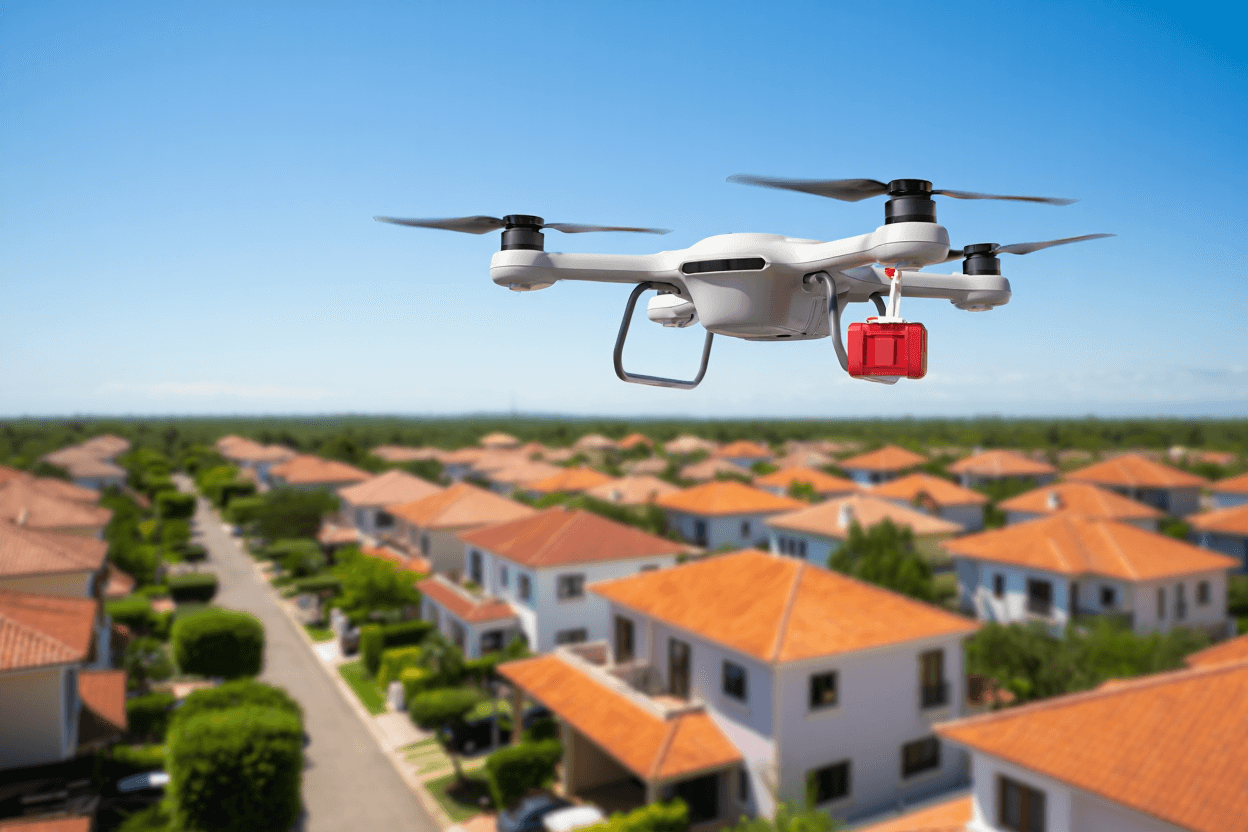
Medical Drone Applications (Generated by Artificial Intelligence)
Since drone technology originated in the military, it is also actively used in combat medicine. In conflict zones, drones are deployed to deliver medical support to wounded soldiers. These drones safely and rapidly transport critical medical supplies such as blood products, medications, and surgical kits to forward lines, replacing hazardous ground transport under enemy fire. Additionally, they transmit preliminary information about wounded soldiers and vital signs to field hospitals, enabling medical personnel to prepare in advance.
Artificial intelligence-integrated military medical systems further enhance drone capabilities. Systems that monitor soldiers’ health status in real time through wearable sensors can analyze data during injury events to support triage (priority classification of casualties). Furthermore, under projects supported by the U.S. Defense Advanced Research Projects Agency (DARPA), autonomous medical robotic assistants and evacuation drones are being developed to safely transport injured personnel from combat zones to secure areas.
Medical drone applications are expanding globally and are supported by various initiatives. The CAELUS (Care & Equity-Healthcare Logistics UAS Scotland) project implemented in the United Kingdom aims to establish a medical delivery network connecting hospitals, laboratories, and distribution centers across Scotland, particularly in rural areas. Led by AGS Airports, this consortium of 13 organizations is working on safely integrating drones into civil airspace, developing ground infrastructure (such as charging stations), and addressing challenges such as noise pollution. The widespread adoption of this technology has also created a need for regulatory frameworks. In the United States, institutions such as the Federal Aviation Administration (FAA) manage licensing and regulation of commercial drone operations. Many countries, including Türkiye, have established their own national regulations to ensure the safe and responsible use of unmanned aerial vehicles.
The success of medical drone operations depends on a robust technological infrastructure and strong security measures. Different missions require drones with varying specifications—flight range, speed, payload capacity, and specialized equipment such as temperature-controlled cargo compartments—determined according to project needs. Security and transparency are among the most critical concerns. In this context, blockchain technology has emerged as a key solution. A report published by the U.S. Department of Transportation highlights the potential use of blockchain to track medical drone deliveries. Through this technology, data such as a drone’s flight path, location, cargo details, and status are recorded in an immutable and transparent ledger. All stakeholders—including air traffic controllers, drone operators, senders, and receiving hospitals—can monitor this shared data set to verify the security and integrity of the delivery process.
Ackerman, E. and M. Koziol. "The Blood Is Here: Zipline's Medical Delivery Drones Are Changing the Game in Rwanda." *IEEE Spectrum* 56, no. 5 (May 2019): 24–31. .
Amukele, T., P. M. Ness, A. A. R. Tobian, J. Boyd, and J. Street. "Drone Transportation of Blood Products." *Transfusion* 57 (2017): 582–588. https://doi.org/10.1111/trf.13900.
Blockchain Türkiye Platformu. "Blokzinciri Tıbbi Malzeme Taşıyan Drone'ları İzlemek İçin Kullanılabilir mi?" BCTR.org. Accessed July 14, 2025. https://bctr.org/blokzinciri-tibbi-malzeme-tasiyan-dronelari-izlemek-icin-kullanilabilir-mi-15918/.
Haidari, Leila A., Shawn T. Brown, Marie Ferguson, Emily Bancroft, Marie Spiker, Allen Wilcox, Ramya Ambikapathi, Vidya Sampath, Diana L. Connor, and Bruce Y. Lee. "The Economic and Operational Value of Using Drones to Transport Vaccines." *Vaccine* 34, no. 34 (2016): 4062–4067. https://doi.org/10.1016/j.vaccine.2016.06.022.
McKenna, Michael. Unmanned Aerial Vehicles in Public Health: Transforming Access and Emergency Response. London: Elsevier, 2021.
Rejeb, Abderahman, Karim Rejeb, Steven J. Simske, and Horst Treiblmaier. "Drones for Supply Chain Management and Logistics: A Review and Research Agenda." *International Journal of Logistics Research and Applications* 26, no. 6 (2023): 708–731. https://doi.org/10.1080/13675567.2021.1981273.
Rosser, James C., ed. Medical Drones: Applications, Regulations, and Implementation. New York: Springer, 2022.
TT CONSULTANTS. "Tıbbi Bakım Raporu Olarak Drone'lar." Accessed July 14, 2025. https://tr.ttconsultants.com/Reports/drones-as-medical-care/.

Medical Drone Technology
Also Known as | Unmanned Aerial Vehicle (UAV) | ||||||||
|---|---|---|---|---|---|---|---|---|---|
Primary Application Areas | Emergency Response, Medical Logistics, Telemedicine, Search and Rescue | ||||||||
Materials Transported | Blood Products, Vaccines, Medications, Organs, AED, Trauma Kits | ||||||||
Key Advantage | Rapid access to hard-to-reach areas | ||||||||
Future Technology | Telesurgery, AI-Assisted Triage | ||||||||
Security Technology | Delivery tracking with blockchain | ||||||||
Henüz Tartışma Girilmemiştir
"Medical Drone Applications" maddesi için tartışma başlatın
Pre-Hospital Emergency Medicine and Search and Rescue
Transport of Medical Supplies, Medications, and Organs
Telemedicine and Remote Diagnosis
Military Medical Applications
International Projects and Regulatory Frameworks
Technological Infrastructure and Security