

Bu içerik Türkçe olarak yazılmış olup yapay zeka ile otomatik olarak İngilizceye çevrilmiştir.
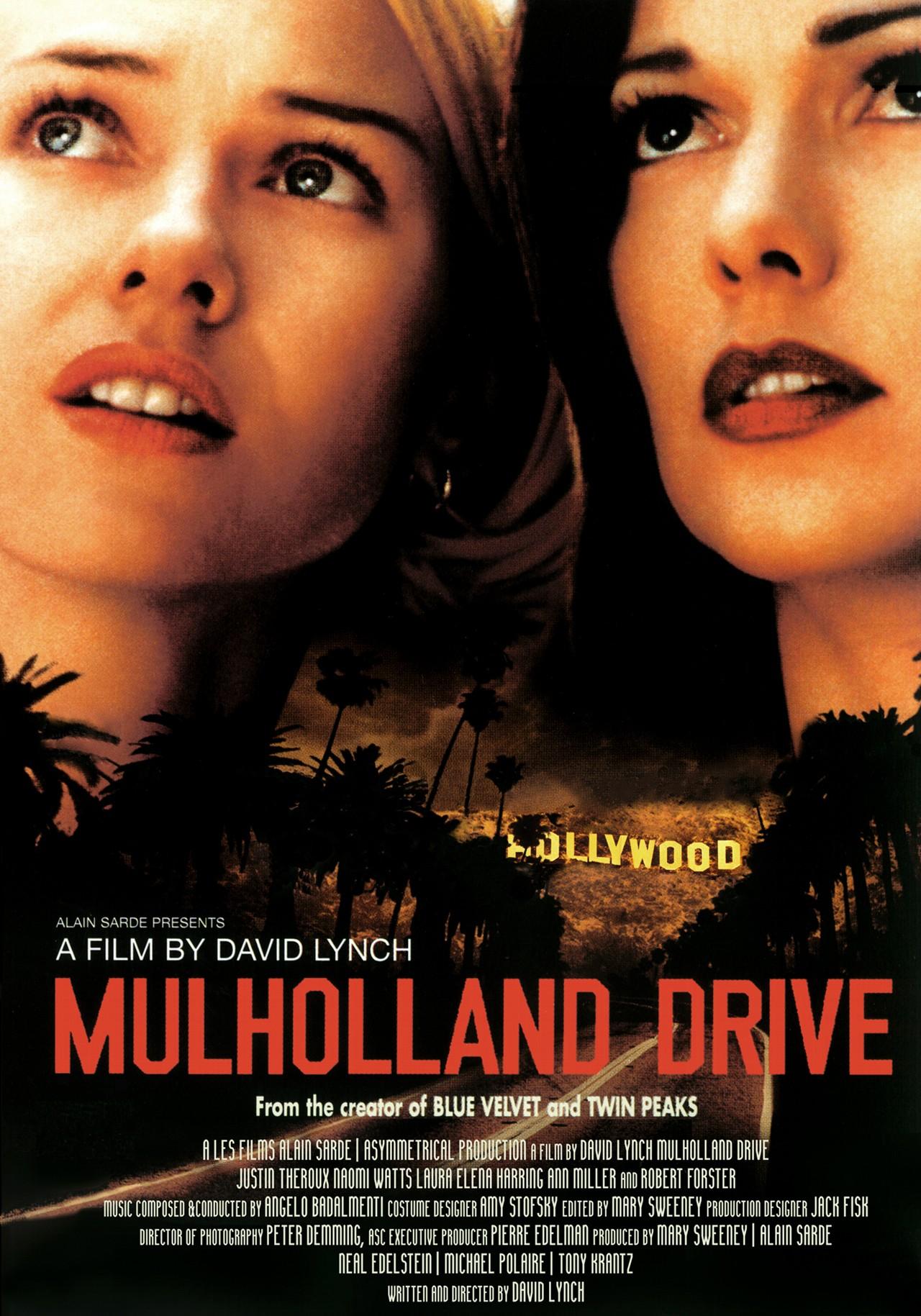
Original Name(s) | Mulholland Drive | ||||||||
|---|---|---|---|---|---|---|---|---|---|
Production Year | 2001 / USA–France co-production | ||||||||
Type(s) | Thriller psychological drama mystery | ||||||||
Director(s) | David Lynch | ||||||||
Screenplay(s) | David Lynch | ||||||||
Main Actors | Naomi Watts (Betty Elms / Diane Selwyn), Laura Harring (Rita / Camilla Rhodes), Justin Theroux (Adam Kesher), Ann Miller (Coco), Robert Forster (Detective McKnight) | ||||||||
Language(s) | English | ||||||||
Duration | 147 minutes | ||||||||
Production Companies | Les Films Alain Sarde, Asymmetrical Productions, Universal Pictures | ||||||||
Notable Achievements | Cannes 2001 Best Director; César 2002 Best Foreign Film; BAFTA and Golden Globe nominations; various critics associations awards for Best Film, Director and Female Actor | ||||||||
Mulholland Drive is a feature film widely regarded as one of the most prominent examples of postmodern narrative structure in modern cinema history. The production explores themes of identity, dream, and illusion behind Hollywood’s glittering surface. The film continuously blurs the line between dream and reality within its narrative unity, deliberately disrupting classical storytelling conventions. This choice generates an unconscious tension in the viewer while symbolically revealing the dark side of the American dream industry. The visual atmosphere is supported by a broad spectrum of lighting, ranging from Los Angeles’s bright daylight to misty nights. Formally, the film can be described as a stream-of-consciousness cinema guided by the logic of dreams.
While confronting the founding myths of the film industry, the work also highlights psychological layers such as identity fragmentation and the fragility of desire. The story unfolds through a circular narrative in which quest, illusion, and dissolution are intricately intertwined. The director consciously fragments continuity in time, space, and character to destabilize the viewer’s perceptual certainty. Every scene in the film questions Hollywood’s promises of success and identity as a false paradise. Flashbacks, dream sequences, and false beginnings obscure the internal logic of the narrative. Ultimately, the film functions both as a tribute to cinematic history and as a structural analysis of it.
The film opens with the arrival of Betty Elms (Naomi Watts), a young woman who comes to Los Angeles to become an actress. Yet upon reaching the city, she encounters a nameless woman (Laura Harring – “Rita”) and together they become entangled in mysterious events that shift the narrative into a film noir atmosphere. The story begins with Rita’s loss of memory and the two women’s efforts to uncover her past. The relationship between the two characters evolves from friendship into an intense bond; however, this transformation radically shifts into an entirely different dimension of reality in the film’s second half. This structural rupture implies that there is no sharp boundary between dream and reality. As the narrative progresses, viewers gradually realize that the same characters assume different identities.
The timeline follows a circular rather than a linear structure; events are re-experienced across different temporal layers. Symbols such as the “Blue Box” and “Club Silencio” center on the relationship between the unconscious and representation. The Club Silencio sequence most clearly shatters the dream-reality duality and establishes the narrative’s metaphysical dimension. Rather than questioning reality, the director invites the viewer to participate in its construction. Thus, the film foregrounds the “dramatization of perception” instead of classical dramatic structure. The central plot becomes an unsolvable mystery; each viewer is guided toward constructing their own version.

An iconic scene from the film (IMDB)
The production was originally conceived as a television series before being transformed into a feature film. This transition resulted in the narrative deliberately carrying a sense of “incompleteness.” Cinematography powerfully reflects Los Angeles’s contrasted lighting structure; transitions between vivid colors and shadows carry thematic significance. The color palette serves as a symbolic indicator of the boundary between innocence and corruption. The camera language focuses on long takes and static framing to draw the viewer into the characters’ psychological worlds. Music, composed by Angelo Badalamenti, conveys both tension and melancholy. The editing rhythm reinforces temporal leaps between scenes and the sensation of a stream of consciousness.
Sound design is one of David Lynch’s signature elements; silences, hums, and echoes carry dramatic weight. The city’s ambient noise is treated as an extension of the characters’ mental chaos. Location choices create a recurring visual motif throughout the film, presenting Hollywood’s hills in an abstracted form. Filming took place across various districts of Los Angeles; interior spaces were lit according to the characters’ psychological states. During editing, Lynch preserved his own experimental approach, assembling scenes through intuitive connections rather than rational explanations. This cohesion elevates the film beyond classical narrative conventions, establishing it as a symbol of contemporary cinematic language.
Naomi Watts (Betty Elms / Diane Selwyn) occupies the center of the narrative by portraying two distinct identities. Her performance delicately conveys the transformation from a woman consumed by the Hollywood dream to a personality shattered by guilt and jealousy. The actress’s facial expressions subtly communicate the psychological distinction between dream and real sequences. Laura Harring (Rita / Camilla Rhodes) is both the catalyst and the unraveling figure of the story, portrayed as a mysterious woman with amnesia. Harring’s interpretation balances elegance and menace. Justin Theroux (Adam Kesher) embodies a director representing the corrupt inner workings of the Hollywood system. His cool yet tense performance strengthens the film’s critique of the industry.
Supporting roles include Ann Miller (Coco), Robert Forster (Detective Harry McKnight), Brent Briscoe (Detective Domgaard), Dan Hedaya (Vincenzo Castigliane), and Lee Grant (Louise Bonner). Each fulfills a distinct function within Hollywood’s ecosystem, saturated with unconscious layers. Rebekah Del Rio creates the film’s symbolic climax with her performance of “Llorando” at Club Silencio. The overall acting style relies on a theatrical consistency that serves the transitions between dream and reality. Characters are positioned as fragments of a labyrinth in which identities merge. This multi-layered acting structure supports the film’s openness to psychoanalytic interpretation.
The film constructs a structure governed by “dream logic” by reversing classical narrative logic. The director’s formal choices ensure that the narrative generates association rather than explicit meaning. Particularly, the “Club Silencio” sequence serves as a metaphorical commentary on cinema’s illusory nature. Color contrasts in the imagery, along with objects such as the blue box and the key, represent the threshold between consciousness and the unconscious. Naomi Watts’s performance deeply embodies the emotional consequences of identity fragmentation. Sound and music design heighten tension while preserving symbolic depth. The film transforms the viewer from a passive recipient of meaning into an active interpreter.
Mulholland Drive is viewed both as a critique of the Hollywood system and as an intrinsic re-writing of cinema history. The film’s open-ended structure generates different readings with each viewing. The deliberate disruption of continuity in time, space, and character opens space for psychoanalytic interpretations. The blurring of the dream-reality distinction becomes a universal symbol of the modern individual’s search for identity. Lynch’s cinematic language creates a tension that is simultaneously unsettling and mesmerizing. Critics have noted that the film has maintained its relevance for over two decades. This enduring power is linked to its aesthetic consistency and intellectual intensity.
Favaro, Aslı. “Kayıp Otoban’ın İzinde: David Lynch’in Postmodern Dünyası.” Akdeniz İletişim Dergisi 13. Accessed October 8, 2025. https://dergipark.org.tr/tr/download/article-file/760810
IMDb. "Mulholland Drive (2001)." Accessed October 8, 2025. https://www.imdb.com/title/tt0166924/
IMDb. "Mulholland Drive – Awards." Accessed October 8, 2025. https://www.imdb.com/title/tt0166924/awards/?ref_=tt_ov_at_op_awd
IMDb. "Mulholland Drive – Filming Locations." Accessed October 8, 2025. https://www.imdb.com/title/tt0166924/locations/?ref_=tt_ov_at_dt_flmg
IMDb. "Mulholland Drive – Full Cast & Crew." Accessed October 8, 2025. https://www.imdb.com/title/tt0166924/fullcredits/?ref_=tt_ov_at_pop_cst
IMDb. "Mulholland Drive – Media Index." Accessed October 8, 2025. https://www.imdb.com/title/tt0166924/mediaindex/?ref_=tt_ov_at_pop_ph
IMDb. "Mulholland Drive – Plot Summary." Accessed October 8, 2025. https://www.imdb.com/title/tt0166924/plotsummary/?ref_=tt_ov_at_pl_pl
IMDb. “Mulholland Drive – Release Info.” Accessed October 8, 2025. https://www.imdb.com/title/tt0166924/releaseinfo/?ref_=tt_ov_at_dt_rdat
Kesova, Erke. “Kurucu Anlatı Olarak Hollywood ve Hollywood ile Postmodern Karşılaşmalar Bağlamında Mulholland Çıkmazı Örneği.” Kronotop İletişim Dergisi 1, no. 1 (2024): 1–30. Accessed October 8, 2025. https://dergipark.org.tr/tr/download/article-file/3473461
MUBI. "Mulholland Drive – Awards." Accessed October 8, 2025. https://mubi.com/tr/films/mulholland-drive/awards
MUBI. "Mulholland Drive." Accessed October 8, 2025. https://mubi.com/tr/tr/films/mulholland-drive
Mulholland Drive. Directed by David Lynch. Les Films Alain Sarde; Asymmetrical Productions; Universal Pictures, 2001.

Original Name(s) | Mulholland Drive | ||||||||
|---|---|---|---|---|---|---|---|---|---|
Production Year | 2001 / USA–France co-production | ||||||||
Type(s) | Thriller psychological drama mystery | ||||||||
Director(s) | David Lynch | ||||||||
Screenplay(s) | David Lynch | ||||||||
Main Actors | Naomi Watts (Betty Elms / Diane Selwyn), Laura Harring (Rita / Camilla Rhodes), Justin Theroux (Adam Kesher), Ann Miller (Coco), Robert Forster (Detective McKnight) | ||||||||
Language(s) | English | ||||||||
Duration | 147 minutes | ||||||||
Production Companies | Les Films Alain Sarde, Asymmetrical Productions, Universal Pictures | ||||||||
Notable Achievements | Cannes 2001 Best Director; César 2002 Best Foreign Film; BAFTA and Golden Globe nominations; various critics associations awards for Best Film, Director and Female Actor | ||||||||
Henüz Tartışma Girilmemiştir
"Mulholland Drive (Film)" maddesi için tartışma başlatın
Plot and Narrative Structure
Production and Technical Features
Actors and Characters
Critical Evaluation
Awards