

Bu içerik Türkçe olarak yazılmış olup yapay zeka ile otomatik olarak İngilizceye çevrilmiştir.
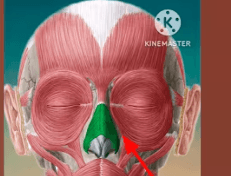
Nasalis Muscle is a facial muscle located around the nose and responsible for movements of the nasal openings. It consists of two main parts: the transverse (compressor naris) and the alar (dilator naris). It is innervated by the facial nerve (CN VII) and plays a role in maintaining the shape of the nose and regulating the patency of the nasal passages during respiration.
The nasalis muscle is a thin, superficial mimetic muscle composed of two main parts. The transverse portion (compressor naris) originates from the incisive fossa of the maxilla and converges with the contralateral muscle fibers and the procerus muscle to form a thin aponeurosis along the bridge of the nose. This portion constricts the nasal openings. The alar portion (dilator naris) arises from the lateral aspect of the upper incisor region of the maxilla and inserts onto the greater alar cartilage; some of its fibers blend with the depressor septi nasi muscle and dilate the nasal openings to increase airflow. The two parts of the muscle work together to provide symmetrical and balanced control of nasal movements.
The nasalis muscle belongs embryologically to the group of facial mimetic muscles derived from the second pharyngeal arch. It is classified as an important component of the perinasal mimetic muscles and contributes to facial expressions and respiratory functions. By controlling the narrowing and widening of the nasal openings, the muscle supports both mimetic and respiratory functions.
The nasalis muscle receives motor innervation from the zygomatic and buccal branches of the facial nerve (cranial nerve VII). Its blood supply is provided by branches of the facial artery and the angular artery. This neural and vascular arrangement enables rapid and coordinated movements of the muscle, allowing effective control of nasal aperture dynamics and facial expressions.
The transverse portion of the nasalis muscle constricts the nasal openings, while the alar portion dilates them to enhance airflow. Together, these parts regulate the nasal passages during olfaction, deep inhalation, and rapid breathing. The muscle also participates in modulating nasal movements during emotional states such as anger, disgust, or intense concentration. The nasalis muscle is a clinically significant structure in cleft lip and palate surgery. The transverse portion must be accurately identified and reattached perpendicularly to the nasal septum during surgical repair to reposition the maxillary origin and restore nasal symmetry. Additionally, during facial nerve function tests, the nasalis muscle is used to assess the integrity of the zygomatic nerve branches. In botulinum toxin treatments, an overactive nasalis muscle can cause undesirable wrinkles around the nose; these contractions can be controlled with botulinum toxin injections.

Henüz Tartışma Girilmemiştir
"Nasalis Muscle" maddesi için tartışma başlatın
Anatomical Structure
Morphology and Attachment Points
Embryological Origin and Classification
Innervation and Vascular Supply
Function and Clinical Relevance