
This article was automatically translated from the original Turkish version.
Nerve | Innervated by the facial nerve (cranial nerve VII). | ||||||||
|---|---|---|---|---|---|---|---|---|---|
Artery | Supplied by the facial artery and supraorbital artery. | ||||||||
Function(s) | Forms the frowning expression by pulling the eyebrows downward and inward. | ||||||||
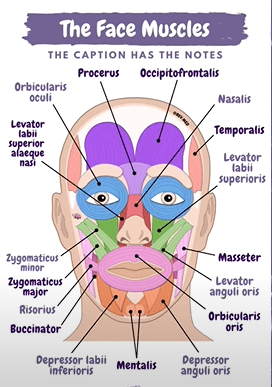
Procerus muscle is a small, pyramid-shaped facial muscle located in the lower part of the forehead (glabellar region). It plays a role in expressions such as frowning, anger, and concentration, and is responsible for the formation of wrinkles on the bridge of the nose. The Latin term procerus, meaning "long," describes the muscle's vertical fiber orientation.
The procerus muscle is a thin, pyramidal muscle situated in the mid-upper facial region, directly above the bridge of the nose. It originates via fine tendinous fibers from the lower part of the nasal bone and the fascia covering the upper lateral nasal cartilage. The muscle fibers ascend in two layers: the deep layer extends to the glabella and merges with the frontalis muscle, while the superficial layer connects to the skin between the eyebrows. This arrangement enables the procerus muscle to actively participate in facial expressions involving both the nose and forehead. It is functionally connected to the adjacent corrugator supercilii and frontalis muscles, establishing it as a key functional link among the upper facial mimetic muscles.
The procerus muscle is classified among the facial mimetic muscles and, accordingly, has a second pharyngeal arch embryological origin. This arch gives rise to the group of muscles innervated by the facial nerve (cranial nerve VII). Thus, like other facial mimetic muscles, the procerus develops and functions under the influence of the facial nerve, both in terms of motor control and physiological role. This characteristic ensures its consistent evaluation within facial muscle classifications in both aesthetic and neurological contexts.
The motor innervation of the procerus muscle is primarily provided by the temporal branch of the facial nerve (nervus facialis, CN VII). However, in some individuals, contributions from the zygomatic or buccal branches have also been reported. This variability in innervation must be considered during clinical procedures such as surgical planning or botulinum toxin injections. The vascular supply is typically derived from branches of the angular artery and superficial branches of the infraorbital artery, which are part of the general vascular network of the superficial mimetic muscles.
The procerus muscle contributes to facial expressions such as anger, concentration, and squinting in response to sunlight by pulling the medial portion of the eyebrows downward and tensing the glabella. This action creates characteristic horizontal lines between the eyebrows. Additionally, by elevating the bridge of the nose, the muscle slightly dilates the nasal openings, providing an indirect contribution to respiration. When contracted among the facial muscles, it produces a prominent "frowning" effect, which serves as an important mimetic function in social and emotional communication. Clinically, the procerus muscle holds significance in both aesthetic and neurological contexts. Aesthetically, it is the primary cause of glabellar wrinkles, commonly known as "11 lines," which can become permanent due to excessive muscle activity. For this reason, botulinum toxin injections are frequently used to temporarily inactivate the procerus muscle and reduce the appearance of these lines. These injections are typically planned in conjunction with the frontalis and corrugator supercilii muscles. Neurologically, involuntary and sustained contraction of the procerus muscle in certain neurodegenerative disorders such as progressive supranuclear palsy (PSP) can produce a "startled face" appearance, serving as a diagnostic sign. Surgically, interventions such as neurectomy of the temporal branch of the facial nerve may be considered, particularly in cases resistant to botulinum toxin. However, due to the potential for permanent outcomes, such procedures are generally regarded as a last resort.
Davis, A. P., and R. Tadi. 2023. Anatomy, Head and Neck, Procerus Muscle. StatPearls [Internet]. Treasure Island (FL): StatPearls Publishing. Accessed July 29, 2025.
Dr. Sam Rizk. 2024. Resection of the Procerus in Rhinoplasty. Accessed July 29, 2025.
IAAPS (International Association of Aesthetic Plastic Surgeons). 2021. Transpalp Approach to Corrugator. Accessed July 29, 2025.
Kim, Hyeonho, Chae Eun Yang, and Byung Chae Lee. 2019. "Ultrasonographic and Three-Dimensional Analyses at the Glabella and Radix of the Nose for Botulinum Neurotoxin Injection Procedures into the Procerus Muscle." ResearchGate. Accessed July 29, 2025. https://www.researchgate.net/publication/336038863.
The provided input contains only HTML tags and a placeholder (`https://www.drsamrizk.com/wp-content/uploads/2024/03/resection-of-the-procerus-in-rhinoplasty.pdf`) with an italic tag, but no actual citation content to translate.Please provide the full Turkish citation text (including author, title, access date, URL, etc.) so I can translate it according to the specified academic formatting rules.
The provided input contains only HTML tags and a placeholder (`https://www.iaaps.net/wp-content/uploads/2021/06/Transpalp-approach-to-corrugator-min.pdf`) with an empty emphasis tag. There is no actual Turkish citation text to translate.Please provide the full Turkish citation content (e.g., author, title, access date, URL, etc.) so I can translate it according to the specified academic formatting rules.
The provided input contains only HTML tags and a placeholder (`https://www.ncbi.nlm.nih.gov/books/NBK534763/`) with an italic tag, but no actual Turkish citation text to translate.Please provide the full Turkish citation (including author, title, access date, URL, etc.) so I can translate it according to the specified academic formatting rules. For example:> Anadolu Ajansı. "Ahlatta Açılan Kurslarla Geleneksel Taş İşçiliği Yaşatılıyor." Accessed 21 Ekim 2025. https://www.aa.com.tr/tr/kultur/ahlatta-acilan-kurslarla-geleneksel-tas-isciligi-yasatiliyor/3116279.I’m ready to translate when you provide the full citation.

Nerve | Innervated by the facial nerve (cranial nerve VII). | ||||||||
|---|---|---|---|---|---|---|---|---|---|
Artery | Supplied by the facial artery and supraorbital artery. | ||||||||
Function(s) | Forms the frowning expression by pulling the eyebrows downward and inward. | ||||||||
Anatomical Structure
Morphology and Attachment Points
Embryological Origin and Classification
Innervation and Vascular Supply
Function and Clinical Relevance