
Bu içerik Türkçe olarak yazılmış olup yapay zeka ile otomatik olarak İngilizceye çevrilmiştir.
Neon Genesis Evangelion (Japanese: 新世紀エヴァンゲリオン, Shin Seiki Evangerion) is a Japanese science fiction anime television series created by Japanese director and producer Hideaki Anno and produced by Gainax. The series originally aired in Japan between 1995 and 1996. Set within a narrative framework centered on the conflict between giant biomechanical war machines and mysterious entities, it has had a significant impact on the anime industry and popular culture since its debut.

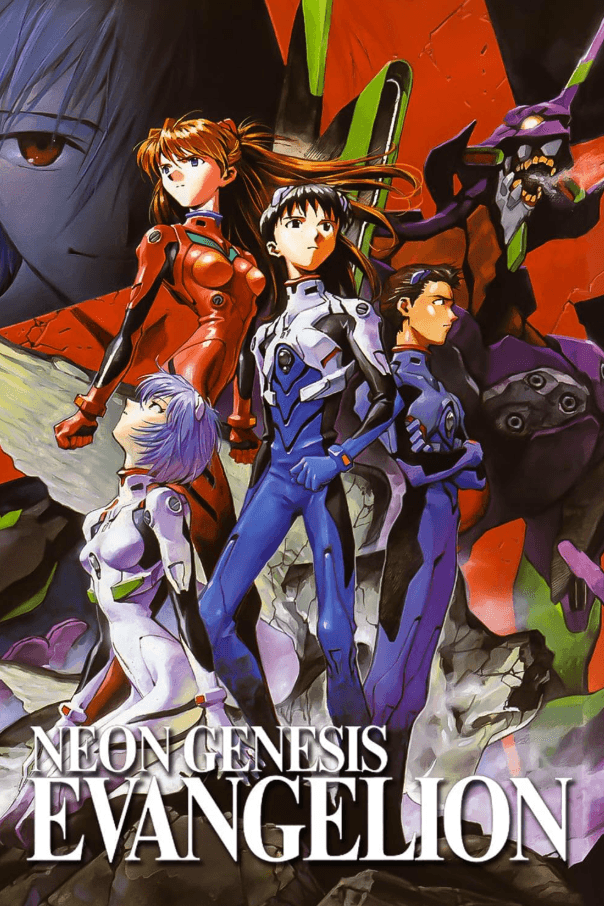
Neon Genesis Evangelion Poster (IMDb)
Neon Genesis Evangelion was planned as a 26-episode television series and aired between 1995 and 1996. Although initially conceived as a traditional mecha (science fiction or futuristic) anime series, later episodes increasingly focused on intense psychological and philosophical themes.
The series’ character designs were created by Japanese artist Yoshiyuki Sadamoto. Mechanical designs were developed by various designers, led by Ikuto Yamashita. The musical score was composed by Shiro Sagisu.
Following its broadcast, the series gained immense popularity and sparked controversy due to its divisive final episodes, prompting its expansion into other formats. In 1997, two major theatrical films were released:
These films were produced to offer alternative or complementary narratives to the concluding episodes of the television series.
Starting in 2007, a cinematic reimagining of the story was launched under the title Rebuild of Evangelion, consisting of the following films:
This film series preserves certain elements of the original story while developing the narrative in a new direction.
The series is set in an alternate future following a global catastrophe known as the Second Impact, which occurred in the year 2000. This event caused widespread destruction, resulted in the loss of a significant portion of the world’s population, and reshaped global political balances. The main events of the story unfold in 2015 in Tokyo-3, a city built in Japan after the disaster.
Mysterious entities known as “Angels” periodically attack Earth. To defend against these threats, a specialized research and defense organization called NERV was established with support from the United Nations.
NERV’s primary defense system consists of giant biomechanical combat units called “Evangelion” (abbreviated as “Eva”). Although their appearance resembles robots, these units are not purely mechanical; they are described as complex organisms containing biological components. Only specific child pilots can operate Evangelions.
Pilots establish direct neurological connections with their Evangelions through a system called “synchronization”. This link allows the Evangelion’s movements to be controlled by the pilot’s mental commands. However, because the synchronization system is directly tied to the pilot’s psychological state, it can cause severe mental and emotional effects during combat.
As the story progresses, it is revealed that NERV is not only attempting to stop the Angels but is also involved in a larger plan known as the “Human Instrumentality Project”. This initiative becomes a central element of the narrative, exploring broader themes of humanity’s future and evolution.
Neon Genesis Evangelion Opening theme and video (KING RECORDS)
The protagonist, Shinji Ikari, is a young boy summoned to Tokyo-3 by his father. His father, Gendo Ikari, is the commander of NERV. Shinji is assigned to pilot Evangelion Unit-01. Initially reluctant to accept this duty, he is forced to engage in combat when the city comes under an Angel attack. Over time, he joins other pilots within NERV to fight against the Angels.
Other pilots accompanying Shinji include Rei Ayanami and Asuka Langley Soryu, who pilot different Evangelion units. As the series progresses, information is revealed about the nature of the Angels, the true composition of the Evangelions, and NERV’s hidden objectives. The narrative focuses not only on battle scenes but also on the psychological states and pasts of the characters.

Asuka Langley Soryu (IMDb)

Shinji Ikari (IMDb)
The series incorporates science fiction and action elements alongside various psychological and philosophical themes. It explores issues such as individual identity, loneliness, human relationships, and the future of humanity.
The series employs diverse narrative techniques to convey the inner lives and psychological struggles of its characters. Some episodes replace traditional action sequences with internal monologues, symbolic imagery, and experimental storytelling methods.
Additionally, the production incorporates various religious and mythological symbols, primarily associated with Christian and Jewish mysticism. However, the creators have stated that these symbols are largely used for aesthetic and thematic purposes rather than doctrinal ones.
The television series consists of 26 episodes and was broadcast as a single season. Its finale, particularly the experimental narrative style of episodes 25 and 26, generated intense debate among viewers. As a result, the film The End of Evangelion, released in 1997, was created to provide an alternative conclusion to the story. This film reinterprets the final events of the television series through a different narrative approach. The subsequent Rebuild of Evangelion film series, produced using modern animation techniques, reinterprets specific elements of the original story.
Neon Genesis Evangelion has had a profound impact on both Japanese and international anime communities since its release. The series contributed significantly to the widespread adoption of psychological and experimental narrative techniques in the anime industry during the 1990s. It has received numerous awards, including being named the best anime of the year in 1996 by the Animage Anime Grand Prix in Japan. It has also been honored by various anime magazines and organizations. The series has expanded into a broad media universe through manga adaptations, video games, novels, and other ancillary projects. Its character designs and visual iconography have left a lasting imprint on anime and popular culture.

Henüz Tartışma Girilmemiştir
"Neon Genesis Evangelion (Series)" maddesi için tartışma başlatın
Overview and Broadcast History
Universe and Fictional Setting
Plot
Main Characters
Themes and Narrative Style
Seasons and Films
Cultural Impact and Awards