Bu içerik Türkçe olarak yazılmış olup yapay zeka ile otomatik olarak İngilizceye çevrilmiştir.
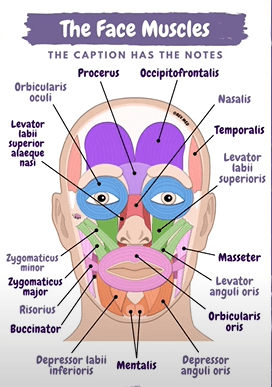
Occipitalis Muscle is a superficial muscle located at the back of the skull and involved in the movement of the scalp. In human anatomy, the occipitalis muscle is classified among the facial muscles and is innervated by the posterior auricular nerve, a branch of the facial nerve. Its primary function is to pull the scalp posteriorly. It is situated superficially among the muscular structures of the occipital region, and its blood supply is provided by the occipital artery.
The occipitalis muscle is a thin, quadrilateral-shaped muscle located at the posterior aspect of the head. It originates from the superior nuchal line of the occipital bone and the mastoid process of the temporal bone, where it is anchored via tendinous fibers. The muscle fibers extend upward and converge into the galea aponeurotica (epicranial aponeurosis), a broad sheet of connective tissue covering the cranial vertex. The occipitalis muscle does not attach directly to bone but rather connects through soft tissues and connective structures. Together with the frontalis muscle, it forms the occipitofrontalis muscle complex, which spans from the forehead to the occiput and contributes to anterior-posterior movement of the scalp. The connection of the occipitalis fibers to the frontalis muscle via the galea aponeurotica integrates the occipitalis into a functional unit that enables cranial superficial mobility. Although classified among the facial muscles, the occipitalis does not directly produce facial expressions; however, it may contribute indirectly to facial mimicry through coordinated activity with other facial muscles.
The occipitalis muscle is embryologically derived from the second pharyngeal arch. Consequently, it is innervated by the facial nerve (nervus facialis). It is grouped among the mimetic muscles and, together with the frontalis muscle, forms a bipolar structure known as the occipitofrontalis. During development, these two ends unite within a common connective tissue layer—the galea aponeurotica.
The muscle is motorically activated by the posterior auricular branch of the facial nerve. This nerve branch passes behind the ear to reach the occipitalis muscle. Its blood supply is provided by the occipital artery, a branch of the external carotid artery that nourishes the muscles and cutaneous tissues of the occipital region.
The primary function of the occipitalis muscle is to pull the scalp posteriorly, contributing to superficial cranial mobility at the back of the head. This movement occurs in synchrony with the frontalis muscle, enabling free anterior-posterior movement of the scalp. Thus, the skin tension generated by contraction of the frontalis during actions such as forehead wrinkling or eyebrow elevation is counterbalanced by the posterior pulling force of the occipitalis. This antagonistic tension allows for more controlled and effective facial expressions. Although the occipitalis muscle does not directly produce facial expressions, its integrative interaction with other facial muscles contributes indirectly to the dynamics of facial mimicry. Clinically, isolated loss of occipitalis function is rare. However, damage to the posterior auricular branch of the facial nerve can disrupt its innervation, leading to reduced superficial cranial mobility on the affected side. Such lesions may occur following traumatic injuries, surgical interventions, or peripheral facial paralysis. In certain neuromuscular disorders, atrophy of the muscle may manifest clinically as restricted range of motion or asymmetry in scalp movement. Due to its anatomical position and functional properties, the occipitalis muscle is a structure that must be considered in aesthetic surgery, neurological assessment, and clinical applications involving the head and neck region.
"A Novel Muscle for Electroneurography in Peripheral Facial Palsy: Occipitalis." 2014. ResearchGate. Accessed July 23, 2025. https://www.researchgate.net/publication/272835683_A_novel_muscle_for_electroneurography_in_peripheral_facial_palsy_occipitalis.
"Cleido Occipitalis Cervicis: An Anomalous Muscle." 2015. *ResearchGate*. Accessed July 23, 2025. https://www.researchgate.net/publication/280043100_Cleido_Occipitalis_Cervicis_An_anomalous_muscle.
"Orthoplastic Approach to the Treatment and Reconstruction of a Neurotrophic Receptor Tyrosine Kinase Type 3 Soft Tissue Sarcoma Arising from the Occipitalis Muscle." 2023. *ResearchGate*. Accessed July 23, 2025. https://www.researchgate.net/publication/386063857_Orthoplastic_Approach_to_the_Treatment_and_Reconstruction_of_a_Neurotrophic_Receptor_Tyrosine_Kinase_Type_3_Soft_Tissue_Sarcoma_Arising_From_the_Occipitalis_Muscle.
"The Occipitalis Muscle as an Adjunct Superficial Landmark for the Transverse Sinus and Transverse-Sigmoid Junction: An Anatomical Study with Application to Posterior Cranial Fossa Surgery." 2023. ResearchGate. Accessed July 23, 2025. https://www.researchgate.net/publication/372076546_The_Occipitalis_Muscle_as_an_Adjunct_Superficial_Landmark_for_the_Transverse_Sinus_and_Transverse-Sigmoid_Junction_An_Anatomical_Study_With_Application_to_Posterior_Cranial_Fossa_Surgery.

Henüz Tartışma Girilmemiştir
"Occipitalis Muscle" maddesi için tartışma başlatın
Anatomical Structure
Morphology and Attachment Points
Embryological Origin and Classification
Innervation and Vascular Supply
Function and Clinical Relevance