


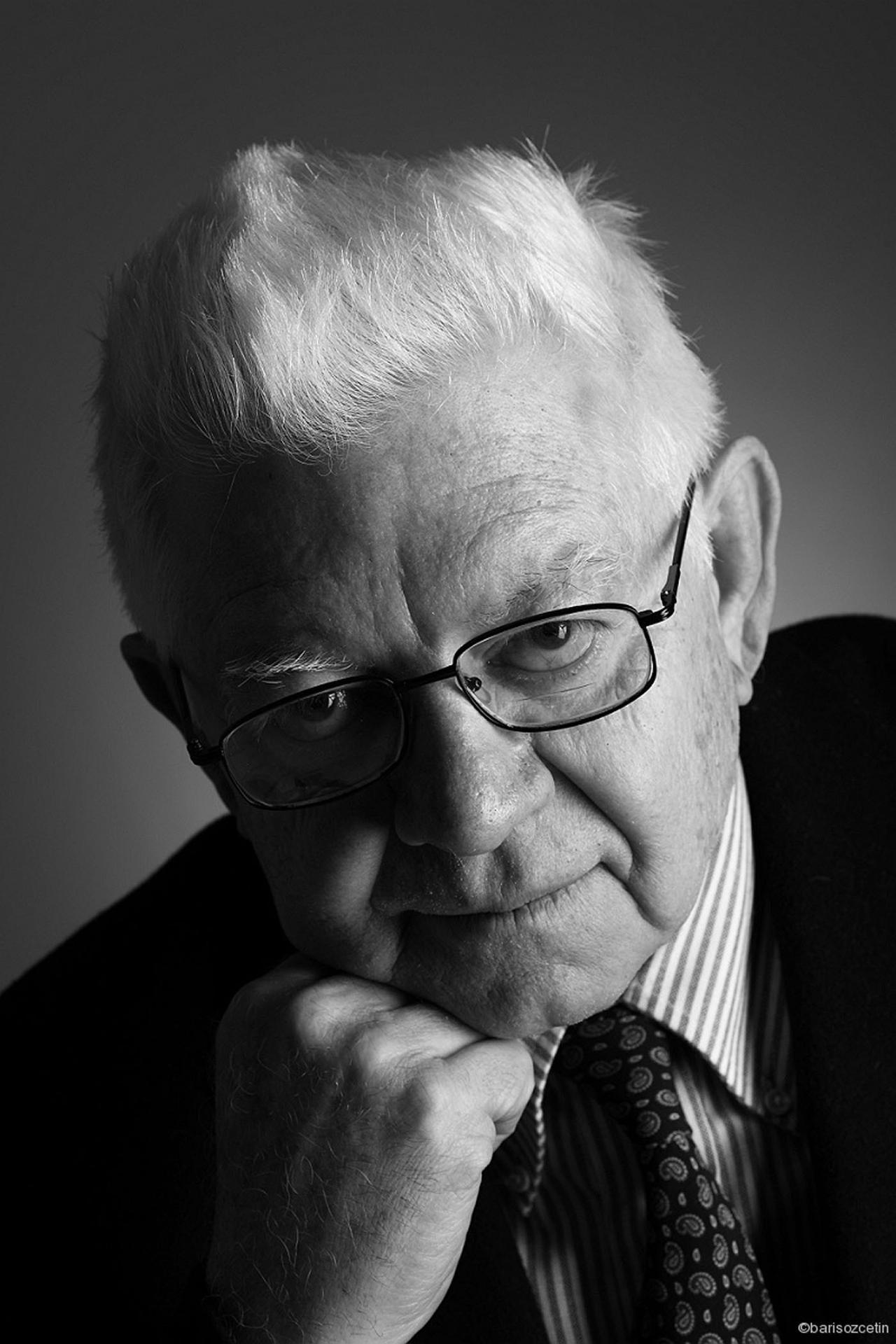
Oktay Sinanoğlu, 25 May 1935 in Bari, Italy, was a distinguished scientist renowned for his contributions to chemical engineering and academia. He taught in the fields of chemistry, molecular biophysics, thermodynamics and quantum mechanics. In 1975, he became the first and only person in the Republic of Türkiye to be awarded the special title of “Republic Professor.” Beyond his academic achievements, his views on the Turkish language and education also sparked widespread debate in Türkiye.
Sinanoğlu’s father, Nüzhet Haşim Sinanoğlu, was serving as consul general in Bari, Italy. In 1939, following the outbreak of the Second World War, he returned to Türkiye with his family.
In 1953, Sinanoğlu graduated first in his class from TED Ankara College Yenişehir High School. In the same year, he went to the United States on a Fulbright scholarship. In 1956, he earned his bachelor’s degree in chemical engineering from the University of California, Berkeley. He then completed his master’s degree in 1957 at the Massachusetts Institute of Technology (MIT) and was awarded the Sloan Prize.
Between 1958 and 1959, after completing his habilitation thesis, he pursued his doctorate in theoretical chemistry at the University of California, Berkeley, under the supervision of Kenneth Pitzer.
In 1960, Sinanoğlu began his academic career as a faculty member at Yale University. On 1 January 1963, he became a full professor in chemistry and, at that time, the youngest person ever to hold that rank at Yale in the 20th century. It was later noted that he was the second youngest full professor in Yale’s last 100 years and the third youngest in its 300-year history.
In 1964, he founded the department of theoretical chemistry at Yale University. Throughout his academic career, he developed the following theories:
In 1988, he published a method based on mathematical models he developed to predict how chemicals would react when combined in a laboratory setting. This method became known as the “Sinanoğlu Reduction.”
Sinanoğlu served at Yale University for 37 years before retiring in 1997. During his tenure at Yale, he advised several Turkish universities, TÜBİTAK, and the Japan Society for the Promotion of Science (JSPS). In 1962, he was appointed professor by Middle East Technical University (ODTÜ). In 1975, he was granted the title of Republic Professor of Türkiye by a special law.【2】
[1]
【1】
[2]
【3】
Sinanoğlu received the TÜBİTAK Science Award in 1966, the Alexander von Humboldt Research Award in 1973, and the International Outstanding Scientist Award from the Japan Academy in 1975. In 1973, he was appointed honorary ambassador to Japan. He stated that he had been nominated twice for the Nobel Prize in Chemistry.
After leaving Yale, he was appointed professor at Yıldız Technical University and continued his work there until 2002.
Scientific Contributions and Research
Sinanoğlu conducted pioneering research in quantum mechanics and theoretical chemistry. He solved a problem concerning the topology and high symmetries of Hilbert space, which Paul Dirac had studied but could not resolve. He also published numerous scientific books and papers.
In addition, he significantly influenced discussions on linguistic awareness and cultural identity in Türkiye through works such as “Hedef Türkiye” and “Bye Bye Türkçe” (2005).
Views and Work on the Turkish Language
During his time in Türkiye, Oktay Sinanoğlu drew attention not only for his scientific work but also for his views on the Turkish language and culture. He argued that Turkish was being eroded under the influence of foreign languages and emphasized the need to strengthen Turkish as a language of science and education.
Sinanoğlu believed that the language of education must be Turkish, while foreign languages should be taught as supportive tools. He strongly opposed the use of exclusively foreign languages in higher education, arguing that this did not promote scientific progress but instead increased dependency on Western countries.
He compiled his views on language in his book “Bye Bye Türkçe.” In this book, he contended that Turkish had lost its identity by being filled with foreign words and proposed Turkish equivalents for certain foreign terms. He also put forward the hypothesis that Turkish and Japanese might share a common linguistic origin.
Sinanoğlu emphasized that language is not merely a tool of communication but one of the fundamental elements of national identity and independence, and he called on the Turkish people to stand up for the Turkish language.

Henüz Tartışma Girilmemiştir
"Oktay Sinanoğlu" maddesi için tartışma başlatın
Life and Education
Academic Career
Books Authored
Academic Books
Other Books