


Bu içerik Türkçe olarak yazılmış olup yapay zeka ile otomatik olarak İngilizceye çevrilmiştir.
+2 Daha
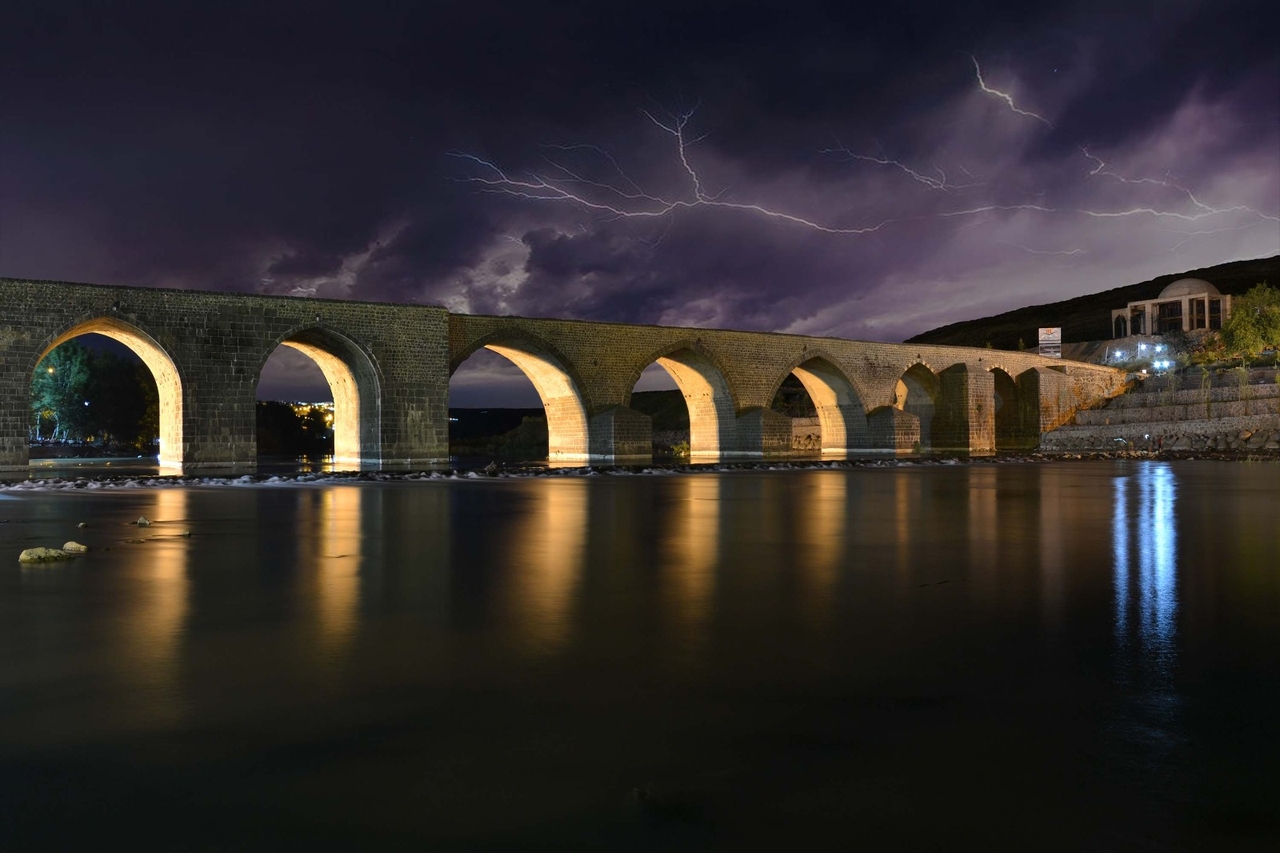
On Gözlü Köprü is a historical bridge spanning the Tigris River in the Sur district of Diyarbakır, place. Also known as Dicle Köprüsü, Silvan Köprüsü, and Mervani Köprüsü, this building is referred to as “On Gözlü Köprü” due to its ten arches, people among which it is commonly called Bridge. Located approximately three kilometers south of the city center, near Mardin Gate, the bridge serves as a vital important connecting the southern urban center with northern settlements. Throughout history, it has suffered various damages and undergone multiple repairs in different periods.

On Gözlü Köprü (Diyarbakır Governorship)
According to an inscription on the bridge, the structure was built between 1065 and 1067 during the rule of the Mervanids. A two-line floral Kufic inscription located between the arches and parapet on the southern facade states that it was commissioned by Kadı Ebü’l-Hasan Abdülvâhid during the reign of Nizâmüddevle Nasr of the Mervanids, under the design of a master builder named Yusuf, son of Ubeyd. However, some researchers argue that this inscription marks a renovation rather than the original construction, suggesting that the bridge was likely built much earlier, possibly in antiquity. While sources mention that the bridge may have been constructed during the reign of Emperor Anastasius I in the 6th century, its definitive original construction date remains unknown.
Throughout history, the bridge has been destroyed and rebuilt multiple times. It was damaged during the siege of Diyarbakır by Byzantine Emperor John Tzimisces in 974. Subsequent repair efforts were initiated during the reign of the Umayyad Caliph Hisham (742–743), but these were never completed. The final major construction and renovation, which forms the basis of the structure seen today, is generally accepted to have been carried out by the Mervanids between 1065 and 1067. The last major restoration occurred in 1899–1900.

On Gözlü Köprü (Diyarbakır Governorship)
On Gözlü Köprü is constructed entirely of cut basalt stone and spans the Tigris River with ten segmented arch. Its length varies between 172 and 180 meters, while its width measures 5.45 to 6.24 meters in the first five arches and increases to 9.69 to 10.20 meters from the fifth arch onward. The arches are pointed in form, with the central arch being the widest. On the upstream side, triangular salt cutwaters are present, while on the downstream side, sloping rectangle abutment walls are found. These walls are curved from east to south to accommodate the flow of the Tigris River and the topography of the terrain.
The bridge’s construction employed lime mortar with rubble infill and cut basalt stones of varying dimensions, applied using an interlocking technique. The parapets are made of rubble and cut stone. At the end of the inscription on the southern facade, a lion relief carved in profile, a motif commonly found in Artuqid and Seljuk architecture, is present. Similar examples can be found at the Bâb al-Jadîd Gate and Mardin Gate on the walls of Diyarbakır.

On Gözlü Köprü (Diyarbakır Governorate)
Restorations carried out during the close period partially compromised the original original fabric of the structure. Concrete and asphalt paved surfaces disrupted its visual integrity and material harmony. However, restoration efforts undertaken in 2008 aimed to preserve the bridge’s architectural coherence. After restoration, the bridge was closed to vehicular traffic and transformed into a social space for the local community and a popular destination for tourists.

On Gözlü Köprü (Diyarbakır Governorate)
On Gözlü Köprü is more than just an architectural structure; it is a vital symbol of Diyarbakır’s cultural heritage. The bridge and its surroundings have been reorganized as a living space for intangible cultural heritage. Traditional events such as Hıdırellez feature rituals where wishes are cast into the river, folk dances are performed, filming for special occasions takes place, and evening gatherings accompanied by regional music are held. The bridge is also associated with local legends and narratives; for instance, the melancholic tale of Suzi and Adil is frequently recalled by the local population and linked to the bridge.
Restaurants and tea gardens along the banks of the Tigris River are preferred by residents, especially during write evenings, as places to relax and spend leisure time. The symbolic value of the bridge is actively preserved through restoration and environment arrangements over the years. However, it is also emphasized that continuous maintenance and attention are necessary to ensure the transmission of this cultural heritage to future generations.
On Gözlü Köprü continues to exist today as a unique structure reflecting the historical, architectural, and cultural richness of Diyarbakır.

Henüz Tartışma Girilmemiştir
"On Gözlü Köprü" maddesi için tartışma başlatın
History
Architectural Features
Restoration and Current Condition
Cultural and Social Significance