

+2 Daha

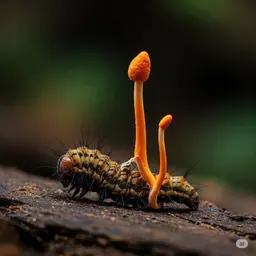
Ophiocordyceps Sinensis
Scientific Name(s) | Ophiocordyceps Sinensis | ||||||||
|---|---|---|---|---|---|---|---|---|---|
Kingdom(s) | Fungi | ||||||||
Phylum | Ascomycota | ||||||||
Class | Sordariomycetes | ||||||||
Order | Hypocreales | ||||||||
Family | Ophiocordycipitaceae | ||||||||
Genus | Ophiocordyceps | ||||||||
Distribution(s) | China Tibet India Nepal | ||||||||
Habitat Altitude | 3000 to 5000 m | ||||||||
Life Cycle | Entomopathogenic | ||||||||
Chemical Components | Peptides Mannitol Adenosine Ergosterol Polysaccharides Cordycepin | ||||||||
Pharmacological Effects | Antiviral Antibacterial Antitumor Antioxidant Immunomodulatory | ||||||||
Ophiocordyceps sinensis is an entomopathogenic fungal species belonging to the phylum Ascomycota. This fungus occurs naturally at high altitudes ranging between 3,000 and 5,000 meters in the Himalayan regions of China, Nepal, India, and Tibet. Traditionally known as “winter worm, summer grass” in Chinese medicine, Ophiocordyceps sinensis parasitizes ghost moth larvae of the genus Hepialus. After infection, the fungus develops within the host's body, ultimately forming a dark, club-shaped fruiting body that emerges from the larva. This unique life cycle and the species’ rarity make O. sinensis ecologically and economically significant.
Although historically known as Cordyceps sinensis, molecular DNA analyses have led to taxonomic revisions. In 2007, based on phylogenetic studies, the species was reclassified into the genus Ophiocordyceps by Sung, Hywel-Jones, and Spatafora. Morphologically, O. sinensis produces a cylindrical, dark brown to black fruiting body that emerges from the head of the infected larva. This fruiting body typically ranges from 5 to 10 cm in length and contains numerous perithecia, which are small flask-shaped structures responsible for spore production.
Ophiocordyceps sinensis inhabits alpine meadows of the Tibetan Plateau, Nepal, Bhutan, and the Sikkim region of India, thriving at elevations of 3,000 to 5,000 meters. It prefers cold, humid climates and well-drained soils. Due to overharvesting and its highly specific ecological niche, the populations of this fungus are currently under threat. Its declining abundance has significant implications for both ecological balance and the economic sustainability of local communities that depend on harvesting it.
The life cycle of O. sinensis is defined by its entomopathogenic nature. Its spores infect Hepialus larvae residing in the soil. Upon infection, fungal mycelium proliferates within the larval body, ultimately causing the host's death. The fungus then grows a fruiting body through the larva’s head, releasing spores into the environment to infect new hosts. This parasitic cycle enables the fungus to persist in its harsh native environment and sustain its population.

Cordyceps Sinensis Mushroom Life Cycle (Created by Artificial Intelligence)
Cordyceps sinensis contains numerous chemical compounds with various biological activities. Among these are:

Cordyceps Sinensis Nutrition (Created by Artificial Intelligence)
Cordyceps sinensis has been used in traditional Chinese medicine for centuries. It has particularly been employed to support kidney and lung functions, reduce fatigue, and enhance sexual performance. Modern scientific studies have confirmed some of these traditional applications. For example, research into the antioxidant, antitumor, and immunomodulatory effects of Cordyceps sinensis has revealed its potential therapeutic benefits. However, medical use should only be carried out under the supervision of a physician, as improper use may cause serious side effects.
Natural populations of Cordyceps sinensis are under threat due to overharvesting and habitat loss. This poses a significant concern for both ecosystem stability and the economic well-being of local communities. As a result, various conservation strategies have been developed to ensure the sustainable harvesting and cultivation of Cordyceps sinensis. These strategies include the development of artificial cultivation techniques and the protection of its natural habitats.
Disclaimer: The content in this article is intended solely for general encyclopedic purposes. The information provided here should not be used for diagnosis, treatment, or as a substitute for professional medical advice. Always consult a physician or qualified healthcare provider before making decisions related to your health. Neither the author nor KURE Encyclopedia accepts any responsibility for outcomes resulting from the use of this information for diagnostic or therapeutic purposes.
Chen, Y., Hu, B., Xu, F., Zhang, W., Zhou, H., ve Qu, L. 2003. “Genetic Variation of Cordyceps sinensis, a Fruit-Body-Producing Entomopathogenic Species from Different Geographical Regions in China.” FEMS Microbiology Letters 230(1): 153–158. https://doi.org/10.1016/s0378-1097(03)00889-9.
Elder, D. P., ve D. J. Snodin. 2009. “Drug Substances Presented as Sulfonic Acid Salts: Overview of Utility, Safety and Regulation.” Journal of Pharmacy and Pharmacology 61(3): 269–278. https://doi.org/10.1211/jpp.61.03.0001.
Paterson, R. R. M. 2008. “Cordyceps – A Traditional Chinese Medicine and Another Fungal Therapeutic Biofactory?” Phytochemistry 69(7): 1469–1495. https://doi.org/10.1016/j.phytochem.2008.01.027.

Ophiocordyceps Sinensis
Scientific Name(s) | Ophiocordyceps Sinensis | ||||||||
|---|---|---|---|---|---|---|---|---|---|
Kingdom(s) | Fungi | ||||||||
Phylum | Ascomycota | ||||||||
Class | Sordariomycetes | ||||||||
Order | Hypocreales | ||||||||
Family | Ophiocordycipitaceae | ||||||||
Genus | Ophiocordyceps | ||||||||
Distribution(s) | China Tibet India Nepal | ||||||||
Habitat Altitude | 3000 to 5000 m | ||||||||
Life Cycle | Entomopathogenic | ||||||||
Chemical Components | Peptides Mannitol Adenosine Ergosterol Polysaccharides Cordycepin | ||||||||
Pharmacological Effects | Antiviral Antibacterial Antitumor Antioxidant Immunomodulatory | ||||||||
Henüz Tartışma Girilmemiştir
"Ophiocordyceps Sinensis" maddesi için tartışma başlatın
Taxonomy and Morphological Features
Ecological Distribution and Habitat
Biological Life Cycle
Chemical Components
Traditional Use and Modern Research
Conservation and Sustainability
Bu madde yapay zeka desteği ile üretilmiştir.