

Bu içerik Türkçe olarak yazılmış olup yapay zeka ile otomatik olarak İngilizceye çevrilmiştir.
+1 Daha
The first object identified as originating from outside the Solar System, 'Oumuamua, was discovered on 19 October 2017 by the Pan-STARRS1 telescope affiliated with the University of Hawaii. This celestial body, recorded in scientific literature as 1I/2017 U1, derives its name from the Hawaiian phrase meaning “the first distant messenger.” The object entered the Solar System on a hyperbolic trajectory and exhibited physical and dynamical characteristics simultaneously resembling those of both an asteroid and a comet.
The object was detected by the Pan-STARRS1 telescope, supported by NASA, which is tasked with monitoring asteroids and comets near Earth. Initially classified as a comet, this classification was later revised to that of an asteroid due to the absence of a visible coma or tail. Subsequent precise measurements revealed an acceleration that could not be explained by gravitational forces alone, confirming that the object behaved like a comet. Officially named by the International Astronomical Union (IAU), this object became the first confirmed example of a body originating from interstellar space.

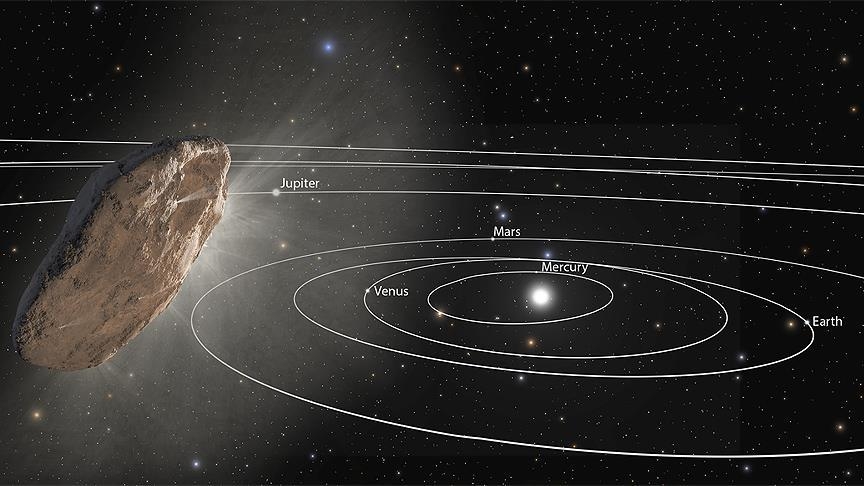
'Oumuamua approaching the Solar System. (Generated by artificial intelligence)
Unlike previously observed natural objects in Solar System, 'Oumuamua exhibited an unusually high length-to-width ratio. The tenfold variations in its brightness were explained by a tumbling motion, rotating around its axis every 7.3 hours.
Initial observations suggested the object was approximately 400 metres long with a cigar-like cylindrical shape. However, later revised analyses indicated it might instead have dimensions of 115 metres in length, 111 metres in width, and 19 metres in thickness, resembling a flat, pancake-like structure.
Its deep red colour resulted from exposure to cosmic radiation over hundreds of millions of years. The surface was determined to be rich in metals and rock, with a dense structure and no evidence of water or ice layers. Telescopic observations showed it as a single point of light, with no surrounding dust cloud or gas tail (coma) detected.
The object’s motion within the Solar System included an acceleration that could not be explained by gravity alone, suggesting a thrust mechanism similar to that of a rocket. The object reached its closest approach to the Sun (perihelion) on 9 September 2017, attaining a speed of 87.3 kilometres per second (approximately 315,000 km/h or 196,000 mph).
'Oumuamua moved faster than expected as it receded from the Sun. This anomaly was linked to the outgassing of gas from invisible surface vents, leading to the conclusion that the object exhibited technical behaviour consistent with a comet.
Orbital calculations indicated that 'Oumuamua originated from the direction of the bright star Vega in the constellation Lyra. However, given its velocity and travel time, it could not be traced to any specific star system, as Vega was not in that position at the time. It was determined to have been wandering interstellar space for hundreds of millions of years in Milky Way Galaxy. As it left the Solar System, 'Oumuamua headed toward the constellation Pegasus.
Scientists have developed various natural formation scenarios to explain the origin of 'Oumuamua.
Simulation models suggest that 'Oumuamua may be a fragment of a larger celestial body torn apart by gravitational forces during a close passage to its parent star. The extreme heating during this close approach, followed by rapid cooling, created surface fractures that gave the object its characteristic elongated shape. This process also explains its “dry” structure by causing volatile substances such as water to evaporate.
Several theories have been proposed to explain the object’s acceleration without a visible tail, focusing on different types of ice:
One theory proposes that 'Oumuamua is a fragment of nitrogen ice ejected from the surface of a Pluto-like planet. Sublimation of this nitrogen under solar heating provided thrust without producing a visible coma.
An alternative hypothesis suggests that cosmic rays in interstellar space transformed water ice on the object’s surface into molecular hydrogen. As the object passed near the Sun, the heating released this trapped hydrogen, causing the observed acceleration.
Modelling indicates that rocky objects like 'Oumuamua are more likely to be ejected from binary star systems than from single-star systems like the Solar System. The stronger gravitational fields in binary systems are more effective at flinging asteroid-like bodies into interstellar space.
Due to its unusual shape and motion, astronomers from Harvard University proposed the possibility that 'Oumuamua could be an artificial spacecraft propelled by a solar sail. However, the broader scientific community has not supported this hypothesis, noting that all available data are consistent with natural explanations. No artificial signals have been detected from the object.

Henüz Tartışma Girilmemiştir
"Oumuamua" maddesi için tartışma başlatın
Discovery and Classification
Physical Structure and Morphology
Geometric Form
Surface Composition
Orbital and Dynamical Properties
Non-Gravitational Acceleration
Direction of Approach and Trajectory
Origin and Formation Hypotheses
Stellar Tidal Disruption
Ice and Gas Composition Theories
Nitrogen Ice
Hydrogen Ice
Binary Star System Origin
Artificial Object Debates