


Bu içerik Türkçe olarak yazılmış olup yapay zeka ile otomatik olarak İngilizceye çevrilmiştir.

A sheet of paper. A few folds. And the sky.
Everyone has made one. Engineer or not. On a child’s notebook cover, on a house’s balcony, on the back of a letter or a bill. The paper airplane is humanity’s most democratic invention. It requires no factory, no vacation, no money.
The Japanese child calls it kamihikōki. The German child, Papierflieger. The French child, avion en papier. Our child says “paper airplane.” Different languages, the same folds. It is among the few things in the world that require no translation.
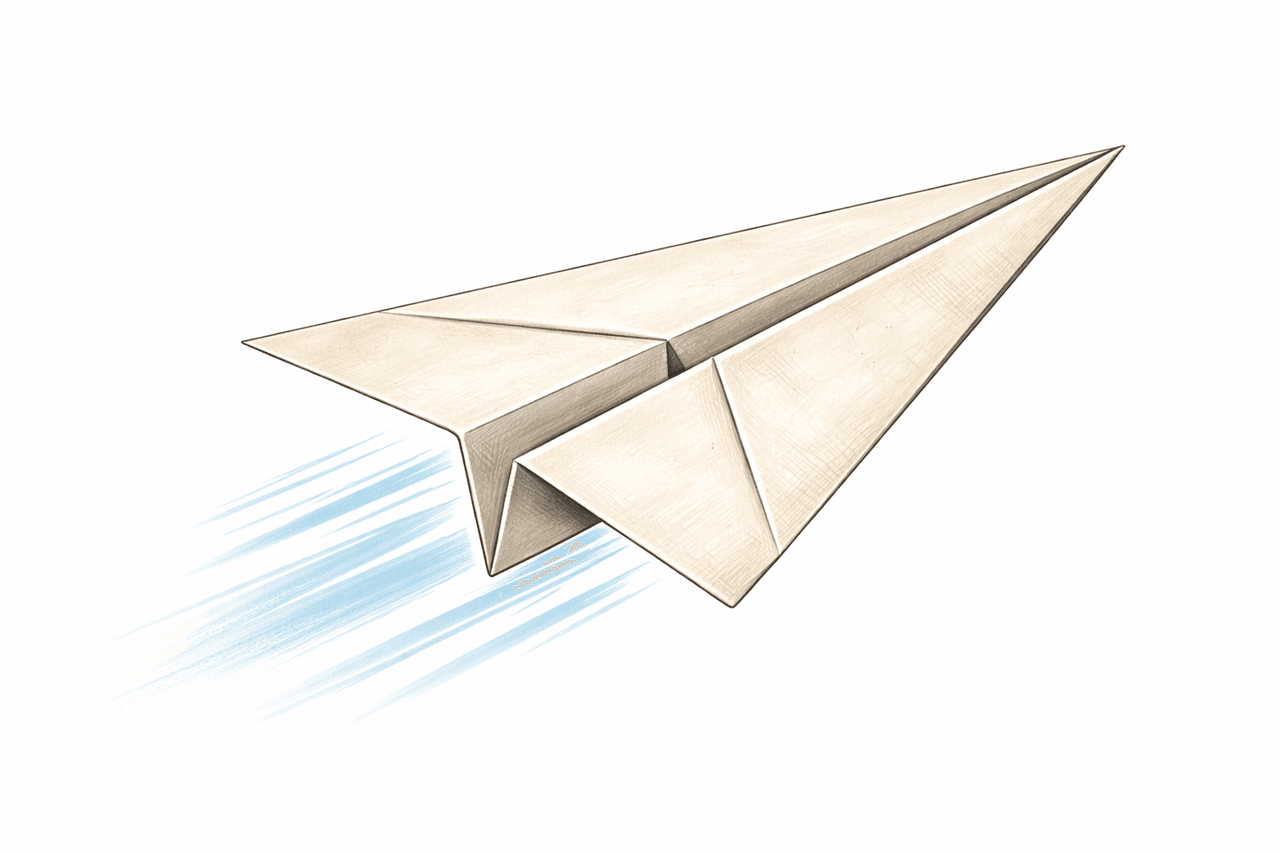
Paper Airplane (Generated by Artificial Intelligence)
The Chinese were the first to invent paper. In 105 AD, palace official Ts’ai Lun developed the first known method of papermaking.【1】 By the 6th century, paper had reached Japan, where it acquired a new name: origami. Derived from oru, meaning “to fold,” and kami, meaning “paper,” this word declared that paper was no longer merely for writing but also for imagination.
At the end of the 15th century and the beginning of the 16th, Leonardo da Vinci sketched flying machines in his notebooks: ornithopters, helical aerial screws, wing designs. The dream of flight was no longer confined to mythology—it now lived on paper.
December 17, 1903. The Wright brothers achieved the first powered flight in Kitty Hawk. They entered history.
Twenty-two years later, in 1925, an airplane glided across the skies of Türkiye. Its pilot, engineer, and designer were all the same man: Vecihi Hürkuş. For months he sketched on paper, cut models, and noted down wing angles in his notebook. On January 28, 1925, he took to the air in the Vecihi K-VI, Türkiye’s first domestically designed and manufactured aircraft.【2】
Every great aircraft begins on paper.
Every paper airplane is in fact a small aerodynamic experiment. The angled wing pushes air downward; according to Newton’s third law, the air pushes the wing upward. This counterforce is called “lift.” The airspeed over the wing’s upper surface decreases pressure—a phenomenon described by Daniel Bernoulli in 1738—which further contributes to lift. It is the combined effect of these two forces that allows a small scrap of paper to remain suspended in the air.
In the official world of paper airplanes, there are two main competitions.
Longest Time in Flight: In 2010, Japanese Takuo Toda set a record by keeping his airplane airborne for 29.2 seconds in a hall in Hiroshima. This record stood for sixteen years. On February 11, 2026, in Kunshan, China, a seven-member Chinese team led by Rao Chongyi broke the record with a flight lasting 31.2 seconds.【3】
Farthest Distance: On December 2, 2022, three Boeing engineers—Dillon Ruble, Garrett Jensen, and Nathan Erickson—set a record of 88.31 meters after six months of work. Three years later, on December 28, 2025, in Shanghai, a six-member Chinese team led by Liu Liwen launched a paper airplane 98.43 meters.【4】
At the first international paper airplane competition in 1966, 5,144 participants from 28 countries submitted a total of 11,851 airplanes. Of these, five thousand were made by children. Among the winners was 10-year-old Hironori Kurisu from Osaka. His folded airplane stayed airborne for 11.28 seconds—outlasting the winner of the amateur category.【5】
And then there is something neither recorded by Guinness nor measurable: the most graceful flight. It is a silent salute given to those airplanes that a child says “look!” to, that a teacher smiles at and pretends not to see, that float slowly like clouds.
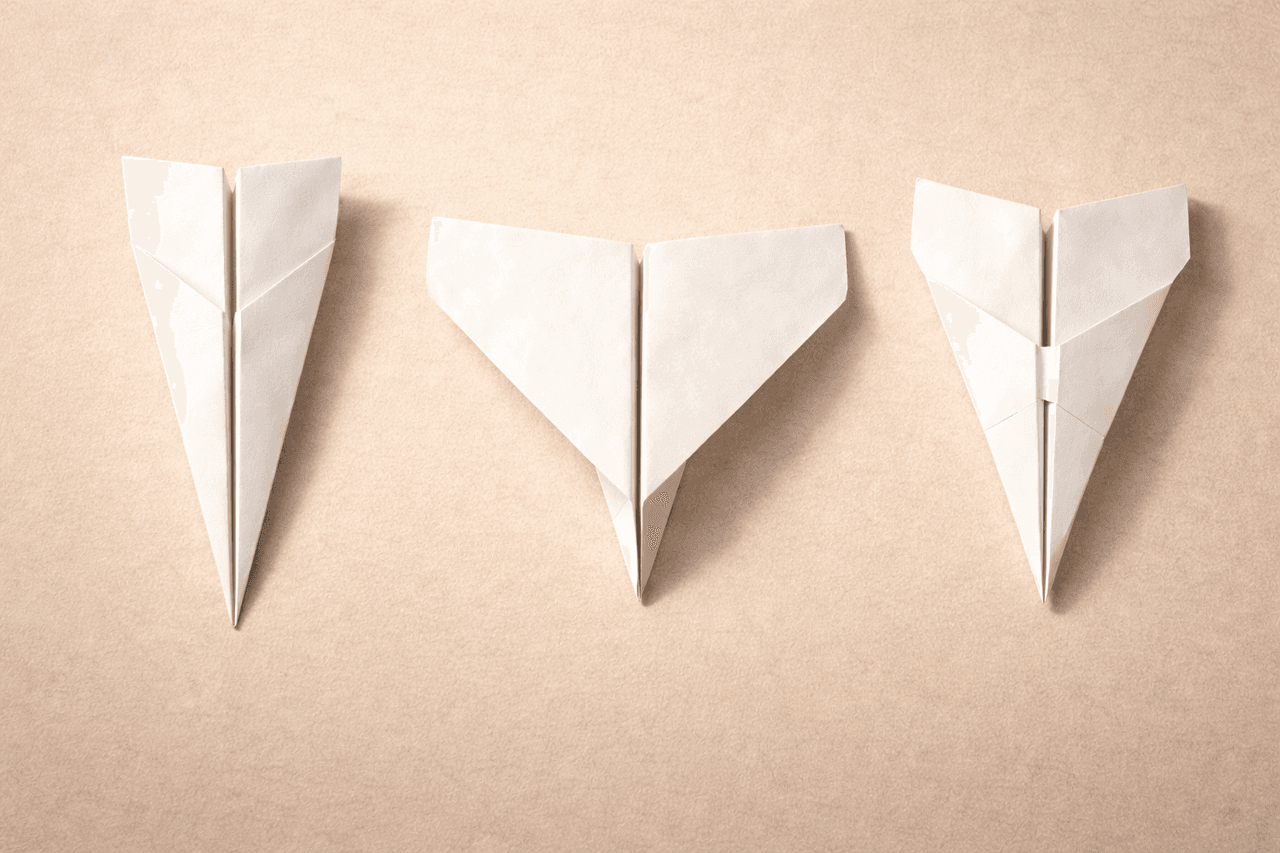
Types of Paper Airplanes (Generated by Artificial Intelligence)
Three designs stand out in the history of paper airplanes:
All three are made from the same sheet of paper. Only the angle of the folds changes. Here is how to make one of these classics:
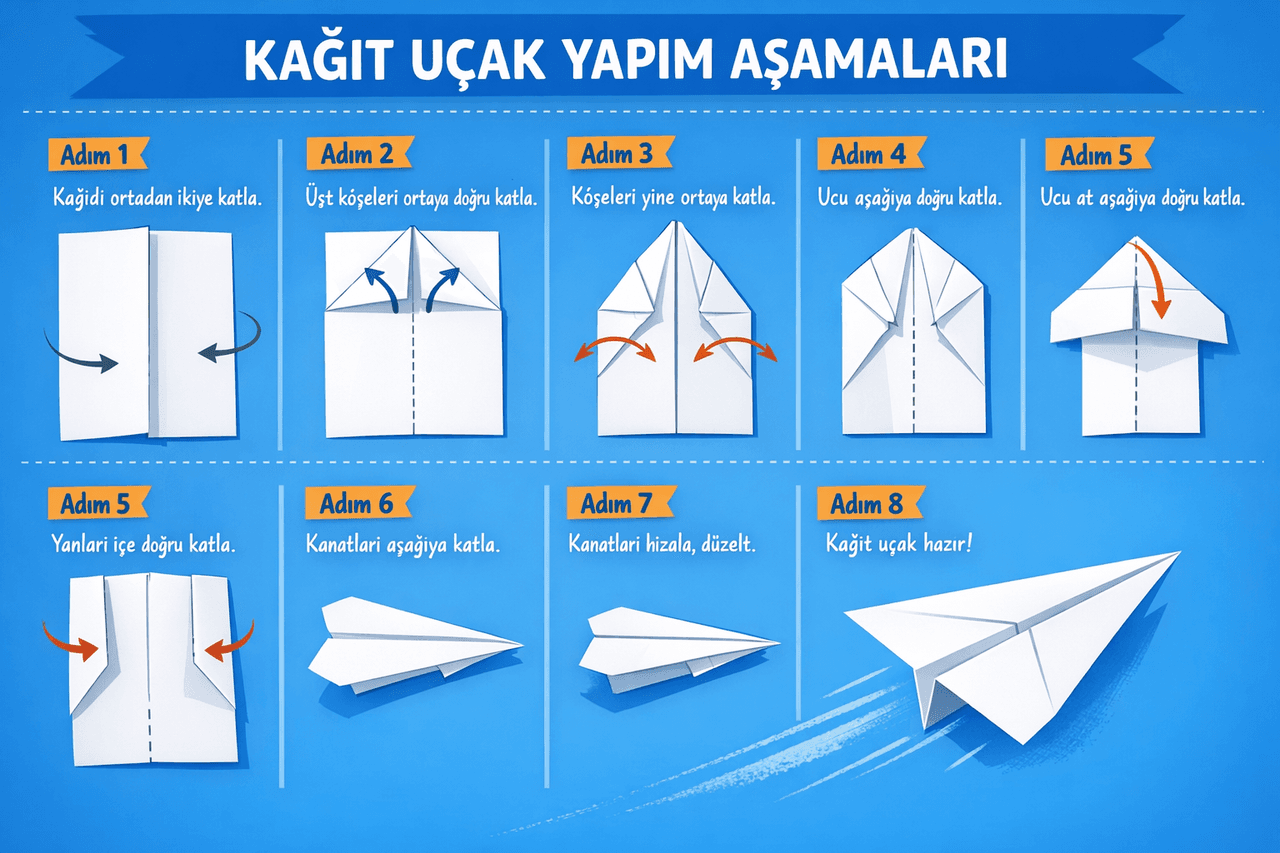
Assembly Steps (Generated by Artificial Intelligence)
Someone who, for years, has worked with the same paper, the same angle, the same wind. Someone who never gave up. Someone who watched thousands of airplanes fall to the ground.
The paper airplane taught us this as children. If it didn’t fly on the first throw, you adjusted the folds. You bent the nose. You aligned the wings. Until one day—it happened. That white thing glided from desk to ceiling.
That moment was a tiny miracle.
Some ask, “Why does it fly?” Others ask, “Why doesn’t it fly?” The paper airplane answers both.
The paper airplane taught us this:
Even when nothing else exists, a single sheet of paper is enough.
Fold. Launch. Watch.
Sometimes it doesn’t fly. Sometimes it crashes to the ground. Sometimes it returns to you the moment it leaves your hand—as if it never wanted to go.
You fold it again. You launch it again.
Eventually, one glides. And that glide erases all the others that fell.
The rest is up to the wind.
As you read this, did you think: When was the last time you launched one?
It may have been years. Ten, twenty, forty years. Perhaps inside you still holds that one paper airplane you never quite got to fly.
Stand up. Take a sheet of paper—white, the back of a bill, a notebook page—it doesn’t matter. Fold it. Launch it.
Don’t worry; your hands still remember how.
And that one-second glide you’ve been waiting for all these years—take it back now. Right now.
[1]
Mehmet Sığırcı, “The Invention of Paper,” TÜBİTAK Bilim Genç, accessed 18 April 2026, https://bilimgenc.tubitak.gov.tr/kagidin-icadi
[2]
Ömer Kökçam, “Vecihi Hürkuş,”Küre Encyclopedia, accessed 18 April 2026, https://kureansiklopedi.com/tr/detay/vecihi-hurkus-3
[3]
Guinness World Records, “Longest Flying Paper Aircraft — Duration,” Guinness World Records, accessed 18 April 2026, https://www.guinnessworldrecords.com/world-records/longest-time-flying-a-paper-aircraft
[4]
Guinness World Records, “Farthest Flight by a Paper Aircraft,” Guinness World Records, accessed 18 April 2026, https://www.guinnessworldrecords.com/world-records/farthest-flight-by-a-paper-aircraft
[5]
Çağlar Sunay, “Mischievous Products of Original Creativity: Paper Airplanes,” Science and Technology, December 1997, Issue 37. https://bilimteknik.tubitak.gov.tr/e-arsiv/sayi-361/kagit-ucaklar/
The Journey of Paper to the Sky
Why Does a Paper Airplane Fly?
Records
Three Classic Designs
8 Steps to a Paper Airplane
How Are These Records Broken?
Now It’s Your Turn