

Bu içerik Türkçe olarak yazılmış olup yapay zeka ile otomatik olarak İngilizceye çevrilmiştir.
+1 Daha
Patagonian Mara (Dolichotis patagonum) is an endemic mammal species within the order Rodentia, suborder Caviomorpha, and family Caviidae. It is the second largest member of its family and the only living representative of its genus.

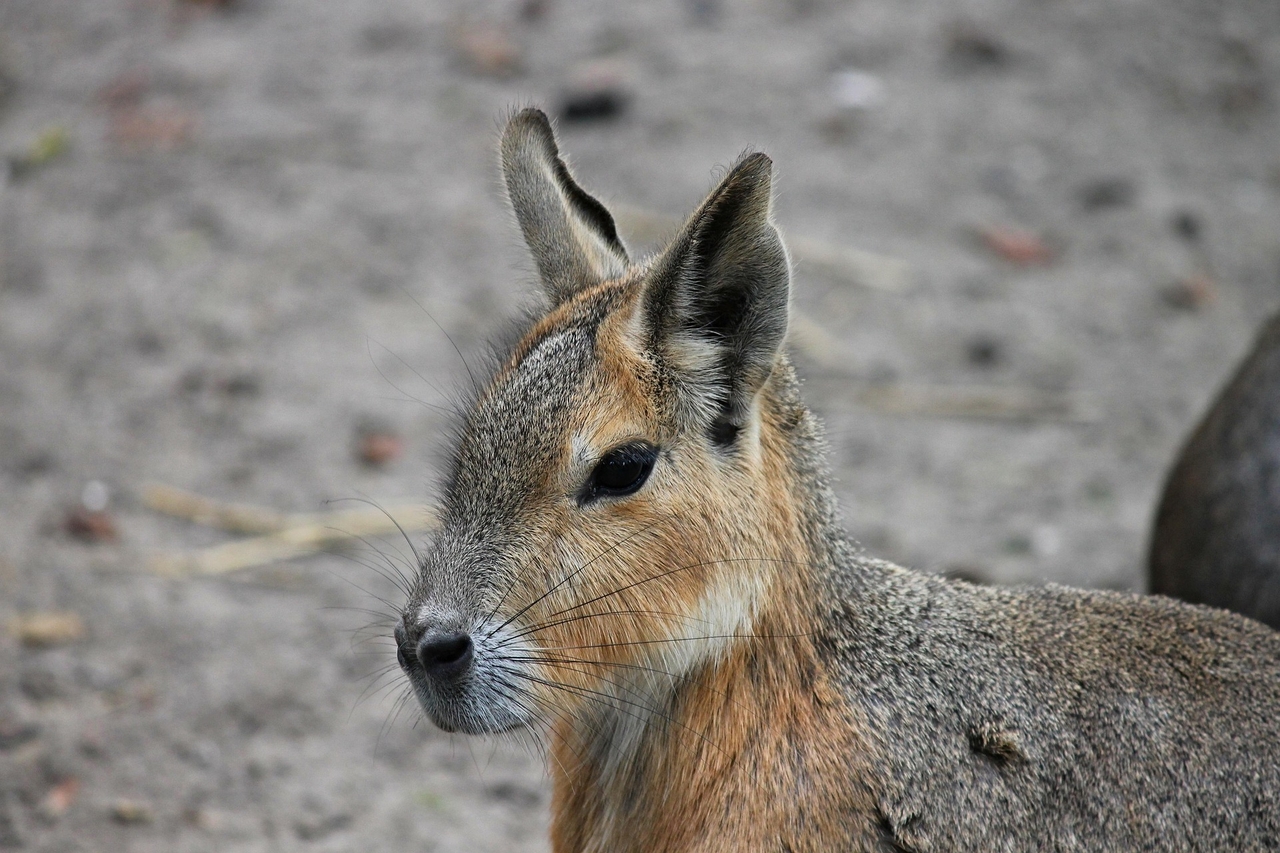
Patagonian Mara (Dolichotis patagonum)(Pixabay)
Adult individuals weigh between 7.7 kg and 8.4 kg on average, with body lengths ranging from 610 mm to 810 mm. 【1】Morphologically, it has long rabbit-like ears and a short, nearly hairless tail held close to the body. The radius bone is longer than the humerus, an anatomical feature associated with the species’ ability to run at speeds up to 45 miles per hour.
The dorsal fur is grayish-brown with a prominent white patch surrounded by a black line on the rump; the underparts are white, while the cheeks and flanks are rust-orange. Unlike other cavy species, its anal glands are located between the anus and the base of the tail.
Dolichotis patagonum is found exclusively in the arid central and southern regions of Argentina, between 28° S and 50° S latitude. Its natural habitats encompass a variety of arid environments, from sandy plains to spiny shrub steppe.
The species prefers open habitats dominated by grasses and low vegetation, which allow it to visually detect predators. Areas with dense vegetation are generally avoided due to increased vulnerability to predation. Home ranges vary seasonally between 33 and 197 hectares and show a continuous tendency to shift in response to the distribution of food resources.

Geographic Distribution of the Patagonian Mara(Generated by Artificial Intelligence)
Patagonian maras are strict herbivores whose diet closely adapts to the composition of local vegetation. Under normal conditions, approximately 70% of their diet consists of grasses from genera such as Pappophorum, Poa, and Panicum.
During periods of drought or food scarcity, they shift their diet to include cacti as a primary source of water, transitioning from grazers to mixed feeders. Their digestive system is specialized for fibrous plant material through cecum-based bacterial fermentation. Additionally, they exhibit coprophagic behavior, re-ingesting a special type of feces to enhance nutrient absorption.
Patagonian maras possess a monogamous social structure, rare among mammals, with pair bonds typically lasting for life. The male maintains the bond by constantly following the female and defending her against rival males. Females have an unusually short estrous cycle, occurring every three to four months and lasting only 30 minutes.

Patagonian Mara and Young(Pixabay)
The breeding season extends primarily from mid-August to late December. Young are raised in communal nests called creches, shared by up to 29 individuals; however, due to the male’s aggressive territorial behavior, only one pair occupies the nest at any given time. Gestation lasts approximately 100 days and typically results in two offspring. Young are precocial, able to walk immediately after birth, and undergo a prolonged lactation period of 75 to 78 days, unusually long for rodents.【2】
This species has adopted a diurnal lifestyle, spending most of the day feeding or basking in the sun. Due to its anatomical adaptations for speed, it exhibits a stotting leap behavior when threatened, lifting all four feet off the ground simultaneously, similar to ungulates.
Males mark their territory and mates with urine and secretions from anal glands. Their senses of vision, hearing, and smell are highly developed, enabling them to detect natural predators such as foxes and raptors at an early stage.
The Patagonian mara is classified as Near Threatened on the IUCN Red List. Its populations are under pressure due to altered vegetation structure from overgrazing by domestic sheep, illegal hunting, and habitat loss. Additionally, competition for food and disease transmission from the introduced European rabbit have led to local extirpations in some areas.
[1]
Claudia M. Campos, Marcelo F. Tognelli and Ricardo A. Ojeda, "Dolichotis Patagonum," Mammalian Species, no. 652 (2001): 1–5, accessed 13 March 2026, http://www.jstor.org/stable/3504392
[2]
Claudia M. Campos, Marcelo F. Tognelli and Ricardo A. Ojeda, "Dolichotis Patagonum," Mammalian Species, no. 652 (2001): 1–5, accessed 13 March 2026, http://www.jstor.org/stable/3504392

Henüz Tartışma Girilmemiştir
"Patagonian Mara (Dolichotis patagonum)" maddesi için tartışma başlatın
Physical Characteristics and Morphological Structure
Geographic Distribution and Ecological Habitat Preferences
Feeding Strategies and Digestive Physiology
Social Organization and Reproductive Biology
Behavioral Traits and Defense Mechanisms
Conservation Status and Anthropogenic Threats