

Bu içerik Türkçe olarak yazılmış olup yapay zeka ile otomatik olarak İngilizceye çevrilmiştir.
+1 Daha
Piyan çiçeği is a species belonging to the genus Thermopsis within the subfamily Papilionoideae of the Fabaceae (legume) family. The genus Thermopsis is represented by approximately 25 species in the mountainous humid regions of Central Asia and North America. In the flora of Türkiye, the only native representative of this genus is Thermopsis turcica.
The species was first introduced to the scientific community in 1983 by Kit Tan, Vural and Küçüködük. Although some studies have proposed classifying it as a separate genus, Vuralia turcica, due to morphological differences, the scientific literature overwhelmingly uses the name Thermopsis turcica.
Local communities have named the plant “Eber sarısı” because of the yellow color of its flowers, and “piyan” or “piyam” because animals avoid eating it due to its bitter taste.【1】

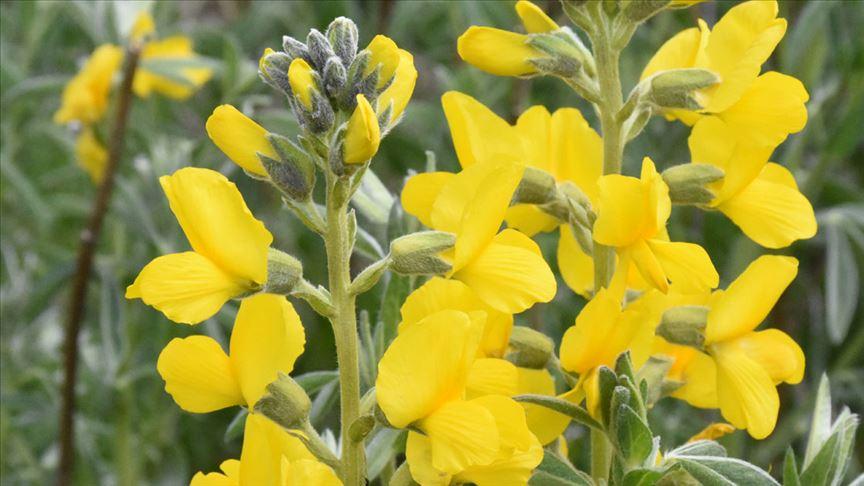
Piyan çiçeği (AA)
Thermopsis turcica is a perennial herbaceous plant with underground rhizomes. Its stem is upright, hairy, and 35–80 cm tall. The leaves are trifoliate and petiolate. The inflorescence is racemose; the flowers are yellow and approximately 25 mm long. It contains ten free stamens and a tricarpellate ovary. Multiple fruits develop from a single flower, each consisting of three or more free carpels. The fruits are legume-type and carry 3–10 seeds; they are pubescent in texture.
Thermopsis turcica is found only in Türkiye, within a narrow area between the southern shore of Eber Gölü and the south-western shore of Akşehir Gölü, within the boundaries of Afyonkarahisar Province. Its habitat is restricted to areas between orchards, lake margins and agricultural fields. Populations occur in fragmented patches. The sustainability of its habitat depends on lake water levels and microclimatic conditions. Agricultural drainage, increased groundwater extraction and the lowering of lake levels are reducing the species’ distribution range.
Thermopsis turcica was first described to science in 1983 by Kit Tan, Vural and Küçüködük. It was initially detected south of Akşehir Gölü within the boundaries of Konya Province, but subsequent studies revealed that its primary distribution lies within Afyonkarahisar Province, between the southern shore of Eber Gölü and the south-western shore of Akşehir Gölü. This discovery is regarded as a significant contribution to the flora of Türkiye.
The plant primarily reproduces vegetatively through its rhizomes. Flowering occurs at the end of April to the beginning of May, and fruiting takes place in August. Natural seed regeneration may be limited because seeds are often damaged by insect larvae.
Thermopsis turcica is classified as “Critically Endangered” (CR) according to IUCN criteria. It is listed in Appendix I of the Bern Convention as a plant species requiring absolute protection. The species’ natural habitat is surrounded by agricultural land; excessive water use, ploughing and harvesting activities negatively impact its populations.
The species is protected under the “Piyan Species Action Plan” prepared by the Ministry of Forest and Water Affairs. Areas around Eber and Akşehir Gölü have been fenced off for protection. In collaboration with Afyon Kocatepe University and the Nezahat Gökyiğit Botanical Garden, ex situ conservation projects are underway; some individuals have been translocated to the botanical garden along with their native soil. Laboratory studies on seed propagation, tissue culture and rhizome explant multiplication have been conducted.
The multi-fruited structure (free carpels) of Thermopsis turcica is rare among legumes and holds value as a genetic resource. This trait may be investigated for improving yield in cultivated crops. Additionally, alkaloid compounds found in the leaves and seeds of the plant have potential applications in pharmaceuticals.
Administrative fines are imposed by the General Directorate of Nature Conservation and National Parks on individuals who uproot or illegally transport the species. In 2019, the fine was set at 60,000 TL, and in 2022 it was increased to 109,593 TL.
Anadolu Ajansı. "Eber Sarısını Koparmanın Cezası 60 Bin Lira." Accessed October 20, 2025. https://www.aa.com.tr/tr/turkiye/eber-sarisini-koparmanin-cezasi-60-bin-lira/1474073.
Anadolu Ajansı. "Piyan Koruma Altına Alındı." Accessed October 20, 2025. https://www.aa.com.tr/tr/bilim-teknoloji/piyan-koruma-altina-alindi/577575.
Cenkci, Süleyman, Mustafa Yıldız, and Hakan Terzi. "Afyonkarahisar Endemiği Thermopsis turcica: Dünü, Bugünü ve Ekonomiye Kazandırılması." *Afyon Kocatepe Üniversitesi Fen Bilimleri Dergisi* 12, no. 2 (2012): 23–26. Accessed October 20, 2025. https://dergipark.org.tr/en/download/article-file/18408.
Özkan, Murat. "Baklagillerin Kraliçesi Eber Sarısı Koruma Altında." Türk Tarım ve Orman Dergisi. Accessed October 20, 2025. http://www.turktarim.gov.tr/Haber/855/baklagillerin-kralicesi-eber-sarisi-koruma-altinda.
[1]
Süleyman Cenkci, Mustafa Yıldız ve Hakan Terzi, "Afyonkarahisar Endemiği Thermopsis turcica: Dünü, Bugünü ve Ekonomiye Kazandırılması," Afyon Kocatepe Üniversitesi Fen Bilimleri Dergisi 12, no. 2 (2012): syf 24, https://dergipark.org.tr/en/download/article-file/18408.

Henüz Tartışma Girilmemiştir
"Piyan Flower (Thermopsis turcica)" maddesi için tartışma başlatın
Morphological Characteristics
Distribution and Habitat
Discovery and Scientific Description
Reproduction and Ecological Features
Conservation Status
Conservation Efforts
Economic and Scientific Potential
Legal Protection and Penalties