


Bu içerik Türkçe olarak yazılmış olup yapay zeka ile otomatik olarak İngilizceye çevrilmiştir.
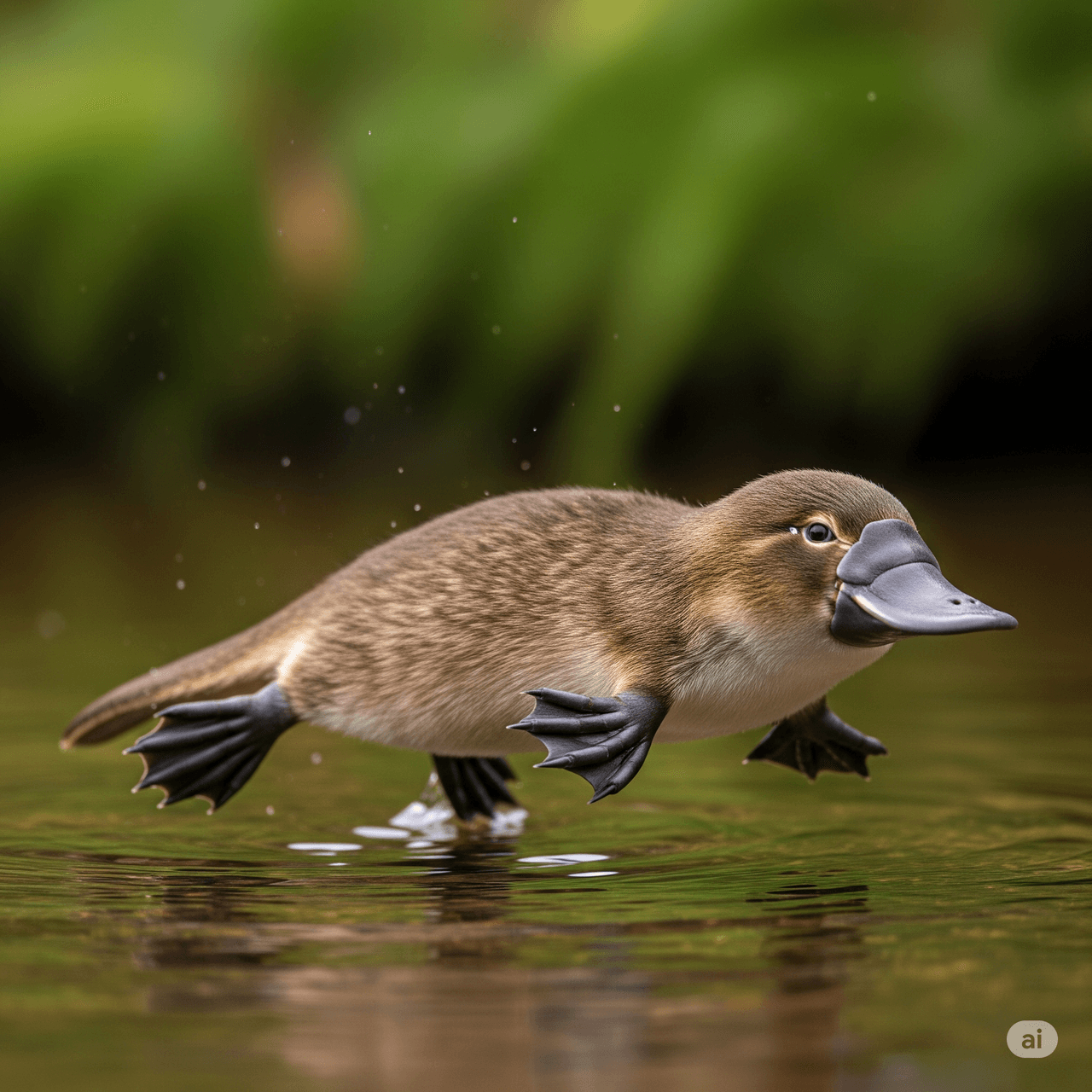
The platypus (Ornithorhynchus anatinus) is a semiaquatic mammal species belonging to the order Monotremata, a subgroup of mammals (Mammalia) that lay eggs, and is found today only on the Australian continent. It is one of only two living representatives of this order; the other is the echidna (genus Tachyglossus family). The platypus stands out among mammals due to its unique morphology that combines features of birds, reptiles, and mammals.
The platypus body is covered in dense, water-repellent fur that forms a fine layer containing approximately 800–900 follicles per square centimeter. The air pockets within the underlayer of fur provide thermal insulation in cold aquatic environments. The anterior snout is broad, flat, and equipped with keratinized plates that house electroreceptive pads; these pads consist of sensory ampullae with concentrated sodium channels capable of detecting weak electric fields generated by prey in water. The forelimbs bear strong keratinized claws and broad, webbed feet; the webs fold back when out of water to allow for digging and manipulation. The hind limbs are oriented backward and laterally to aid in steering during swimming and to support tail balance.
In the platypus, electroreception detects microscopic electrical potential differences in water with a sensitivity of 5 µV/cm through a complex network of approximately 40,000 receptors. Receptor distribution is concentrated on the lateral and ventral regions of the rostrum. Working in combination with mechanoreceptor clusters, they transmit synchronized, layered data on prey location to the central nervous system.
In male platypuses, spurred hind feet (tarsal spurs) secrete a toxin mixture triggered by androgens during the breeding season. The venom contains defensin-like peptides, natriuretic peptides, and neurotoxic components capable of inducing severe edema and pain in mammals; however, lethal doses are only effective against small mammals. Females retain embryonic spur rudiments but lose them shortly after birth.
Platypuses maintain a relatively low but stable body temperature of approximately 32 °C. Their metabolic rate is lower than that of placental mammals. During dives, limited oxygen reserves are efficiently utilized through hemoglobin with high oxygen affinity. The cloaca serves as a common opening for the urogenital and digestive systems. The short intestinal tract is adapted to a high-protein benthic diet.

Platypus (Generated by Artificial Intelligence.)
The platypus is primarily nocturnal and spends most of the day in tunnel systems. In underwater foraging, it exhibits a cyclical pattern of short dives (30–90 seconds) alternating with surface rest intervals (10–20 seconds). During swimming, the forelimb webs function as active propulsion mechanisms, while the hind limbs and tail provide steering and balance. Terrestrial movement is highly limited; land crossings typically occur between adjacent drainage systems, although habitat fragmentation suppresses this behavior.
The breeding season occurs between July and September. Females construct nests by digging tunnels along riverbanks. Embryonic development prior to egg-laying lasts approximately 28–30 days. Hatchlings are hairless and blind and are nourished by milk secreted from mammary patches on the mother’s abdomen. Lactation lasts about four months. Young reach adulthood at 12 months of age.
The diet consists primarily of benthic macroinvertebrates such as crab larvae, freshwater shrimp, and insect larvae, along with small fish and tadpoles. As a nocturnal forager, the platypus spends 40% of its total activity time underwater; average dive duration is 30–90 seconds with surface rest intervals of 10–20 seconds. Electroreceptive foraging compensates for visual limitations in muddy or turbid waters. Annual energy expenditure is high due to thermal insulation and swimming costs, requiring daily food intake equivalent to 15–30% of body mass.

Diet (Generated by Artificial Intelligence.)
Ornithorhynchus anatinus is endemic to Australia. Its natural range extends from the Cape York Peninsula in northeastern Queensland through New South Wales, Victoria, and Tasmania. A population is also present on the western tip of Kangaroo Island. The species’ distribution is continuous in some river basins but fragmented in areas dominated by urban and agricultural land use. For example, in some basins such as the Bega River, populations have declined or disappeared locally.
Genetic analyses by Brunt and Smith (2025) in southeastern Queensland show that gene flow is maintained among individuals in areas with connected waterways, but genetic isolation becomes pronounced in regions with low vegetation cover and low rainfall². Particularly, dam constructions and artificial modifications around waterways restrict movement between populations.
Platypuses are semiaquatic organisms dependent on freshwater systems. Their habitats typically consist of low-flow, deep river channels, lake margins, and muddy-bottomed creeks. These areas feature dense riparian vegetation, high densities of benthic invertebrates, and stable water flow. Individuals excavate burrows in riverbank soil for resting and nesting. Burrows usually begin above the waterline and terminate in an expanded chamber several meters inland.
Habitat preference is directly correlated with environmental factors such as the Topographic Wetness Index (TWI), vegetation density (NDVI), and rainfall. Regions with lower NDVI values (0.2–0.4) show reduced gene flow and decreased habitat suitability. Urban expansion and artificial surfaces along riverbanks (such as asphalt and concrete impermeable substrates) both directly reduce available habitat and limit individual mobility.
The earliest monotreme traces include genera such as Opalios splendens from the Late Cretaceous (Cenomanian) Lightning Ridge deposits. Early Paleocene platypoid fossils indicate that the divergence from the modern Ornithorhynchus lineage occurred approximately 60 million years ago, a finding corroborated by nuclear DNA and retrotransposon data placing the split between 55 and 50 million years ago.
2025 bone microstructure studies reveal that semiaquatic burrowing behavior originated in the Mesozoic and that early monotremes were adapted to amphibious ecological niches. Whole-genome sequencing shows that the egg-laying trait has been preserved in this lineage, while most genes associated with placental embryonic development have undergone restricted expression profiles.
According to IUCN 2016 data, the species is classified as “Near Threatened.” However, this assessment is based on limited data due to insufficient large-scale monitoring. Local population declines of up to 90% have been reported in regions such as Victoria. Conservation strategies recommend restoring habitat connectivity and preserving genetic diversity.
Brunt, Tamielle, and Annabel L. Smith. “Habitat Quality and Water Availability Affect Genetic Connectivity of Platypus Across an Urban Landscape.” *Animal Conservation*, 2025. Accessed May 20, 2025. https://doi.org/10.1111/acv.13011
Gregory, J. E., A. Iggo, A. K. McIntyre, and U. Proske. “Electroreceptors in the Platypus.” *Nature* 326, no. 6111 (1987): 386–387. Accessed May 20, 2025. https://doi.org/10.1038/326386a0
Musser, A. “Review of the Monotreme Fossil Record and Comparison of Palaeontological and Molecular Data.” *Comparative Biochemistry and Physiology Part A: Molecular & Integrative Physiology* 136, no. 4 (2003): 927–942. Accessed May 20, 2025. https://doi.org/10.1016/s1095-6433(03)00275-7
Scheich, H., G. Langner, C. Tidemann, R. B. Coles, and A. Guppy. “Electroreception and Electrolocation in Platypus.” *Nature* 319, no. 6052 (1986): 401–402. Accessed May 20, 2025. https://doi.org/10.1038/319401a0
Woinarski, J. & Burbidge. "Ornithorhynchus anatinus." *The IUCN Red List of Threatened Species*. Accessed May 20, 2025. https://dx.doi.org/10.2305/IUCN.UK.2016-1.RLTS.T40488A21964009.en

Henüz Tartışma Girilmemiştir
"Platypus (Ornithorhynchus anatinus)" maddesi için tartışma başlatın
Morphological Characteristics
External Morphology
Sensory Systems and Venom Glands
Internal Systems and Thermoregulation
Behavior and Ecology
Reproduction
Diet
Geographic Distribution and Habitat Characteristics
Natural Distribution
Habitat Characteristics
Fossil Records and Molecular Evidence
Conservation Status