


Bu içerik Türkçe olarak yazılmış olup yapay zeka ile otomatik olarak İngilizceye çevrilmiştir.
+1 Daha
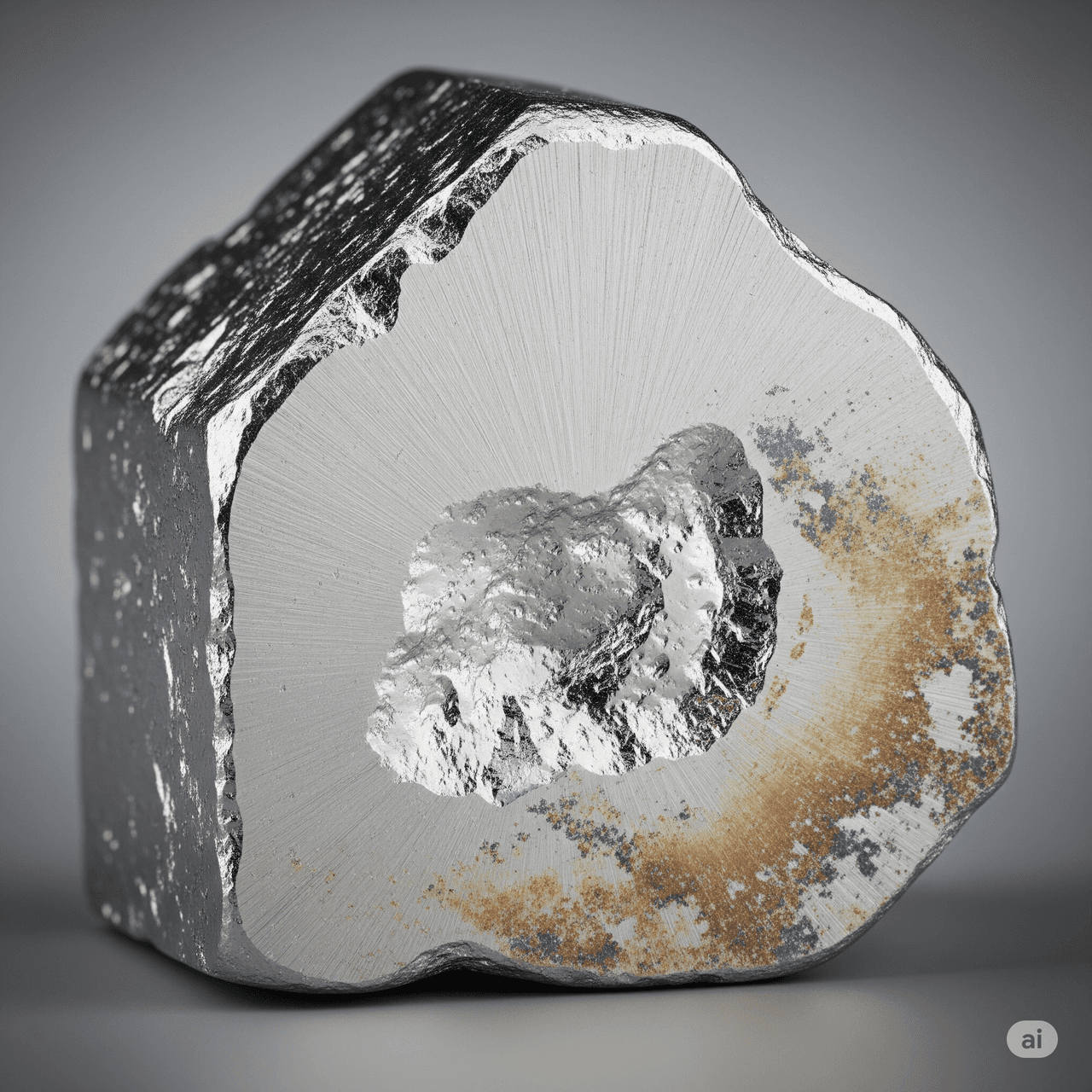
Potassium (K)
Periodic Table | 4 | ||||||||
|---|---|---|---|---|---|---|---|---|---|
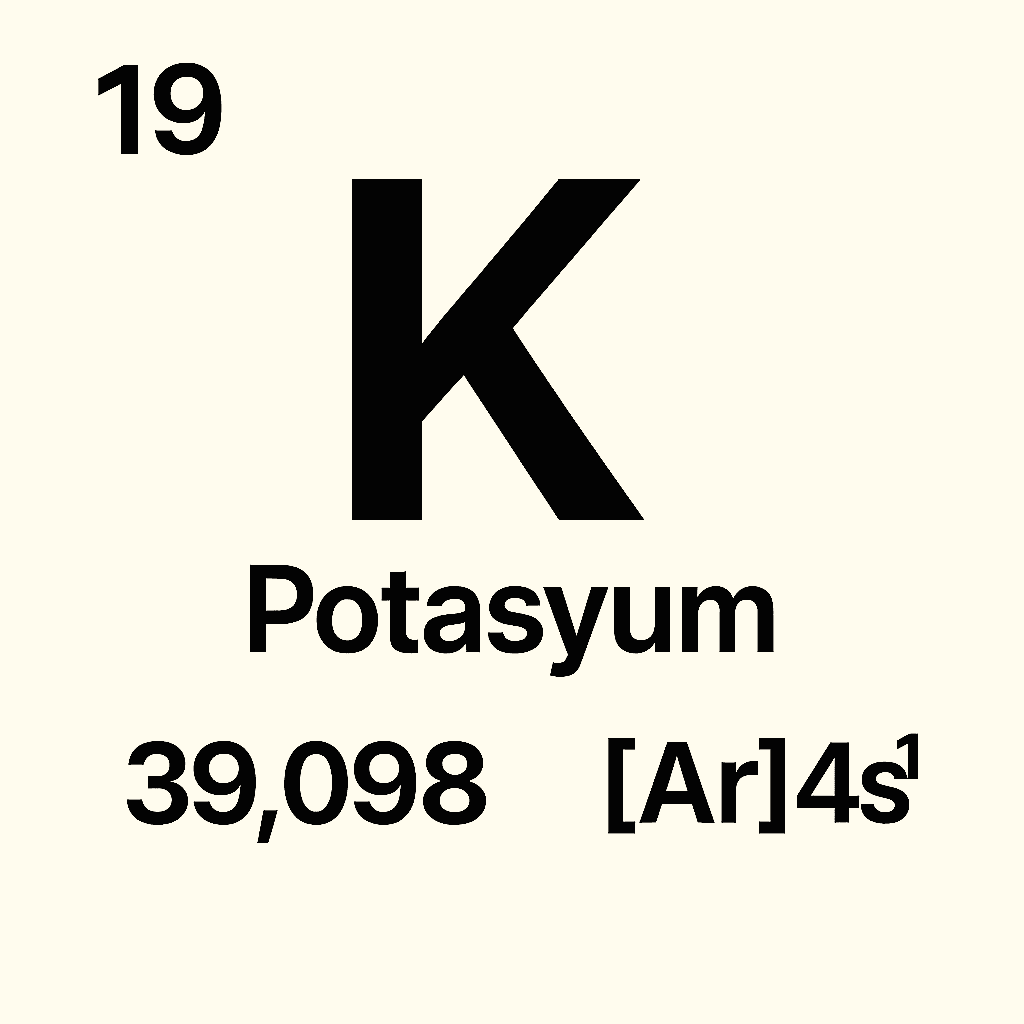
Chemical Symbol | K | ||||||||
Atomic Number | 19 | ||||||||
Group Number | 1 (Alkali Metal) | ||||||||
Electron Configuration | [Ar] 4s¹ | ||||||||
Density | 0.89 | ||||||||
Melting Point | 63.5 | ||||||||
Boiling Point | 759 | ||||||||
Atomic Radius | 2.75 Å | ||||||||
Year of Discovery(ies) | 1807 | ||||||||
Discoverer(s) | Sir Humphry Davy | ||||||||
Potassium (K) is a soft, silvery-white, highly reactive metallic element belonging to the alkali metals group, with an atomic number of 19 and the chemical symbol K. It is located in the fourth period and first group (1A) of the periodic table and is an essential element for living organisms.
Potassium is a member of the alkali metals group in the periodic table. Like other elements in this group, it has a single valence electron in its outermost electron shell. This structure causes potassium to readily lose an electron and form a +1 cation (K⁺), resulting in high chemical reactivity. This reactivity is the primary reason why potassium does not occur in nature in its elemental form but is instead found in compounds. At room temperature, potassium is a solid that is soft enough to be cut with a knife; its freshly cut surface is bright silvery-white but rapidly oxidizes and dulls upon exposure to air.
The element potassium was first isolated in 1807 by the English chemist Sir Humphry Davy. Davy achieved this discovery through the electrolysis of potash (potassium hydroxide, KOH). Electrolysis, a novel technique at the time, involves decomposing a compound into its constituent elements by passing an electric current through its molten or dissolved state. Davy successfully melted potassium hydroxide and passed a high-voltage electric current through it to obtain metallic potassium. This method was also used to discover other alkali metals such as sodium and marked a significant advancement in chemistry for isolating elements from their compounds.
Potassium Element (Generated by Artificial Intelligence.)
The name potassium derives from the English term "pot-ash," referring to potash, the residue obtained from burning wood in large pots. Historically, potash was produced from these ashes and used to extract potassium for soap making. The chemical symbol "K" comes from the Latin word "kalium," the historical name for potash. The origin of "kalium" traces back to the Arabic word "al-qalyah," meaning plant ashes.
Potassium is highly reactive chemically and reacts rapidly with oxygen. For this reason, it is typically stored under an inert atmosphere or submerged in liquids such as mineral oil. It reacts violently with water in an exothermic reaction, producing potassium hydroxide (KOH) and hydrogen gas (H₂); the heat released during this reaction can ignite the hydrogen gas, causing it to burn with a characteristic lilac-colored flame. Potassium also reacts vigorously with acids.
Potassium does not occur in nature in its elemental form but is the seventh most abundant element in the Earth's crust and is found in the structure of many minerals. As an essential nutrient for plants, potassium is absorbed directly from the soil. Consequently, plants serve as a major source of potassium. Potassium salts are also present in oceans, although their concentration is significantly lower than that of sodium salts.
Major potassium-containing minerals include sylvite (KCl), carnallite (KCl·MgCl₂·6H₂O), langbeinite (K₂Mg₂(SO₄)₃), and polyhalite (K₂Ca₂Mg(SO₄)₄·2H₂O). These minerals are commonly found in ancient seabeds and salt lakes. Industrially, potassium is typically obtained through the electrolysis of molten potassium chloride (KCl) or by thermal reduction methods.
Naturally occurring potassium has three isotopes:

Potassium (Generated by Artificial Intelligence.)
Potassium and its compounds have a wide range of applications:
National Center for Biotechnology Information. "Potassium." *PubChem Compound Database*. Accessed May 29, 2025. https://pubchem.ncbi.nlm.nih.gov/compound/5462222.
TÜBİTAK Bilim Genç. "Potasyum." *Bilim Genç*. Accessed May 29, 2025. https://bilimgenc.tubitak.gov.tr/periyodik-tablo/potasyum.

Potassium (K)
Periodic Table | 4 | ||||||||
|---|---|---|---|---|---|---|---|---|---|
Chemical Symbol | K | ||||||||
Atomic Number | 19 | ||||||||
Group Number | 1 (Alkali Metal) | ||||||||
Electron Configuration | [Ar] 4s¹ | ||||||||
Density | 0.89 | ||||||||
Melting Point | 63.5 | ||||||||
Boiling Point | 759 | ||||||||
Atomic Radius | 2.75 Å | ||||||||
Year of Discovery(ies) | 1807 | ||||||||
Discoverer(s) | Sir Humphry Davy | ||||||||
Henüz Tartışma Girilmemiştir
"Potassium (K)" maddesi için tartışma başlatın
Classification and Basic Properties
Discovery
Etiology
Physical and Chemical Properties
Occurrence in Nature and Extraction
Isotopes
Applications
Biological Importance