


The Prisoner’s Dilemma is a model in game theory that demonstrates how individuals attempting to maximize their rational self-interest can end up with worse outcomes if they fail to cooperate. Game theory aims to model the behavior of actors such as individuals, groups, and states. It helps us understand how the decisions of different actors interact with one another.
The Prisoner’s Dilemma is a significant example of this type of modeling and is frequently used in international relations. The fundamental concept of the Prisoner’s Dilemma is that two actors, even if they fully understand what the best outcome for them might be, may choose a different course of action. In other words, despite knowing the best available option, they may opt for a seemingly rational choice that ultimately leads to worse long-term consequences.

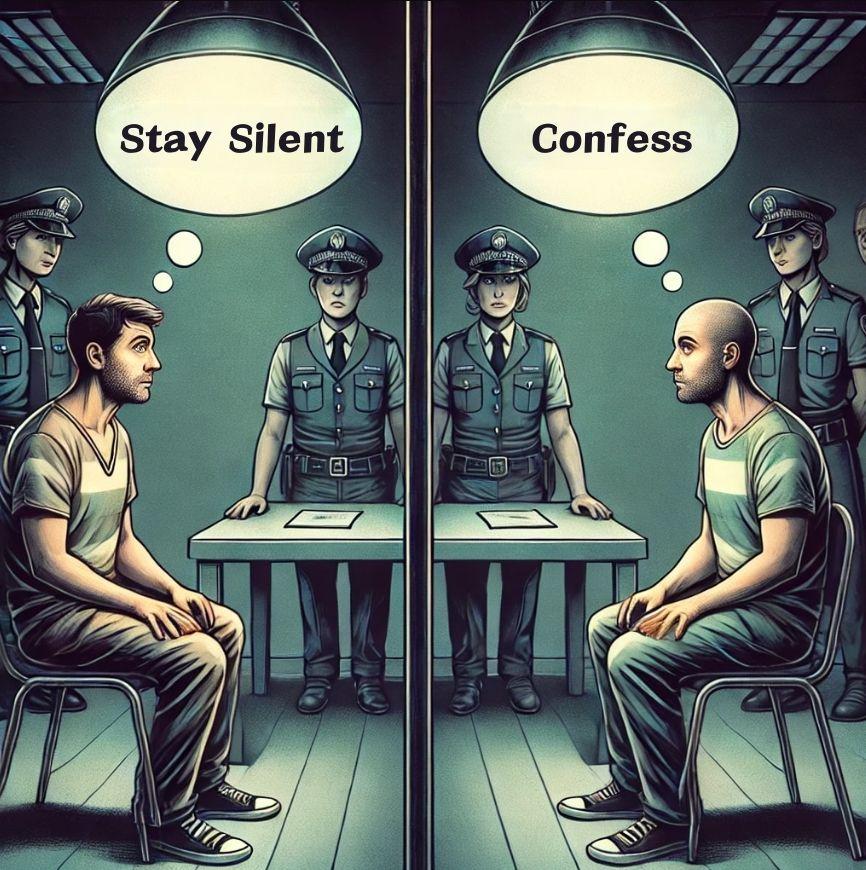
An Illustration on Prisoner's Dilemma (Source: Artificial Intelligence)
According to the story of the game, the police interrogate two suspects in separate rooms, trying to get them to confess to a crime they are believed to have committed together. The police have sufficient evidence for a smaller crime but insufficient evidence for a more serious offense. As a result, they make the following offer to the suspects:
This scenario reflects the lack of trust between the suspects, who cannot communicate or predict each other’s decisions. The best outcome for both is to remain silent, as this results in only a small penalty for the lesser crime. However, each suspect fears that the other will confess, leading them to confess themselves to avoid the worst-case scenario. As a result, both suspects confess and receive a harsher penalty.
This story illustrates how individuals (or states) can make choices that lead to worse outcomes due to mutual distrust and the lack of guaranteed cooperation, even when collaboration would yield the best results. The Prisoner’s Dilemma is a powerful metaphor used in international relations to explain the lack of cooperation in situations such as arms races, trade disputes, and climate change negotiations.

The Payoff Matrix (Source: Artificial Intelligence)
The Prisoner’s Dilemma is frequently used in international relations to explain cooperation and trust issues. This model highlights how rational actors seeking to maximize their individual gains may end up with worse outcomes due to mutual distrust and the absence of guarantees for cooperation.
The Prisoner’s Dilemma metaphor provides a valuable framework for understanding the complexities of state behavior in an anarchic international system. It emphasizes the importance of building trust, enhancing transparency, and developing institutional mechanisms to facilitate cooperation.
Reinelt, Janelle, and Gerald Hewitt. "The Prisoner's Dilemma: Game Theory, Conflict Resolution, and the New Europe." Contemporary Theatre Review 13, no. 2 (2003): 41–55.
Özdamar, Özgür. "Oyun Kuramının Uluslararası İlişkiler Yazınına Katkıları." Uluslararası İlişkiler/International Relations (2007): 33–65.
Marks, M. P. "The Prison as Metaphor: Recasting the ‘Dilemma’ of International Relations." Alternatives 26, no. 3 (2001): 349–371.

Henüz Tartışma Girilmemiştir
"Prisoner's Dilemma" maddesi için tartışma başlatın
The Story of the Game
The Payoff Matrix
Explanations:
Stay Silent / Stay Silent (-1, -1):
Stay Silent / Confess (-10, 0):
Confess / Stay Silent (0, -10):
Confess / Confess (-5, -5):
The Prisoner’s Dilemma Metaphor in International Relations
Key Elements of the Prisoner’s Dilemma in International Relations:
Examples of the Prisoner’s Dilemma in Practice:
Arms Control Agreements:
Trade Negotiations:
Climate Change Initiatives:
Bu madde yapay zeka desteği ile üretilmiştir.