

Bu içerik Türkçe olarak yazılmış olup yapay zeka ile otomatik olarak İngilizceye çevrilmiştir.
+2 Daha
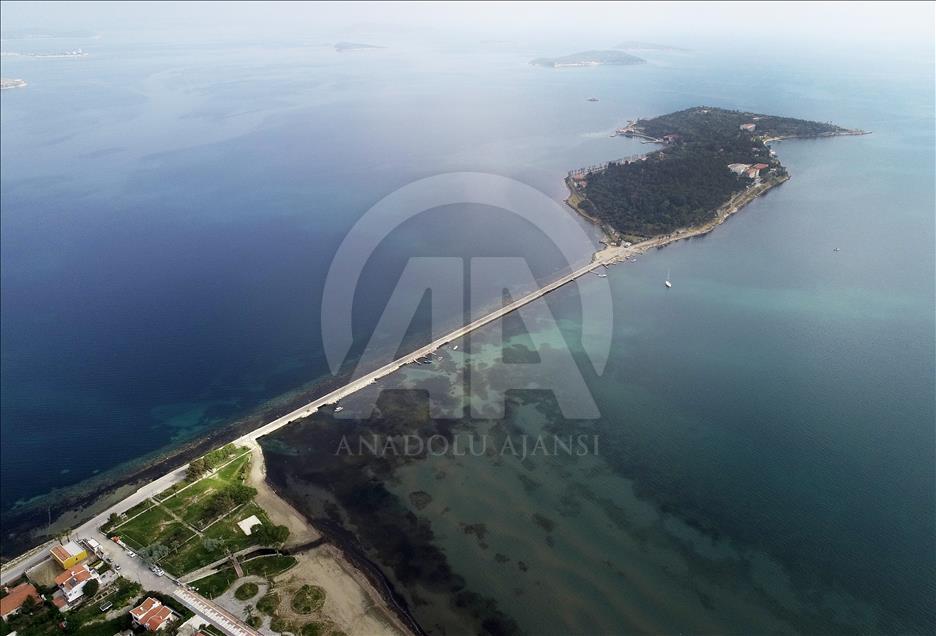
Quarantine Island is an island located off the coast of the Urla district of İzmir, exhibiting historical continuity as part of the ancient Klazomenai settlement. The island possesses a multi-layered cultural landscape characterized by archaeological remains from antiquity as well as quarantine buildings constructed in the 19th century. Today it is managed by institutions and protection units under the Ministry of Health.

Quarantine Island (Anadolu Agency)
Quarantine Island has been part of settlement and production activities since antiquity, assuming different functions across various periods. Architectural remains from the Hellenistic and Roman periods indicate that the island was inhabited during these eras. From the second half of the 18th century onward, the island began to be used for quarantine purposes in response to epidemic diseases, and this function continued in subsequent periods through the construction of health facilities.
The island contains various structures dating to the Hellenistic and Roman periods. References to a theater in ancient sources led modern excavations to focus intensively on the northern section. During the 2011–2013 excavations, the skeletal plan of a Hellenistic theater, an open-air sacred area, and numerous terracotta figurines were uncovered. The figurines include depictions of men and women, mythological figures, theatrical masks, animal forms, and miniature altars.【1】
Excavation periods:
In addition, foundations of structures believed to have been temples, sacred areas assessed as having served as holy springs, remains of Roman villas, and traces of ceramic kilns have also been identified.【2】

Urla Quarantine Building (Anadolu Agency)
In the 19th century, increasing maritime trade elevated the risk of infectious disease, prompting the Ottoman State to establish a quarantine organization to monitor health boundaries. The Klazomenai-Urla quarantine facility, constructed between 1866 and 1869 in İzmir, served to isolate passengers disembarked from infected ships, treat patients, and disinfect goods.
The quarantine facilities continued to be used for health services during the Republic of Türkiye period. As quarantine practices lost global significance, the island was repurposed in the 1950s as the Institute of Sea and Sun, in the 1960s as the Hospital for Bone and Joint Diseases, and after 1986 as Urla State Hospital. It is also noted that recreational facilities and some educational units under the Ministry of Health were located on the island.【3】
The buildings constructed for quarantine purposes on the island are situated on a topography formed by the convergence of two elevations. Groups of structures were divided according to their functions. Today, 20 registered and protected buildings remain on the island. These structures served quarantine, treatment, and disinfection functions. The design of the buildings reflects the influence of French architects and the use of European materials.【4】

Urla Quarantine Building Shower Area (Anadolu Agency)
The island has been known by different names in different periods. In antiquity it was called “Marathousa,” and during the Ottoman period it was known as “Yolluca.” From 1869 onward, it began to be referred to as “Quarantine Island.”
Aksu, Murat, and İbrahim Başağaoğlu. “İzmir Urla-Klazomenai Karantina Teşkilatı.” *Mersin Üniversitesi Tıp Fakültesi Lokman Hekim Tıp Tarihi ve Folklorik Tıp Dergisi* (Supplement) (September 2013): 30–31. Accessed January 25, 2026. https://dergipark.org.tr/tr/pub/mutftd/article/590031
Anadolu Ajansı. “Anadolu’nun Sağlık Kapısı: Urla Tahaffuzhanesi.” March 29, 2020. Accessed January 25, 2026. https://www.aa.com.tr/tr/kultur-sanat/anadolunun-saglik-kapisi-urla-tahaffuzhanesi/1783898
Anadolu Ajansı. “İzmir Urla Karantina Adası güzel görüntüler oluşturdu.” Foto Galeri, April 20, 2018. Accessed January 25, 2026. https://www.aa.com.tr/tr/pg/foto-galeri/izmir-urla-karantina-adasi-guzel-goruntuler-olusturdu/147#!
Cebe, Mehmet. “Urla Karantina Adası Tesisleri Mekansal Analizi.” Dicle ÜniversitesiAçık Erişim, 2021. Accessed January 25, 2026. https://acikerisim.dicle.edu.tr/items/187fe595-5484-480c-86a1-6e349bd3b8fe
Gündüz, Lemye. *İzmir-Urla, Karantina Adası’ndaki Osmanlı Dönemi Yapıları*. Master's thesis, Ege Üniversitesi, 2023. Accessed January 25, 2026. https://acikerisim.ege.edu.tr/items/be5f919c-3e84-46ed-8110-08d29df9bbf9
Koparal, Elif. *Urla Karantina Adası: Arkeolojik ve Tarihsel Peyzaj Çalışması*. Bilimsel Araştırma Projeleri (BAP) raporu, Mimar Sinan Güzel Sanatlar Üniversitesi, 2022. Accessed January 25, 2026. https://acikerisim.msgsu.edu.tr/xmlui/handle/20.500.14124/5715
Özbay, Fikret, and Aslıhan Özbay. “Karantina Adası Kuzey Yamacı Kazıları Stratigrafik Değerlendirmesi ve Hellenistik Dönem Pişmiş Toprak Figürinler.” *Seleucia* no. 7 (January 2017): 197–224. Accessed January 25, 2026. https://dergipark.org.tr/tr/pub/seleucia/article/751488
[1]
Fikret Özbay ve Aslıhan Özbay, “Karantina Adası Kuzey Yamacı Kazıları Stratigrafik Değerlendirmesi ve Hellenistik Dönem Pişmiş Toprak Figürinler,”Seleucia 7 (Ocak 2017): 197–224, Erişim tarihi: 25 Ocak 2026, https://dergipark.org.tr/tr/pub/seleucia/article/751488
[2]
Elif Koparal, Urla Karantina Adası: Arkeolojik ve Tarihsel Peyzaj Çalışması (Bilimsel Araştırma Projeleri Raporu, Mimar Sinan Güzel Sanatlar Üniversitesi, 2022), Erişim tarihi: 25 Ocak 2026, https://acikerisim.msgsu.edu.tr/xmlui/handle/20.500.14124/5715
[3]
Murat Aksu ve İbrahim Başağaoğlu, “İzmir Urla-Klazomenai Karantina Teşkilatı,”Mersin Üniversitesi Tıp Fakültesi Lokman Hekim Tıp Tarihi ve Folklorik Tıp Dergisi, Supplement (Eylül 2013): 30–31, Erişim tarihi: 25 Ocak 2026, https://dergipark.org.tr/tr/pub/mutftd/article/590031
[4]
Mehmet Cebe, “Urla Karantina Adası Tesisleri Mekânsal Analizi,” Turkish Studies (Elektronik) 16, no, 4 (2021): 1207–1210, Erişim tarihi: 25 Ocak 2026, https://acikerisim.dicle.edu.tr/items/187fe595-5484-480c-86a1-6e349bd3b8fe

Henüz Tartışma Girilmemiştir
"Quarantine Island" maddesi için tartışma başlatın
History
Antique Period Remains
Quarantine Facility in the Ottoman Period
Usage During the Republican Period
Architectural Structures and Settlement Layout
Origin and Historical Names of the Island