


Bu içerik Türkçe olarak yazılmış olup yapay zeka ile otomatik olarak İngilizceye çevrilmiştir.
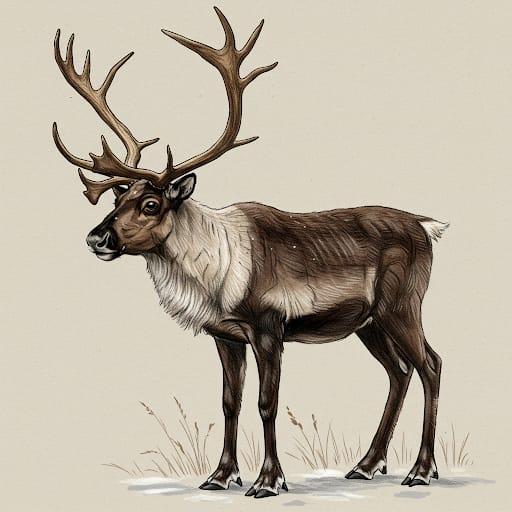
Reindeer is a species of deer that inhabits the Arctic regions of northern Europe, Siberia and northern North America. In North America it is also known as caribou. Reindeer populations vary in herd size depending on the region and have numerous subspecies with names specific to their geographic ranges. The Labrador reindeer, Porcupine reindeer, Finnish forest reindeer and Svalbard reindeer like are still extant, bringing the total number of subspecies to 14 including two that have gone extinct.
Reindeer are distributed across the entire Arctic circle and their size varies according to their habitat, with many distinct subspecies. Females typically range in length from 162 to 205 cm and weigh between 80 and 120 kg. Males are larger than females, measuring 180 to 214 cm in length and weighing 159 to 182 kg. When standing on all four foot legs, their shoulder height ranges from 85 to 150 cm. The Svalbard reindeer, with a shoulder height of up to 80 cm, is the smallest of all subspecies in terms of body measurements.
The coat color of reindeer varies by subspecies and can be brown, gray, dark gray or white. Northern populations, which are relatively small, tend to be whiter, while larger southern populations are darker. The most extreme examples are the Peary reindeer (Rangifer tarandus pearyi), the smallest and whitest subspecies living in the far north of North America, and the boreal reindeer, the darkest colorful and largest subspecies found in the south. Reindeer also exhibit a countercurrent heat exchange mechanism, common in other polar animals. Unlike birds, foxes and hares, in reindeer this mechanism occurs not only in the limbs but also nose internally. Countercurrent heat exchange involves warming cold blood returning from body parts exposed to cold air with warm blood flowing from the heart, essentially preventing cold blood from reaching the animal’s core.
The hooves of reindeer undergo seasonal changes that help them survive harsh polar conditions. During months when the tundra is soft and muddy, the soles become spongy building to provide extra grip on the ground. In winter, the hooves contract and harden, exposing rigid edges that prevent slipping on ice and snow. These hard structures also enable them to dig through the snow layer to reach their favorite food, reindeer lichen (Cladonia rangiferina).
Another distinctive feature of the reindeer is the clicking sound produced by tendons sliding over bones in the knees while walking. This sound can be heard hundreds of meters away. This form of nonvocal communication, rare among mammals, serves as an indicator of body size among deer species and is carefully listened to by other reindeer.
One of the most notable features that make the reindeer one of the most popular Arctic animals is its large and striking antlers. It is the only species in the deer family in which both males and females grow antlers. As one moves northward, antler size decreases, but the reindeer still possesses the largest antlers among all deer species after the moose (Alces alces). In males of the largest subspecies, antlers can reach widths of up to 100 cm and lengths of up to 135 cm. These same subspecies also have the largest antlers relative to body size. Information about the availability of food resources and climatic conditions in the reindeer’s habitat can be inferred from the size of its antlers. Reindeer antlers are shed and regrown annually. Antler growth occurs in males during March or April months and in females during May or June months. Indigenous peoples living in the Arctic region hold the reindeer in high cultural regard. For example, the Inuit named the months of their calendar after phases of the reindeer’s life cycle. The term “Amiraijaut,” used for a specific September month, refers to the time when the velvet covering on the antlers is shed.
Reindeer are ruminants with a four-chambered stomach. During winter months, their primary food source is lichen. Thanks to specialized bacteria and enzymes, they are the only large mammal capable of digesting lichen, converting it into glucose through the secretion of lichenase. In summer, they also consume tree leaves, flowering tundra plants, sedges and mushrooms.
Reindeer mate between late September and November. Gestation lasts approximately 228 to 234 day days. During the mating season, males use their antlers to compete with other males. Two males lock antlers and push against each other. The dominant male may mate with 15 to 20 females. Females seek isolated coastal areas or islands in lakes to give birth away from predators. Typically, only one calf is born at a time. The average weight of a newborn calf is only 6 kg. The calf begins to walk within two hour after birth, starts grazing within 45 days but continues to nurse for 3 to 4 moon. While some subspecies undertake seasonal migrations in herds, others such as the boreal forest reindeer are sedentary. In contrast, the forest reindeer of Labrador travels greater distances than any other mammal, covering up to 5000 km annually. Whether or not a population migrates and the distance traveled depend on the region. Under normal conditions, reindeer can travel 19 to 55 km per day during migration and reach speeds of 60 to 80 km per hour. Reindeer are also strong swimmers and do not hesitate to cross lakes or rivers encountered during migration.
Natural predators such as the golden eagle, gray wolf, Arctic wolf, brown bear and polar bear mean that reindeer populations are directly proportional to the numbers of these predators. Due to a population decline of approximately 40 percent over the past 25 years, the International Union for Conservation of Nature has classified the reindeer as “vulnerable” on its Red List.

Henüz Tartışma Girilmemiştir
"Reindeer (Rangifer tarandus)" maddesi için tartışma başlatın
Physical Characteristics
Diet
Reproduction