


Bu içerik Türkçe olarak yazılmış olup yapay zeka ile otomatik olarak İngilizceye çevrilmiştir.
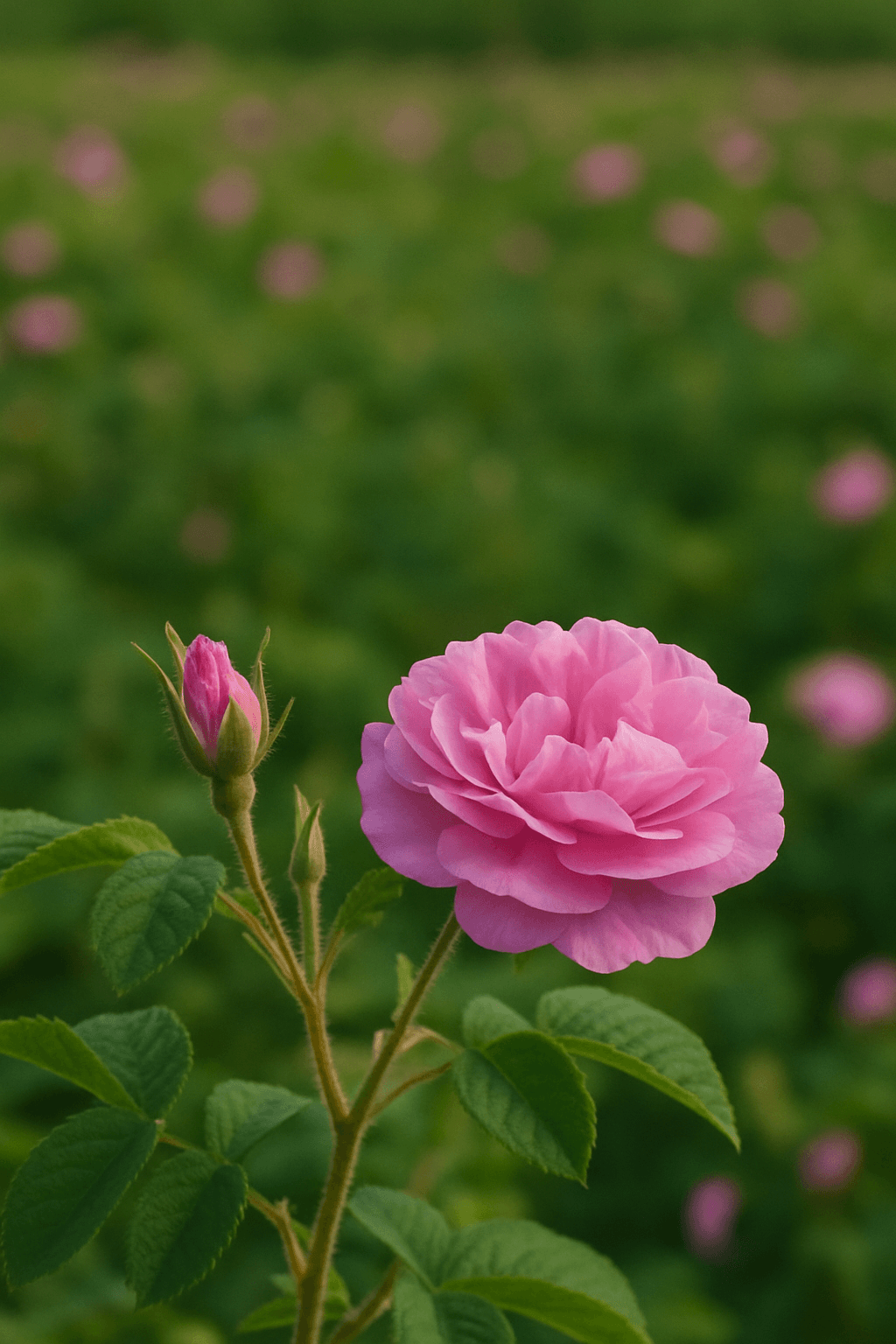
Generated with artificial intelligence.
Rose Oil (Rosa damascena)
Scientific Name(s) | Rosa damascena Mill | ||||||||
|---|---|---|---|---|---|---|---|---|---|
Family | Rosaceae | ||||||||
Native Country | Türkiye | ||||||||
Area(s) of Use | Perfume food medicine cosmetic | ||||||||
Production Center | Isparta, Türkiye | ||||||||
One of the most valuable sources of essential oils in the world, the oil rose (Rosa damascena Mill.) is a plant species notable for both its economic value and cultural significance. Due to its intense aromatic fragrance, it is widely used in the perfumery, cosmetic, food, and pharmaceutical industries. Türkiye, particularly the Lake Region centered in Isparta, holds a global leading position in the cultivation of this plant and the production of rose oil.
The oil rose is a species belonging to the family Rosaceae and the genus Rosa. It is regarded as a natural hybrid of Rosa gallica and Rosa phoenicia, both native to Türkiye’s flora. Rosa damascena is characterized by its pink flowers and shrubby, upright growth habit. Although it can be propagated by seed, it is predominantly propagated through root suckers and cuttings.
Rosa damascena is primarily cultivated in Türkiye, especially in the regions surrounding Isparta, Burdur, Afyon, Denizli, Konya, and Antalya. Limited production also occurs in other countries worldwide, including Bulgaria, Iran, India, and Morocco.
Türkiye’s total production of oil rose, which amounted to approximately 4,870 tons in 1980, reached 10,000 tons by 2009. About 84 percent of Türkiye’s production comes from Isparta. From Rosa damascena, four primary products are obtained: rose oil, rose concrete, rose absolute, and rose water. These products serve as key raw materials for the perfume and cosmetic industries.
Nearly all rose oil produced in Türkiye is exported. The majority of exports go to France, Germany, the United States, and Switzerland. As of 2010, Türkiye achieved rose oil exports worth approximately 10.4 million US dollars. Marketing of these products is largely conducted through GÜLBİRLİK and the private sector.
Due to the limitations of traditional propagation methods (seed, cutting, root sucker), in vitro micropropagation techniques have gained prominence. This method enables the production of large numbers of plant individuals throughout the year. In Rosa damascena, key factors influencing success in micropropagation include explant selection, type of culture medium, hormone combinations, and physical structure of the culture environment.
Terpenoid compounds derived from Rosa damascena—such as citronellol, linalool, and geraniol—possess high economic value. Although the production of these metabolites in callus cultures derived from petal tissues is limited, their yield can be increased using bioreactor systems.
Tissue culture offers potential in breeding through applications such as the production of disease-free plants, protoplast fusion, and the conservation of genetic diversity. However, research in this area for Rosa damascena remains limited. Techniques such as hybridization and protoplast fusion have only been tested in specific experimental trials.
Dilmen, R., and N. G. Baydar. 2016. “Yağ Gülü (Rosa damascena Mill.)’nde Doku Kültürü Uygulamaları.” Süleyman Demirel Üniversitesi Ziraat Fakültesi Dergisi 11, no. 2: 134–141. Accessed August 9, 2025. https://dergipark.org.tr/en/download/article-file/308629.
Örmeci Kart, M. Ç., M. İkiz, and V. Demircan. 2012. “Türkiye’de Yağ Gülü (Rosa damascena) Üretimi ve Ticaretinin Gelişimi.” Süleyman Demirel Üniversitesi Ziraat Fakültesi Dergisi 7 (1): 124–134. Accessed August 9, 2025. https://dergipark.org.tr/en/download/article-file/308738.

Generated with artificial intelligence.
Rose Oil (Rosa damascena)
Scientific Name(s) | Rosa damascena Mill | ||||||||
|---|---|---|---|---|---|---|---|---|---|
Family | Rosaceae | ||||||||
Native Country | Türkiye | ||||||||
Area(s) of Use | Perfume food medicine cosmetic | ||||||||
Production Center | Isparta, Türkiye | ||||||||
Henüz Tartışma Girilmemiştir
"Rose Oil (Rosa damascena)" maddesi için tartışma başlatın
Botanical Characteristics
Taxonomic Classification
Geographical Distribution
Production and Economic Importance
Rose Oil Production in Türkiye
Trade and Export
Tissue Culture Applications
Micropropagation Techniques
Secondary Metabolite Production
Breeding Studies