


Bu içerik Türkçe olarak yazılmış olup yapay zeka ile otomatik olarak İngilizceye çevrilmiştir.
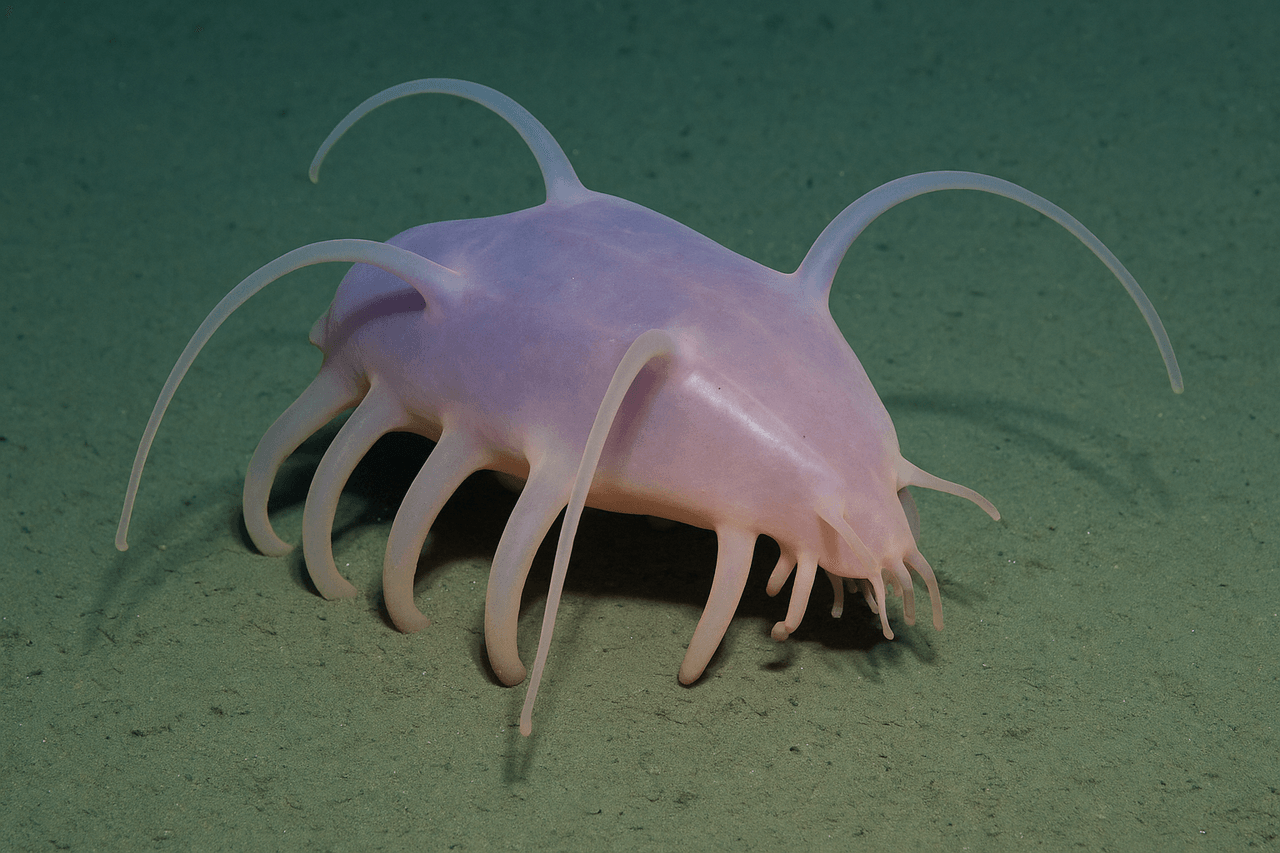
Sea pig (Scotoplanes globosa) is a spineless animal belonging to the class Holothuroidea, commonly known as sea cucumbers, that lives on the deep ocean floor. Although known as the “sea pig,” this name derives solely from its appearance and indicates no biological relationship to pigs. This creature typically has a pink, translucent, and soft body and uses modified tube feet to walk. It primarily inhabits depths between 1000 and 6000 meters and feeds on organic matter on the ocean floor. In scientific research, it is also regarded as an indicator species for the health of deep-sea ecosystems.
The most recognizable feature of Scotoplanes globosa is its pig-like appearance. Its body is soft and gelatinous, which helps it adapt to the high pressure of the deep-sea environment. Its average length ranges from 5 to 15 centimeters, though some individuals can exceed 20 centimeters. Due to its translucent skin, internal organs are partially visible from the outside. This characteristic provides a significant advantage for physiological studies by scientists.
Using its tube feet, this animal “walks” along the ocean floor and can also use certain protrusions on its back to orient itself. These protrusions function like antennae, helping it detect environmental signals. Its skin and muscle structure allow oxygen to be absorbed directly through diffusion. Although Scotoplanes has a simple digestive system, it is well adapted to break down detritus (organic waste). Additionally, these animals possess mild electroreceptive senses, enabling them to detect movement in their immediate surroundings.
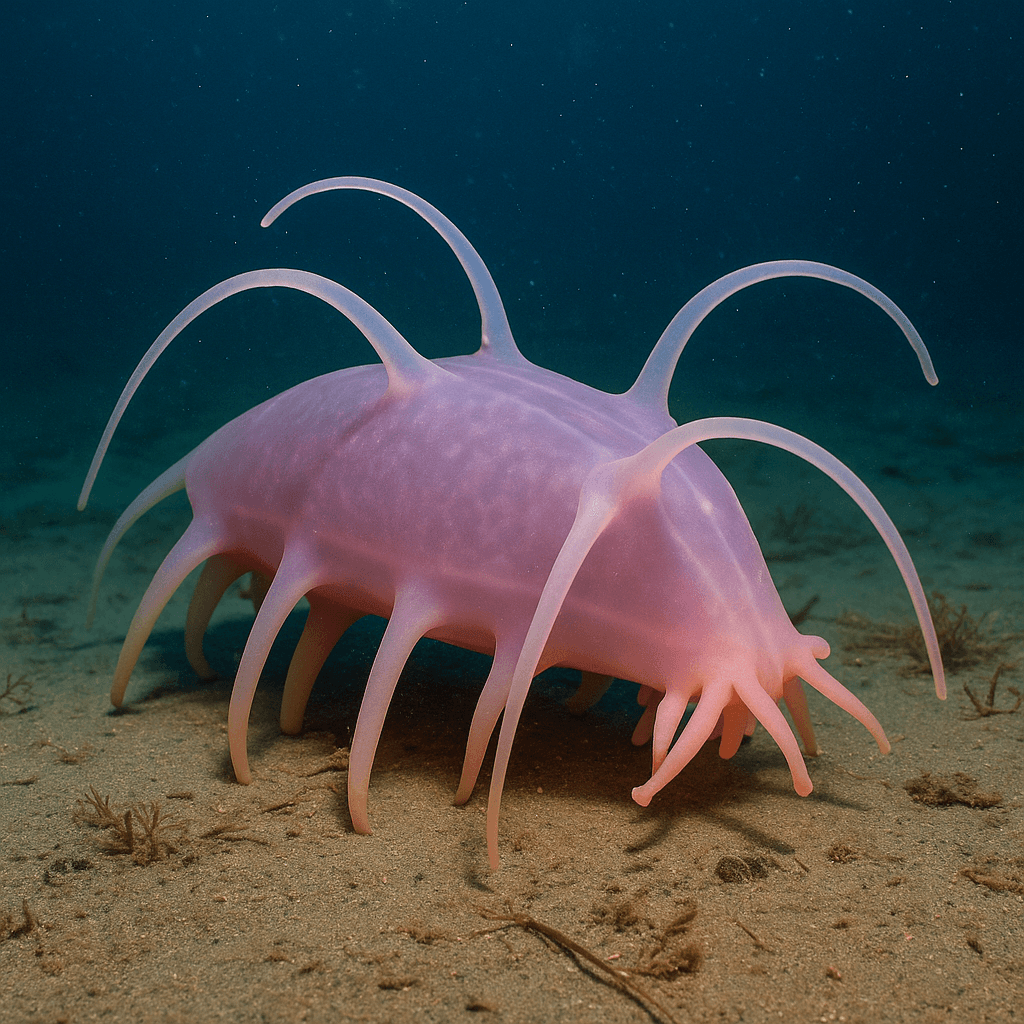
Sea pig (generated with the help of artificial intelligence)
Scotoplanes globosa typically inhabits the deep ocean floor below 1000 meters in the Pacific and Atlantic Oceans. The most frequently observed regions include the Gulf of California, waters off Japan, and the Peru Trench. Its habitat consists of completely dark, cold, and high-pressure environments, with average temperatures ranging from 2 to 4°C.
Sea pigs concentrate in areas with muddy, organic-rich sediments. These regions are known as biological hotspots where dead plankton and animal remains accumulate. The benthic zones of the oceans provide Scotoplanes with both food and a safe living environment. They commonly share their habitat with other slow-moving or stationary organisms.
This species has frequently been encountered in deep-sea scientific research. It is distinctly identifiable in images captured by remotely operated underwater vehicles (ROVs) and deep-sea cameras. It is also commonly found in micro-ecosystems formed by the sinking of large whale carcasses, known as “whale falls.”
Although Scotoplanes globosa is primarily a solitary species, it can exhibit schooling behavior under certain conditions. In areas with concentrated food sources, hundreds of individuals may gather. These aggregations are often associated with feeding or reproductive periods. When moving in groups, they arrange themselves in a pattern that minimizes physical contact with one another.
These animals are highly sensitive to environmental vibrations. When they sense danger, they become motionless to blend into their surroundings or slowly retreat. This behavior protects them from predators. Aside from passive defense mechanisms, they have no active predatory strategies. Social interactions occur primarily through chemical signals rather than physical contact.
A critical behavior of sea pigs relates to orientation. Thanks to nerve extensions on their tube feet, they can determine direction and navigate effectively even in complete darkness. They have developed chemotactic tracking abilities, which aid in locating food sources. Additionally, minimal chemical signaling among group members helps coordinate collective movement.
Scotoplanes globosa has a detritivorous feeding strategy, consuming remains of dead organisms, plankton, and organic mud. These organic materials, which settle on the ocean floor, constitute its primary food source. Consequently, sea pigs play a vital recycling role in ocean ecosystems.
Their tube feet and sensory structures around the mouth are functional in detecting food locations. These structures enable them to identify organic particles within the sediment and direct them toward their mouths. Their digestive system collaborates with specialized bacteria capable of efficiently breaking down low-energy food sources. These symbiotic microorganisms facilitate digestion.
During foraging, they move continuously but at a very slow pace. When organic matter in an area is depleted, they migrate a few meters to a new location. This behavior also contributes to the redistribution of seafloor sediments. Thus, they function both as consumers and ecological engineers.
Knowledge about the reproductive biology of Scotoplanes globosa remains limited, but observations indicate that it reproduces sexually. Females lay eggs on the ocean floor, where the eggs complete their development in the external environment. Temporary egg-carrying behavior has also been observed in some individuals.
Larvae hatching from the eggs undergo a planktonic phase, drifting freely in the water column before sinking to the ocean floor after several weeks. Survival rates during this stage are very low due to vulnerability to predators. Consequently, laying large numbers of eggs is an adaptive strategy.
It can take years for individuals to reach sexual maturity, and their growth rate is slow—a common trait among deep-sea organisms. Reproductive periods vary depending on environmental factors, particularly the abundance of organic matter. In some cases, individuals congregating around whale carcasses have been observed to reproduce simultaneously.
Sea pigs are not directly targeted by fishing, but they are indirectly affected by human activities. The greatest threat comes from deep-sea mining and oil and gas drilling operations. These activities destroy seafloor habitats and eliminate the living environments of species like Scotoplanes.
The second major threat is microplastics reaching the ocean floor. Sea pigs may mistakenly consume these particles as food, leading to blockages in their digestive systems and potential mortality. Additionally, climate change and ocean acidification negatively impact their habitat by altering temperature and pH levels.
Conservation efforts are currently very limited, primarily due to insufficient knowledge about the species. However, in recent years, populations of this species have begun to be monitored in certain marine reserves, and habitat protection policies are under discussion. International agreements have also been proposed to regulate deep-sea mining activities.
Scotoplanes globosa has no direct economic impact on humans. However, its use in scientific research as an indicator of deep-sea ecosystem health has made it an indirectly significant species. The presence or absence of these animals provides important data for analyzing living conditions on the seafloor.
Beyond research-oriented relationships, the genetic material and adaptive physiology of this species hold potential for biotechnology. Traits such as resistance to high pressure may have future applications in medical or industrial contexts.

Henüz Tartışma Girilmemiştir
"Sea Pig (Scotoplanes globosa)" maddesi için tartışma başlatın
Physical Characteristics
Habitat and Distribution
Behavior and Social Structure
Feeding Habits
Reproduction and Larvae
Threats and Conservation Efforts
Relationships with Humans