

Bu içerik Türkçe olarak yazılmış olup yapay zeka ile otomatik olarak İngilizceye çevrilmiştir.
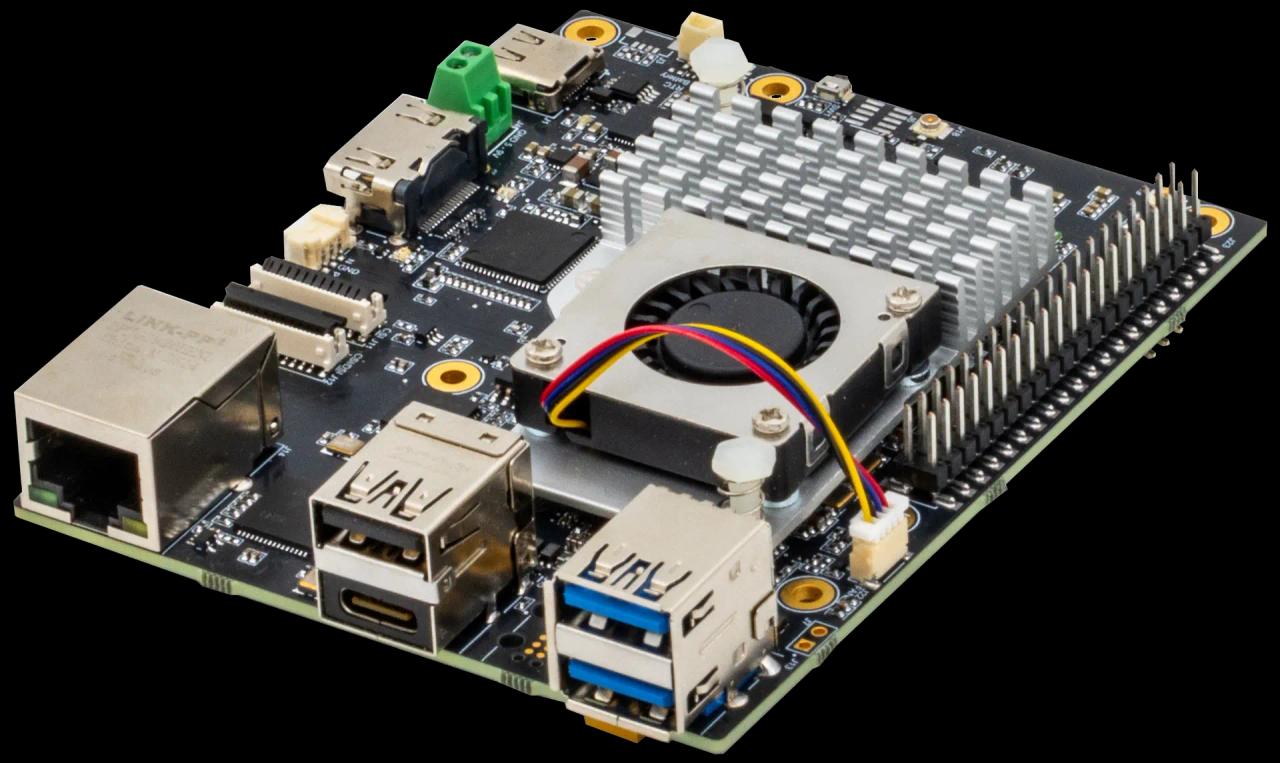
T3 Gemstone is a family of development boards in the single-board computer class, designed for embedded system development projects. The first development board in the family is identified by the code T3 GEM O1 and is named “Obsidian.” The term “Gemstone” is the product family name, and each product is given a name inspired by precious stones.
The T3 GEM O1 is based on the Texas Instruments AM67A processor. The board features a quad-core 64-bit ARM Cortex-A53 processor cluster designed to run high-level operating systems such as Linux. For real-time tasks, two ARM Cortex-R5F cores are included. For artificial intelligence workloads, two 2 TOPS accelerators provide a total of 4 TOPS of deep learning acceleration capacity. On the graphics side, 50 GFLOPS of computational power is provided, with support targeted for OpenGL ES 3.2, OpenCL 1.2 EP, and Vulkan 1.2 APIs.
In the microprocessor architecture, the Cortex-A53 cores serve as application processors while the Cortex-R5 cores assume the role of MCUs. The AM67A model also includes a C7x DSP component.

GemStone (T3Gemstone)
The board includes 4 GB of LPDDR4 system memory. For built-in storage, a 32 GB eMMC is used, enabling the board to operate without requiring a microSD card. For configuration purposes, a 512 Kbit serial EEPROM compatible with I2C is included. For expandable storage, the board features a microSD card slot supporting SDR104 mode and native support for M.2 2280 NVMe SSDs.
The wireless connectivity module is the TI WL1835MOD, providing Wi-Fi 4 802.11n support with two external 2.4 GHz antenna connections, as well as Bluetooth 5.1 and BLE support. On the wired side, Gigabit Ethernet is available via an RJ45 port. For automotive-class use cases, a CAN FD transceiver is integrated on the board.
The board includes two USB 3.0 Type-A ports, one USB 2.0 Type-A port, one USB 2.0 Type-C port, and one USB 2.0 Type-C port supporting device mode with Power Delivery. For video and display connectivity, two 4-lane MIPI CSI camera interfaces and one 4-lane MIPI DSI interface are provided. Full-size HDMI output enables external display connection. The DSI lane is multiplexed, allowing configuration choices between dual CSI or one CSI with one DSI. For expansion, a 40-pin GPIO header is provided with a pinout compatible with the Raspberry Pi layout. For debugging, an ARM Cortex 10-pin JTAG connector and a 3-pin UART connector for serial console access are included.
The board integrates the InvenSense ICM-20948 sensor for 9-axis motion tracking. For environmental sensing, a 24-bit barometric pressure sensor, the Bosch BMP390, and the TI HDC2010 for humidity and temperature measurement are included.
Power input is provided via USB Type-C at 5 V to 9 V with a current capacity of 3 A, with USB Power Delivery designated as the primary input. An alternative input is a 5 V to 12 V DC power connector rated for 5 A. For system control, a boot mode switch, power button, programmable button, and red and green status LEDs are provided.
The T3 Gemstone project presents both hardware and software components using an open-source approach. The goal is to enable the redesign of the hardware from its electronic schematics and the reuse or modification of software components.
Three distinct operating system images are prepared for the Gemstone development board: a desktop image containing desktop components, a minimal image targeted at IoT and embedded projects that do not require a graphical interface, and a third image for specialized use cases. The minimal image includes pre-installed drivers for serial port, CAN Bus, and Ethernet, and is intended for headless applications. During desktop image installation, the Gemstone Imager presents Desktop, Kiosk, and Minimal options under Ubuntu or Debian images. By default, Ubuntu 22.04 is the recommended SDK option, with Debian 11, Debian 12, and Pardus 23 images also supported based on user requirements.
Gemstone Imager is an image writing application developed for selecting, downloading, customizing, and writing Gemstone images to an SD card or the board’s built-in storage device. It operates on Linux, Windows, and macOS. After selecting the board, operating system, and storage options in the Imager, the OS Customisation menu opens, allowing system customization through General, Services, and Options tabs. The board can boot from either an SD card or the onboard eMMC. Using the Internal eMMC option in the Imager, the operating system, firmware, and bootloader can be written directly to the eMMC.
Within discussions in the Pardus community, the integration of Pardus into the SDK and the process of writing the operating system to microSD cards, M.2 SSDs, or eMMC via GemImager are addressed within the same installation workflow.
For AI workloads on the board, sample application collections are provided using a GStreamer-based approach, offering ready solutions for image processing, object detection, and streaming tasks. Example execution flows are provided in both Python and C++.
The T3 Gemstone ecosystem is designed for embedded technology projects that integrate sensors and environmental devices. Data from sensors and cameras can be collected and processed via communication channels such as serial port, CAN Bus, I2C, SPI, and Ethernet to create control systems for motors and actuators.
Target application areas include:
Guides are available for running ArduPilot on the T3 Gemstone O1. The roadmap lists objectives and status updates for running components such as NuttX, PX4, Buildroot, and Phoenix RTOS on the board’s cores.
T3 Gemstone Project. "Gemstone Development Boards and Software Ecosystem (t3gemstone)." GitHub. Accessed January 27, 2026. https://github.com/t3gemstone
T3 Gemstone. “Açık Kaynak Dünyasının Yeni Cevheri.” T3 Gemstone. Accessed January 27, 2026. https://t3gemstone.org/tr
Turkish Technology Team Gemstone. “Geliştirme.” T3 Gemstone Geliştirme Kartı Dokümantasyonu. Accessed January 27, 2026. https://docs.t3gemstone.org/tr/development

Henüz Tartışma Girilmemiştir
"T3 Gemstone" maddesi için tartışma başlatın
Basic Hardware Architecture
Memory and Storage
Networking and Communication
USB, Camera, Display, and Expansion Interfaces
Built-in Sensors, Power, and System Control
Software Ecosystem and Development
Operating System Images
Installation and Customization with Gemstone Imager
Artificial Intelligence and Image Processing Work
Purpose and Application Areas