


Bu içerik Türkçe olarak yazılmış olup yapay zeka ile otomatik olarak İngilizceye çevrilmiştir.
+2 Daha
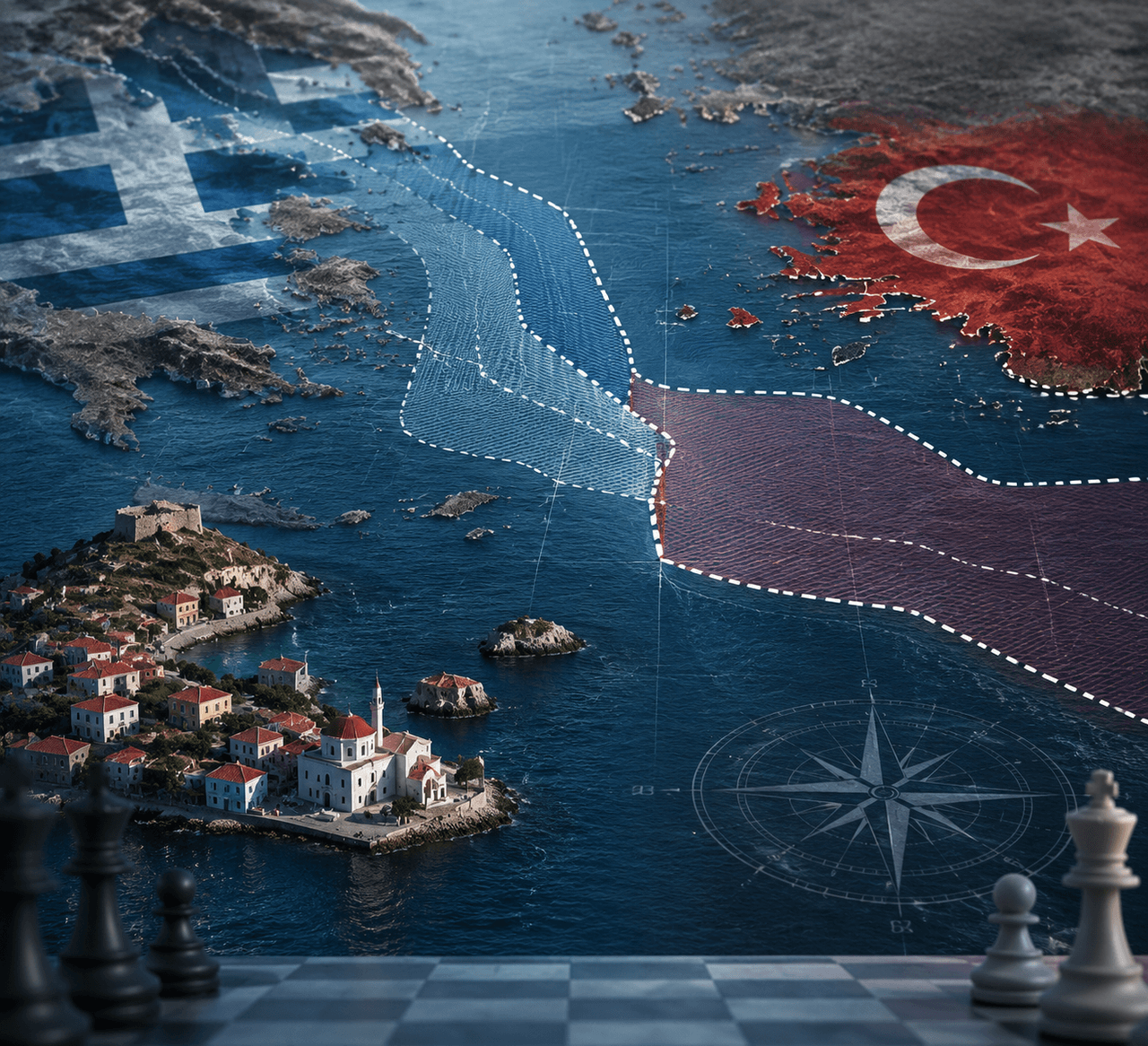
(Generated with Artificial Intelligence)
The Meis Issue
Island Names | Meis (Turkish), Kastellorizo / Megisti (Greek), Castelrosso (Italian) | ||||||||
|---|---|---|---|---|---|---|---|---|---|
Location | Eastern Mediterranean, off the coast of Kaş district, Antalya | ||||||||
Sovereign State | Greece | ||||||||
Area | 9 km² | ||||||||
Distance to Anatolian Coast (Kaş) | Approximately 1,950 m | ||||||||
Distance to Türkiye (Kaş) | ~2 km | ||||||||
Population (2011 Census) | 490 | ||||||||
Distance to Greek Mainland | ~580 km | ||||||||
French Occupation | 1915 | ||||||||
Source of Legal Status | Article 15 of the 1923 Treaty of Lausanne, Article 14 of the 1947 Treaty of Paris | ||||||||
Transfer to Italy | 1921 | ||||||||
Demilitarization Obligation | Article 14 and Annex XIII of the 1947 Paris Treaty | ||||||||
Source of Legal Status | Article 15 of the 1923 Treaty of Lausanne, Article 14 of the 1947 Treaty of Paris | ||||||||
Subject of Dispute | Influence of the island in continental shelf / EEZ delimitation | ||||||||
Subject of Dispute | Issues concerning entitlement and delimitation of maritime zones | ||||||||
Relevant International Regulation | United Nations Convention on the Law of the Sea (UNCLOS) Article 121 | ||||||||
Relevant International Regulation | United Nations Convention on the Law of the Sea (UNCLOS) Article 121 | ||||||||
Related Doctrine | Blue Homeland Doctrine | ||||||||
Related Doctrine | Blue Homeland Doctrine | ||||||||
The Meis Issue, refers to the dispute surrounding Meis Island, located approximately 1,950 meters from the Kaş district of Antalya in the Eastern Mediterranean and under Greek sovereignty, in the context of the maritime jurisdiction dispute between Türkiye and Greece. This dispute involves two distinct legal questions concerning Meis Island together with its neighboring islands, Karaada and Fener Adası: first, whether these islands are entitled to claim continental shelf and exclusive economic zone (EEZ) rights under UNCLOS Article 121 — specifically, whether they qualify as “islands” or merely “rocks”; second, even if they are deemed entitled to such rights, to what extent those rights should be considered in the delimitation process — whether full, partial, or zero effect should be granted under the principle of equity and relevant precedent. These two issues are independent and must not be conflated.【1】 According to Greece’s official position and legal doctrine, Meis, Karaada, and Fener Adası are collectively referred to as the “Meis Group” (Kastellorizo archipelago), and it is argued that this group should enjoy the same full effect as the mainland; Türkiye, however, rejects this claim both regarding entitlement to rights and their effect in delimitation.【2】
The island group comprising Meis, Karaada, and Fener Adası is situated directly opposite the Kaş district of Antalya.【3】 According to official Greek data, Meis Island has an area of 9 km²; Karaada is 1.6 km² and Fener Adası is 1 km².【4】 According to Kurumahmut’s calculations, the distance from Meis to the Anatolian coast is 1,950 meters; from Fener Adası to the Anatolian coast is 3,300 meters; and from Karaada to the Anatolian coast is 5,350 meters; the three islands are located 3,700 to 5,200 meters apart from each other.【5】 The population of Meis was 800 according to the 1951 census, declined to 222 by the 1981 census, and rose to 490 by the 2011 census due to Greece’s regional settlement policy initiated in 1996; according to the same census, 15 people were recorded on Karaada and 9 on Fener Adası, both previously uninhabited.【6】 This demographic disparity provides the geographical basis for why these three islands must be evaluated separately in the entitlement debate discussed in Section 4 below.
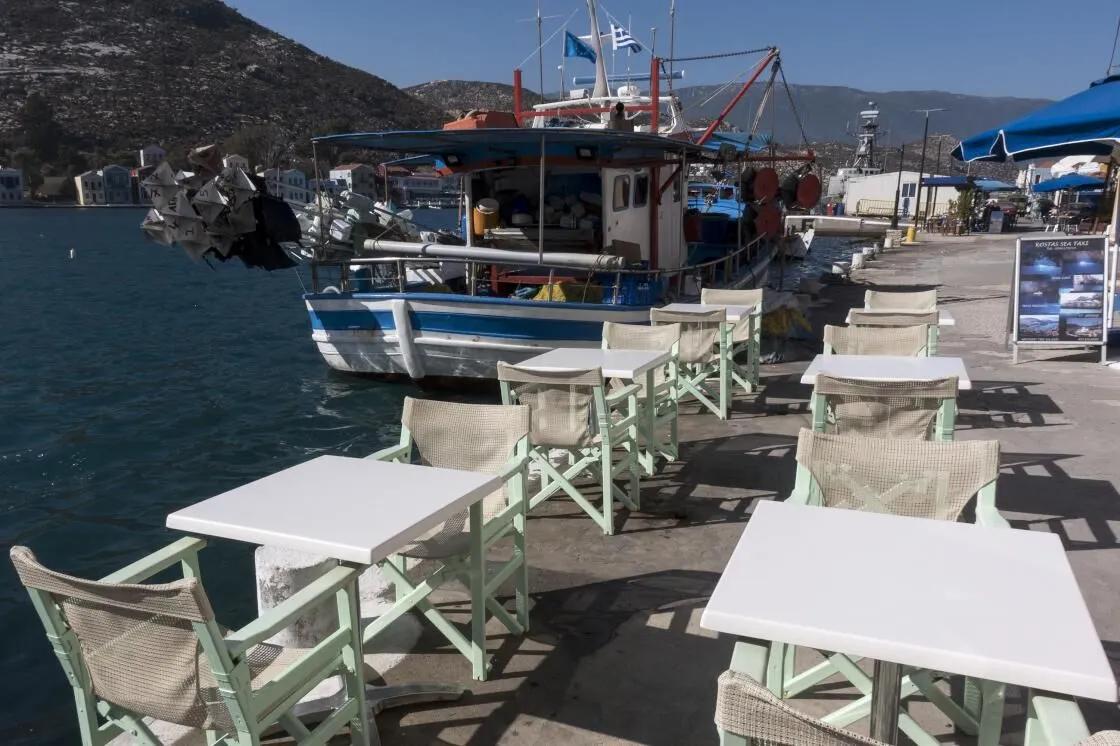
Meis Limanı (AA)
The sovereignty process of Meis in the early 20th century followed a different trajectory from the other Dodecanese islands; this distinction is frequently overlooked in discussions concerning its legal status.
During the Italo-Turkish War (Tripolitanian War), Italy, with the support of its powerful navy, occupied Rhodes on 4 May 1912 and, without significant resistance, seized the other 16 islands in the region by the end of May 1912; however, this wave of occupation excluded Meis; Meis did not come under Italian control during the 1912 occupation.【7】 On 14 March 1913, the local population detained the Ottoman garrison and established a provisional administration, leaving the island in de facto independence; during World War I, France occupied the island in December 1915 to use it as a secure base for submarine operations.【8】 Turkish coastal batteries responded to this French occupation with artillery fire and succeeded in sinking a British ship in 1917.【9】
Under the terms of the Armistice of Mudros, Italy assumed control of Meis, which had been under French occupation until then, and established an administration on 20 November 1921 under the name “Administration of Rhodes, Meis and the 12 Occupied Islands.”【10】 Article 15 of the Treaty of Lausanne, signed on 24 July 1923, stipulated that Türkiye renounced all rights and titles over the Dodecanese Islands, including Meis, in favor of Italy; the islands were listed individually, and Meis was explicitly named in this list.【11】
Following World War II, the 14th article of the Paris Peace Treaty signed on 10 February 1947 transferred the Dodecanese Islands — including Meis — to Greece.【12】 The treaty text listed the islands individually: “Italy hereby fully and entirely relinquishes sovereignty over the Dodecanese Islands, namely Istanbul, Rhodes, Herke, Kerpe, Kaşot, Ilyaki, Incirli, Kilimli, İleriye, Batnaz, İlipsi, Sömbeki, İstanköy, Meis and the adjacent islets.”【13】 The second paragraph of the same article required the complete demilitarization of the islands and their retention in a non-military status.【14】 Türkiye is not a party to this treaty.

1947 Paris Barış Antlaşmasına Ait Bir Görsel (United Nations)
The second paragraph of Article 14 of the 1947 Paris Treaty and Annex XIII require that the Dodecanese Islands — including Meis — transferred to Greece maintain a non-military status, prohibiting any military forces, installations, or fortifications except for police forces.【15】 However, since the 1960s, Greece has begun establishing military facilities on these islands.
Greece advances several legal justifications for this situation: a fundamental change of circumstances (rebus sic stantibus), the right to legitimate defense, and the argument that Türkiye cannot invoke this provision since it was not a party to the 1947 Treaty (res inter alios acta). These are among the grounds cited.【16】 In Turkish legal doctrine, these arguments are considered unconvincing under the principles of international treaty law; it is argued that Türkiye qualifies as a relevant party under Article 16 of the Treaty of Lausanne and therefore retains the right to object.【17】 Greece’s deployment of military personnel to Meis during the 2020 Oruç Reis crisis in the Eastern Mediterranean revived this dispute.【18】
The legal dimension of the Meis Issue encompasses two separate and independent matters. Confusing these two undermines the proper understanding of the dispute.
Articles 1 and 2 of UNCLOS Article 121, titled “Regime of Islands,” regulate that a naturally formed area of land, surrounded by water and above water at high tide, may, under certain conditions and subject to the principle of equity, generate territorial seas, contiguous zones, exclusive economic zones, and continental shelves like a mainland. However, this does not mean that every geographical feature classified as an “island” automatically acquires these rights; the principles of “Geographical Superiority,” “Equity,” and “Proportionality” applicable between coastal states require that entitlements and their effects be adjusted according to the circumstances of the respective states under the principle of equity. Article 3 of the same article specifies that “rocks” — which cannot sustain human habitation or economic life of their own — cannot generate exclusive economic zones or continental shelves, and are therefore deprived of such entitlement capacity.【19】
In the South China Sea Arbitration (2016) between the Philippines and China, the Permanent Court of Arbitration provided significant clarification in interpreting the phrase “cannot sustain human habitation” in Article 121/3. According to the Court, this assessment must be based not on whether a geographical feature currently hosts a human population, but on whether its natural condition has the capacity to support such a population; historical evidence of human settlement or economic activity constitutes strong proof of such capacity.【20】 The Court also emphasized that artificially rendering a rock habitable through new technology or external resources undermines the purpose of Article 121, which is to assess the natural status; however, this does not mean that external supply alone and automatically disqualifies a feature — the Court’s primary concern is the feature’s natural capacity prior to human intervention or intensive modification.【21】
Applying these criteria, Meis, Karaada, and Fener Adası must be evaluated separately: Meis has a continuous and distinct history of settlement and economic life (fishing, sponge harvesting, trade), reaching a population of 800 in 1951; in contrast, Karaada and Fener Adası had no permanent settlement prior to 1996, and their current populations are the direct result of Greece’s recent settlement policies.【22】 In Turkish legal doctrine, it is argued that Meis’s historical settlement record makes its classification as a “rock” under Article 121/3 debatable, whereas Karaada and Fener Adası are in a significantly weaker position regarding natural capacity and must be subject to separate legal evaluation.【23】
Even if a geographical feature is recognized as entitled to an EEZ or continental shelf under Article 121, this does not automatically mean it must be granted full effect in the actual delimitation between two states. International courts have adopted a method of first drawing a provisional equidistance line and then adjusting it by taking into account “relevant circumstances” — including the presence of small islands — to achieve an equitable outcome. In this context, an “equivalent decision” refers to a prior judicial or arbitral ruling on a similar legal issue that has been referenced by parties or courts in subsequent disputes; in international law, such precedents serve as strong guidance on judicial approaches. In cases such as the Continental Shelf Case (Libya/Malta, 1985), the Qatar-Bahrain Case (2001), and the Nicaragua-Honduras Case (2007), the International Court of Justice developed a practice of either disregarding very small islands or granting them limited effect in delimitation.【24】
According to Greece’s note to Türkiye dated 20 February 2013, one of the exploration areas granted by Türkiye to TPAO in the Eastern Mediterranean lies close to the 6-nautical-mile territorial sea boundary of the “Meis Group”; Greece claims that this group, both in terms of entitlement and effect in delimitation, should enjoy the same full maritime rights as the mainland.【25】 In Greek doctrine, Meis is described as a “small archipelago” or part of a “Greek island complex,” and this characterization is presented as the foundation of Greece’s broader maritime claim extending as far as Cyprus.【26】
Türkiye’s official position, as stated in its note of 12 March 2013, asserts that the exploration areas granted by Türkiye to TPAO in the Eastern Mediterranean lie within its own continental shelf, while the territorial seas of Greek islands such as Meis lie far outside it.【27】 In Turkish legal doctrine, this position is grounded on two distinct levels: (i) on the entitlement level, as previously noted, the weak natural capacity of Karaada and Fener Adası; (ii) on the effect in delimitation level, through the concept of “cut-off effect,” it is argued that an island located on the opposite side of the median line between the two mainland coasts and whose size is negligible compared to the mainland — even if entitled to rights — should not generate any effect beyond its territorial sea in delimitation.【28】 As consistently emphasized in Türkiye’s official statements, granting a maritime area disproportionate to its coastline to an island located 1,950 meters from Anatolia and 580 kilometers from the Greek mainland contradicts the principle of equity.【29】
In the case brought by Romania before the International Court of Justice (ICJ) on 16 September 2004, Romania argued that Snake Island (Serpents Island), a Ukrainian territory of approximately 0.17 km², cannot sustain human habitation or economic life and is therefore deprived of entitlement to an EEZ or continental shelf under UNCLOS Article 121/3.【30】 The ICJ, however, did not directly answer this entitlement question; without ruling on whether the island qualified under Article 121/2 or 121/3, the Court proceeded directly to delimitation and, following its prior jurisprudence (Libya/Malta 1985, Qatar-Bahrain 2001, Nicaragua-Honduras 2007), limited Snake Island’s effect in the final delimitation line to its 12-nautical-mile territorial sea only.【31】
In other words, the ICJ left open the question of whether the island was entitled to rights and confined its effect in delimitation to a near-zero level — this is a concrete example of the distinction between the two issues explained above. In Turkish legal doctrine, this approach is interpreted as a strong precedent supporting the view that even if the entitlement question remains unresolved, small islands may be granted limited effect in delimitation; it is therefore argued that a similar limited-effect approach should apply to Meis, Karaada, and Fener Adası; the Greek side, however, contends that the geographical and demographic conditions of these islands differ from those of Snake Island and that the precedent cannot be directly applied.【32】
The Memorandum of Understanding on the Delimitation of Maritime Jurisdiction Areas in the Mediterranean, signed between Türkiye and the Libyan National Accord Government on 27 November 2019, is one of the most recent applications in the Eastern Mediterranean dispute.【33】 The line drawn in the memorandum is based solely on the mainland coasts of the two countries and does not take into account islands such as Meis, Rhodes, and Crete. Academic assessments indicate that this approach aligns with the international jurisprudential trend that small islands should not affect delimitation when facing large mainland coasts.【34】
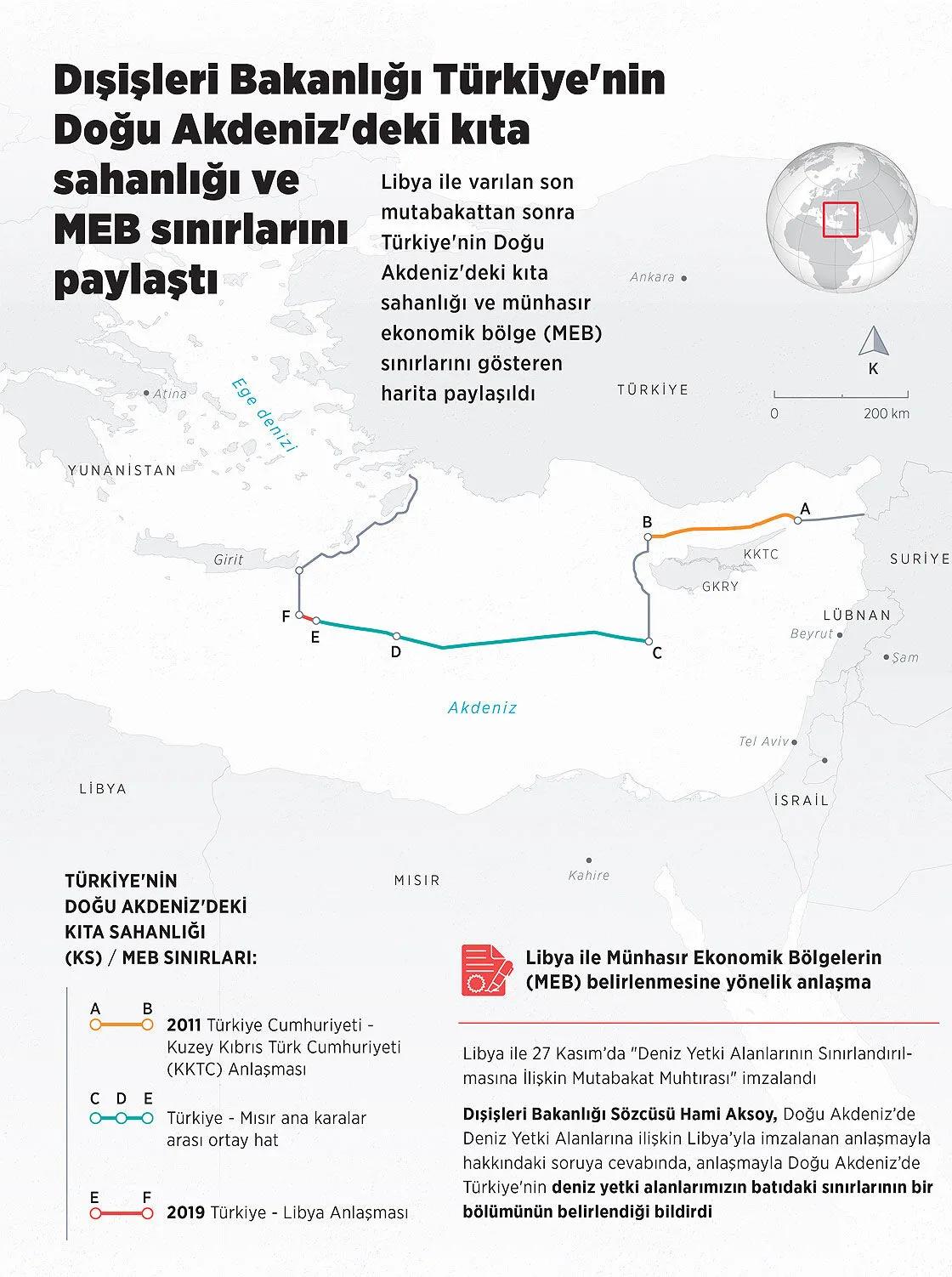
Türkiye-Libya Hattı (AA)
The Meis Issue is one of the practical applications of Türkiye’s Blue Homeland doctrine, which asserts that small islands cannot be used to diminish maritime zones derived from the mainland; Meis constitutes the primary case testing this proposition both in terms of entitlement and effect in delimitation.
The fundamental disagreement between the parties on the Meis Issue remains unresolved and continues to be relevant due to recent developments. On 6 August 2020, Greece signed a partial EEZ delimitation agreement with Egypt in the Eastern Mediterranean; this agreement was registered with the United Nations on 24 December 2020. The Turkish Ministry of Foreign Affairs declared the agreement invalid for Türkiye, stating that it violates Türkiye’s continental shelf boundaries notified to the UN.【35】
In April 2025, Greece published an official Marine Spatial Planning (MSP) map under the European Union’s MSP directive, which includes the area around Meis; the Turkish Ministry of Foreign Affairs declared that this map violates Türkiye’s maritime jurisdiction areas in the Aegean and Eastern Mediterranean and therefore has no legal effect for Türkiye.【36】 Türkiye announced its own national MSP on 16 April 2025 and notified the UNESCO Intergovernmental Oceanographic Commission on 12 June 2025.【37】 Turkish legal doctrine anticipates that Türkiye’s further development of its legal arguments regarding the entitlement status of Meis, Karaada, and Fener Adası will further strengthen Türkiye’s positions concerning the Eastern Mediterranean.【38】
Anadolu Ajansı. "Yunanistan-Mısır Anlaşmasıyla Akdeniz'de Haksızlığını Tescil Etti." Anadolu Ajansı, August 10, 2020.https://www.aa.com.tr/tr/analiz/yunanistan-misir-anlasmasiyla-akdenizde-haksizligini-tescil-etti/1937166
Bayıllıoğlu, Uğur. "Birleşmiş Milletler Deniz Hukuku Sözleşmesi'nin 121. Maddesinin Doğu Akdeniz'de Etkisi: Meis, Karaada ve Fener Adası'nın Statüsüne İlişkin Bir Değerlendirme." Ankara Hacı Bayram Veli Üniversitesi Hukuk Fakültesi Dergisi 23, no. 2 (2019): 185-223.https://dergipark.org.tr/en/pub/ahbvuhfd/article/571006
Bayıllıoğlu, Uğur. "International Court of Justice's Findings on the Impact of Serpents Island in the Maritime Boundary Delimitation between Romania and Ukraine." Çankaya University Journal of Law, no. 7/1 (2010): 23-41.https://dergipark.org.tr/en/download/article-file/45443
Ergüven, Nasıh Sarp. "Karadeniz'de Deniz Alanı Sınırlandırması Davası (Romanya/Ukrayna) ve Uluslararası Hukuk Açısından Etkileri." Ankara Üniversitesi Hukuk Fakültesi Dergisi 63, no. 2 (2014): 309-328.https://dergipark.org.tr/tr/pub/auhfd/article/510783
Küçük, Cevdet. "Oniki Ada." TDV İslâm Ansiklopedisi, Volume 33. İstanbul: TDV İslâm Araştırmaları Merkezi, 2007, pp. 353-355.
Mengeş, Yeter. "İkinci Dünya Savaşı'nda Menteşe (Rodos, 12 Ada ve Meis) Adaları." Çağdaş Türkiye Tarihi Araştırmaları Dergisi 17, no. 34 (2017): 279-318.
Ministry of Foreign Affairs of the Republic of Türkiye. "SC-20, Response by Ministry of Foreign Affairs Spokesperson Öncü Keçeli to the Question Regarding Greece's Registered Maritime Spatial Planning Map on the EU Maritime Spatial Planning Platform." November 21, 2025.https://www.mfa.gov.tr/sc_-20_-disisleri-bakanligi-sozcusu-oncu-keceli-nin-ab-nin-deniz-mekansal-planlama-platformu-nda-kayitli-yunan-deniz-mekansal-planlama-haritasi-hk-sc.tr.mfa
United Nations. "Treaty of Peace with Italy." February 10, 1947. United Nations Treaty Series, Volume 49, no. 747.
Yüksel, Cüneyt, and Deniz Baran. "Uluslararası Hukukta Doğu Akdeniz Krizi ve Türkiye ile Libya Arasındaki Deniz Yetki Alanlarını Sınırlandırma Mutabakatının Değerlendirilmesi." Public and Private International Law Bulletin 40, no. 1 (2020): 519-556.
Yüksel, Cüneyt, and Nesrin Singil. "Uluslararası Hukukta Gayri Askeri Statü ve Doğu Ege Adaları'nın Askerileştirilmesi Sorunu." Public and Private International Law Bulletin 43, no. 2 (2023): 447-489.
İnce, Erdem, and İbrahim Ethem Alper. "Güney Çin Denizi Tahkim Kararı Başta Olmak Üzere Uluslararası Yargı Kararları Işığında Ada Kavramı." DEHUKAM (Ankara Üniversitesi Deniz Hukuku Ulusal Araştırma Merkezi), March 30, 2026.https://www.dehukam.org/2026/03/30/guney-cin-denizi-tahkim-karari-basta-olmak-uzere-uluslararasi-yargi-kararlari-isiginda-ada-kavrami/
[1]
Uğur Bayıllıoğlu, "Birleşmiş Milletler Deniz Hukuku Sözleşmesi'nin 121. Maddesinin Doğu Akdeniz'de Etkisi: Meis, Karaada ve Fener Adası'nın Statüsüne İlişkin Bir Değerlendirme," Ankara Hacı Bayram Veli Üniversitesi Hukuk Fakültesi Dergisi 23, no. 2 (2019): 185–188. Accessed August 10, 2026.https://dergipark.org.tr/en/pub/ahbvuhfd/article/571006
[2]
Bayıllıoğlu, "Meis, Karaada ve Fener Adası'nın Statüsü," pp. 189–190.
[3]
Bayıllıoğlu, "Meis, Karaada ve Fener Adası'nın Statüsü," pp. 189–190.
[4]
Bayıllıoğlu, "Meis, Karaada ve Fener Adası'nın Statüsü," p. 206.
[5]
Bayıllıoğlu, "Meis, Karaada ve Fener Adası'nın Statüsü," p. 207.
[6]
Bayıllıoğlu, "Meis, Karaada ve Fener Adası'nın Statüsü," pp. 208–209.
[7]
Yeter Mengeş, "İkinci Dünya Savaşı'nda Menteşe (Rodos, 12 Ada ve Meis) Adaları," Çağdaş Türkiye Tarihi Araştırmaları Dergisi 17, no. 34 (2017): 283-284. Accessed August 10, 2026.https://dergipark.org.tr/en/download/article-file/473897
[8]
Mengeş, "Menteşe Adaları," s. 284-285.
[9]
Mengeş, "Menteşe Adaları," s. 285.
[10]
Mengeş, "Menteşe Adaları," s. 285.
[11]
Cevdet Küçük, "Oniki Ada," TDV İslâm Ansiklopedisi, c. 33 (İstanbul: TDV İslâm Araştırmaları Merkezi, 2007), erişim 10 Ağustos 2026, https://islamansiklopedisi.org.tr/oniki-ada, s. 354.
[12]
Küçük, "Oniki Ada," s. 355.
[13]
Birleşmiş Milletler, "Treaty of Peace with Italy," 10 Şubat 1947, United Nations Treaty Series, c. 49, no. 747, erişim 10 Ağustos 2026, https://treaties.un.org/doc/Publication/UNTS/Volume%2049/v49.pdf, Section V, Md. 14/1.
[14]
Birleşmiş Milletler, "Treaty of Peace with Italy," Md. 14/2.
[15]
Birleşmiş Milletler, "Treaty of Peace with Italy," Md. 14/2 ve Ek XIII.
[16]
Cüneyt Yüksel and Nesrin Singil, "Uluslararası Hukukta Gayri Askeri Statü ve Doğu Ege Adaları'nın Askerileştirilmesi Sorunu," Public and Private International Law Bulletin 43, no. 2 (2023): 447-460. Accessed August 10, 2026.
[17]
Yüksel ve Singil, "Gayri Askeri Statü," s. 460-475.
[18]
Yüksel ve Singil, "Gayri Askeri Statü," s. 475-480.
[19]
Erdem İnce ve İbrahim Ethem Alper, "Güney Çin Denizi Tahkim Kararı Başta Olmak Üzere Uluslararası Yargı Kararları Işığında Ada Kavramı," DEHUKAM, 30 Mart 2026, erişim 10 Ağustos 2026, https://www.dehukam.org/2026/03/30/guney-cin-denizi-tahkim-karari-basta-olmak-uzere-uluslararasi-yargi-kararlari-isiginda-ada-kavrami/.
[20]
Ince and Alper, "Ada Kavramı" (citing paragraphs 208 and 212 of the South China Sea Arbitration Award).
[21]
Ince and Alper, "The Concept of Island" (citing paragraphs 214–215 of the South China Sea Arbitration Award).
[22]
Bayıllıoğlu, "Meis, Karaada ve Fener Adası'nın Statüsü," pp. 206–209.
[23]
Bayıllıoğlu, "Meis, Karaada ve Fener Adası'nın Statüsü," pp. 216–220.
[24]
İnce ve Alper, "Ada Kavramı" (Romanya v. Ukrayna kararının Libya/Malta, Katar-Bahreyn ve Nikaragua-Honduras kararlarına yaptığı atıflara ilişkin bölüm).
[25]
Bayıllıoğlu, "Meis, Karaada ve Fener Adası'nın Statüsü," p. 190.
[26]
Bayıllıoğlu, "Meis, Karaada ve Fener Adası'nın Statüsü," pp. 190–191.
[27]
Bayıllıoğlu, "Meis, Karaada ve Fener Adası'nın Statüsü," pp. 195–196.
[28]
Bayıllıoğlu, "Meis, Karaada ve Fener Adası'nın Statüsü," p. 192.
[29]
Bayıllıoğlu, "Meis, Karaada ve Fener Adası'nın Statüsü," pp. 192–193.
[30]
Ergüven, "Karadeniz'de Deniz Alanı Sınırlandırması Davası," p. 309.
[31]
İnce ve Alper, "Ada Kavramı" (Romanya v. Ukrayna kararı bölümü).
[32]
Ergüven, "Karadeniz'de Deniz Alanı Sınırlandırması Davası," pp. 320-325.
[33]
Yüksel ve Deniz Baran, "Uluslararası Hukukta Doğu Akdeniz Krizi ve Türkiye ile Libya Arasındaki Deniz Yetki Alanlarını Sınırlandırma Mutabakatının Değerlendirilmesi," Public and Private International Law Bulletin 40, sy. 1 (2020), erişim 10 Ağustos 2026, https://dergipark.org.tr/en/pub/ppil/article/756853, s. 519.
[34]
Yüksel ve Baran, "Doğu Akdeniz Krizi," s. 519-525.
[35]
Anadolu Ajansı. "Yunanistan-Mısır Anlaşmasıyla Akdeniz'de Haksızlığını Tescil Etti." Accessed August 10, 2026.
[36]
Ministry of Foreign Affairs of the Republic of Türkiye, "SC-20, Response by Ministry of Foreign Affairs Spokesperson Öncü Keçeli to the Question Regarding the Greek Maritime Spatial Plan Registered in the EU Maritime Spatial Planning Platform," November 21, 2025, Accessed August 10, 2026,https://www.mfa.gov.tr/sc_-20_-disisleri-bakanligi-sozcusu-oncu-keceli-nin-ab-nin-deniz-mekansal-planlama-platformu-nda-kayitli-yunan-deniz-mekansal-planlama-haritasi-hk-sc.tr.mfa.
[37]
T.C. Dışişleri Bakanlığı, "SC-20."
[38]
Bayıllıoğlu, "Meis, Karaada ve Fener Adası'nın Statüsü," pp. 222-223.

(Generated with Artificial Intelligence)
The Meis Issue
Island Names | Meis (Turkish), Kastellorizo / Megisti (Greek), Castelrosso (Italian) | ||||||||
|---|---|---|---|---|---|---|---|---|---|
Location | Eastern Mediterranean, off the coast of Kaş district, Antalya | ||||||||
Sovereign State | Greece | ||||||||
Area | 9 km² | ||||||||
Distance to Anatolian Coast (Kaş) | Approximately 1,950 m | ||||||||
Distance to Türkiye (Kaş) | ~2 km | ||||||||
Population (2011 Census) | 490 | ||||||||
Distance to Greek Mainland | ~580 km | ||||||||
French Occupation | 1915 | ||||||||
Source of Legal Status | Article 15 of the 1923 Treaty of Lausanne, Article 14 of the 1947 Treaty of Paris | ||||||||
Transfer to Italy | 1921 | ||||||||
Demilitarization Obligation | Article 14 and Annex XIII of the 1947 Paris Treaty | ||||||||
Source of Legal Status | Article 15 of the 1923 Treaty of Lausanne, Article 14 of the 1947 Treaty of Paris | ||||||||
Subject of Dispute | Influence of the island in continental shelf / EEZ delimitation | ||||||||
Subject of Dispute | Issues concerning entitlement and delimitation of maritime zones | ||||||||
Relevant International Regulation | United Nations Convention on the Law of the Sea (UNCLOS) Article 121 | ||||||||
Relevant International Regulation | United Nations Convention on the Law of the Sea (UNCLOS) Article 121 | ||||||||
Related Doctrine | Blue Homeland Doctrine | ||||||||
Related Doctrine | Blue Homeland Doctrine | ||||||||
Henüz Tartışma Girilmemiştir
"The Meis Issue" maddesi için tartışma başlatın
Geographical Location and Key Characteristics
History of Sovereignty
The Divergent Process: 1912–1915
Transfer to Italy (1921) and the Treaty of Lausanne (1923)
The 1947 Paris Peace Treaty and Transfer to Greece
The Non-Military (Demilitarized) Status Issue
Entitlement to Maritime Zones and Effect in Delimitation: Two Distinct Legal Issues
Entitlement Issue: UNCLOS Article 121 and the Island/Rock Distinction
Effect in Delimitation: Principle of Equity and Precedent
Legal Positions of the Parties
Greece’s Position
Türkiye’s Position
The Black Sea Case (Romania v. Ukraine, 2009)
Position of Meis in the Türkiye-Libya Memorandum of Understanding
Relation to the Blue Homeland Doctrine
Current Status