KÜRE Ansiklopedi olarak size en verimli ve keyifli deneyimi sunmak için çerezlerden yararlanıyoruz.
İzniniz doğrultusunda, ziyaret geçmişiniz ve tercihlerinizi dikkate alarak içeriklerimizi ve hizmetlerimizi size özel hâle getirebiliriz. Eğer yalnızca temel çerezlere izin vermek isterseniz, bazı özellikler sınırlı çalışabilir.

Bu içerik Türkçe olarak yazılmış olup yapay zeka ile otomatik olarak İngilizceye çevrilmiştir.

Mavi Vatan evokes a familiar image in our minds: geopolitical maps, strategic boundaries, sovereignty claims, and continental shelf disputes…
But beyond the lines on maps and military strategies, a far more layered, silent, yet captivating world awaits us beneath the waves. These blue depths surrounding Türkiye are not merely drawn lines on modern maps; they are a vast repository of lived experience, connecting East and West for thousands of years, linking ancient civilizations, merchants, seafarers, and empires.
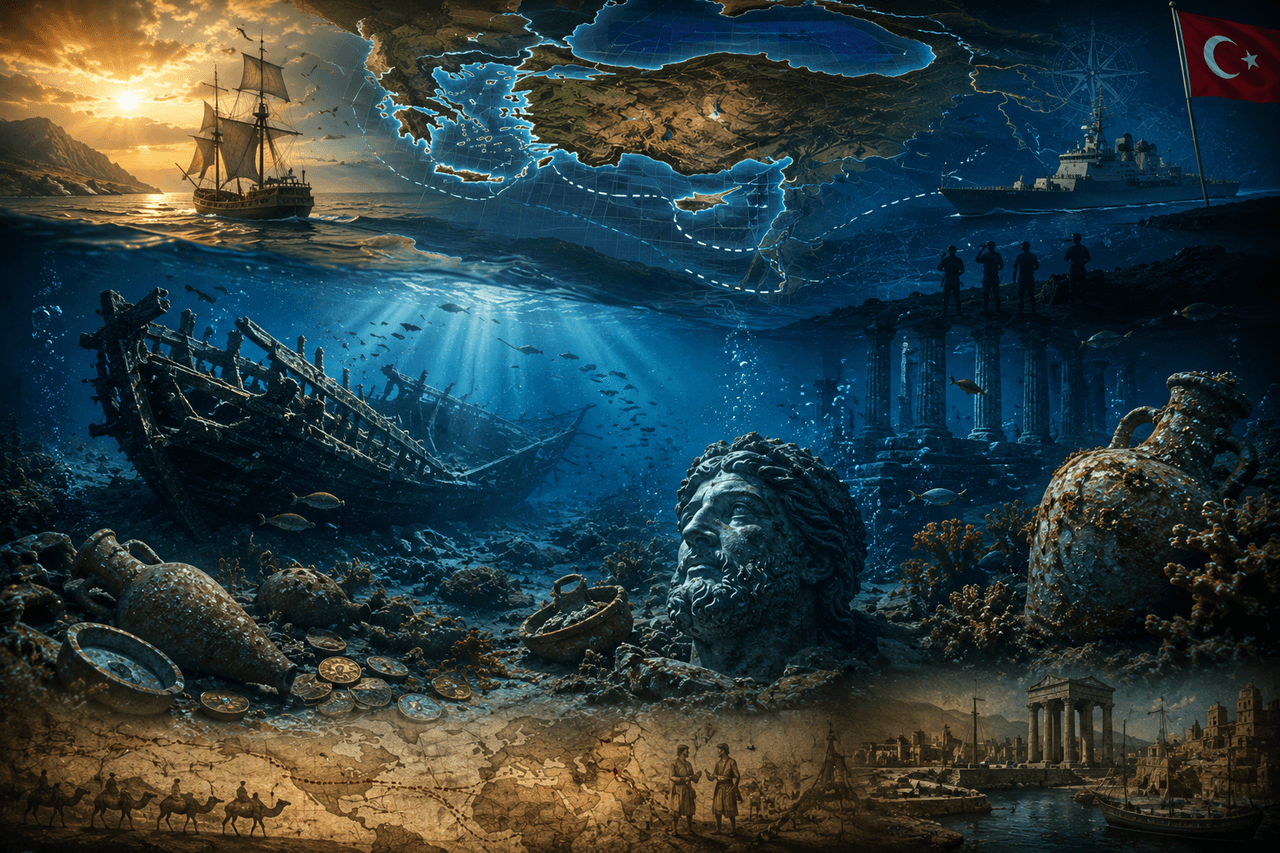
Visual Representing the Blue Homeland (Generated by Artificial Intelligence)
While on land we trace history through ancient cities and architectural remains, beneath the sea time seems to pause. A merchant vessel lost to storms and swallowed by the waves becomes a kind of time capsule, preserving its cargo intact.
Even a single ceramic vessel, encrusted with marine life, can whisper to us across centuries about ancient trade routes, human connections between ports, and the rhythm of the ancient economy.
So today, as we proudly and passionately strive to protect these waters, are they merely a political boundary—or a living memory, breathing with humanity’s shared heritage? To answer this question, we must move beyond the notion of Mavi Vatan as a mere line on a map and listen to the silent witnesses beneath the surface.
When we say Mavi Vatan, we typically think of a geopolitical boundary or a zone of sovereignty. But there is another, invisible dimension: a vast underwater treasure trove containing millennia of Anatolia’s seafaring heritage.
Let us briefly clarify the terminology, because the distinction matters. Underwater archaeology encompasses a broad field, from submerged architectural structures to portable cultural artifacts. 【1】Shipwreck archaeology, as a subset of this field, focuses directly on sunken vessels, their cargoes, and navigation routes.【2】
Indeed, Türkiye is the very geographical site where modern underwater archaeology was born, with the 1960 excavation at Gelidonya. The first underwater shipwreck ever excavated scientifically in its entirety by an archaeologist was the Gelidonya Shipwreck off the coast of Antalya in 1960.【3】 Therefore, reading the deep memory of Mavi Vatan means understanding a global heritage.
Recognizing this distinction is the first step toward understanding what each trace on the seabed truly signifies. For in this text, we will interpret Mavi Vatan not as a line on a map but as a living memory breathing beneath the waves.
If you believe the idea of protecting underwater heritage is a recent invention, you are mistaken. The story reaches back to 1884 and to Osman Hamdi Bey, Director of the Imperial Museum.
In the 19th century, foreign vessels were plundering underwater artifacts in the Mediterranean and Aegean without restraint. Article 3 of the 1884 Regulation on Antiquities, drafted by Hamdi Bey, speaks clearly:
“All antiquities discovered in Ottoman territory, or to be discovered through future investigations, and retrieved from seas, lakes, rivers, streams, and brooks, shall belong entirely to the state.” 【4】
With these words, underwater artifacts were placed under legal protection, marking one of the earliest known instances of a state enshrining its underwater cultural heritage in law.
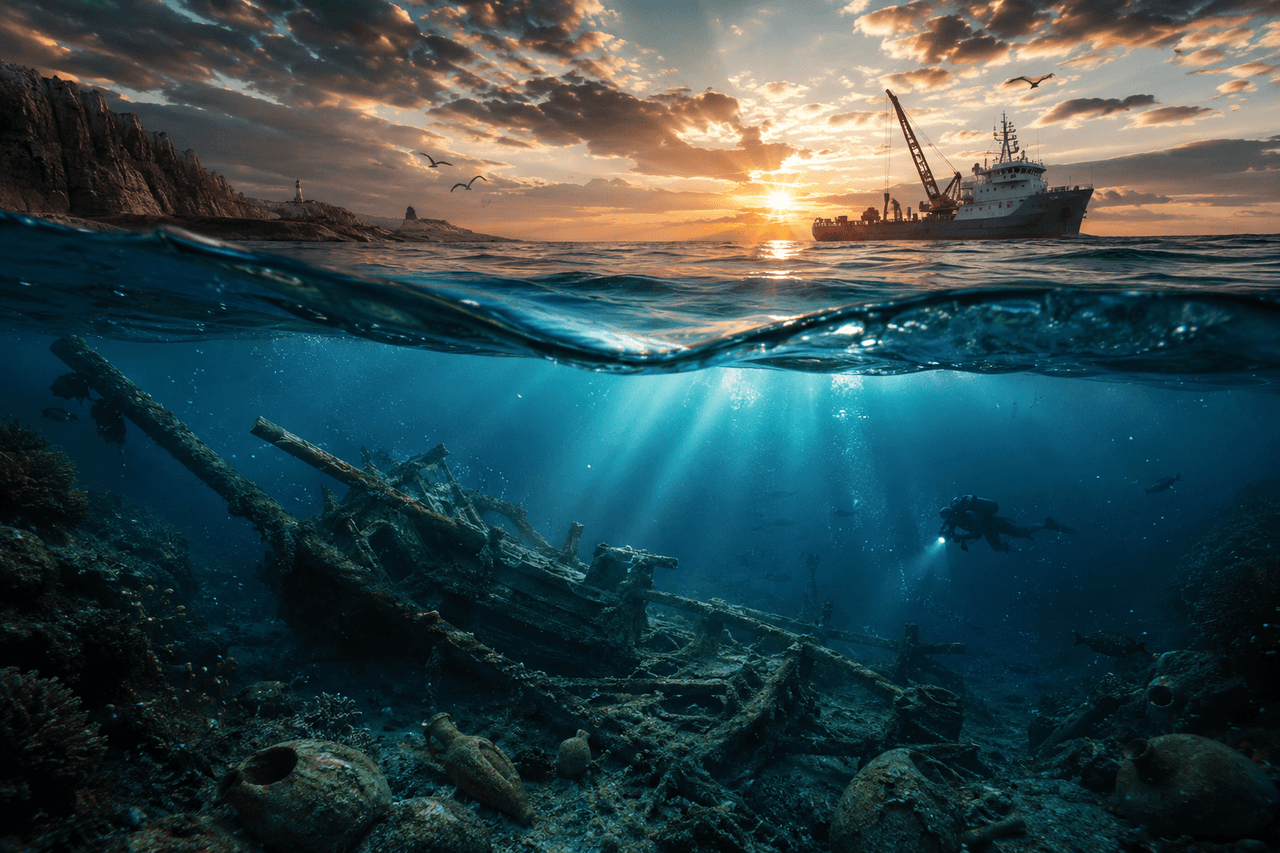
Visual Representing the Blue Homeland (Generated by Artificial Intelligence)
Moreover, this was not merely theoretical. In 1891–1892, when ancient gold coins were identified off the coast of Formako Island in the Aegean, the state directly dispatched divers to recover the finds.
When news arrived that some of the ancient gold coins retrieved from the sea near Formako Island had fallen into the hands of a shepherd, Osman Hamdi Bey immediately mobilized the Ministry of the Navy from the capital, sent divers to recover the artifacts, and ensured their registration in the museum records via the administration in Rhodes.【5】
So we must ask: The doctrine of Mavi Vatan emerged in the 2000s, but the reflex to claim these waters already existed 120 years ago. The justification for protection was different—so what exactly were these waters protecting? The answer lies in the depths off Fethiye.
To see the tangible counterpart of this abstract protection ideal, one need only descend into the Fethiye Gulf. The Karaburun Rhodes Shipwreck, discovered at the Karaburun site under the Türkiye Shipwreck Inventory Project (TUBEP) and dated to the second half of the 3rd century CE, carries the dynamics of ancient maritime trade into the present.【6】
The ship’s main cargo consists of Rhodian amphorae with rostrum handles; the grape seed residues found alongside them indicate active wine exports from the region during that period.【7】 The cargo also includes amphorae produced in Knidos, as well as other commercial vessels of types Agora M273 and LR2/Dressel 24 Similis. These finds are not random; they constitute concrete evidence of maritime transport and navigation routes between the Rhodian Peraias and coastal settlements around Göcek/Daidala in antiquity.【8】
Today we see this sea as a boundary line, but perhaps 1800 years ago it was a real trade highway.
The legal vision of the 1884 Regulation on Antiquities and the individual amphorae now being recovered from the Karaburun Shipwreck in Fethiye Gulf today both cry out the same truth: If Mavi Vatan is a line on a map, underwater archaeology is the memory beneath that line.
The determination to protect recorded by Osman Hamdi Bey on paper in 1884 and the silent Karaburun Shipwreck resting 35 meters deep in Fethiye Gulf today speak the same truth. Mavi Vatan is not merely our geopolitical domain over the seas; it is a living space of memory, holding within its depths thousands of years of production, human life, joy, and tragedy.【9】
To see beyond the boundary lines when we look at these waters today, we must stand up for the silent witnesses beneath the waves. Lines draw borders; but it is the memory beneath the sea that fills those borders with meaning.
So I ask: As we carry this unique heritage, hidden in the sea’s embrace for centuries, into the future, how truly are we fulfilling our duty of protection?
Gölbaş, Alper. "Sualtı Arkeolojisinin Terminoloji Sorunsalı." *Cedrus* 7 (2019): 589–605. Accessed July 30, 2025.https://dergipark.org.tr/en/download/article-file/838921.
Gündüz, Serkan. "Sualtı Arkeolojisi ve Marmara Denizi." *Uludağ Üniversitesi Fen-Edebiyat Fakültesi Sosyal Bilimler Dergisi* 22, no. 40 (2021): 633–662. Accessed July 30, 2026.https://doi.org/10.21550/sosbilder.791422.
Öniz, Hakan, and Okay Sütçüoğlu. "Sualtı Kültür Mirası, Osmanlı İmparatorluğu ve Osman Hamdi Bey." *Arkeoloji ve Sanat*, no. 153 (2016): 241–248. Accessed July 30, 2026.https://www.academia.edu/33279997/
Özdaş, Harun. "Karaburun Roma Dönemi Rodos Batığı: Ön İnceleme Sonuçları." *Türk Arkeoloji ve Etnografya Dergisi*, no. 83 (2022): 11–31. Accessed July 30, 2026.https://dergipark.org.tr/tr/download/article-file/1639013.
[1]
Alper Gölbaş, "Sualtı Arkeolojisinin Terminoloji Sorunsalı," Cedrus 7 (2019): 594,Erişim 30 Temmuz 2026, https://doi.org/10.13113/CEDRUS/201927
[2]
Gölbaş, "Sualtı Arkeolojisinin Terminoloji Sorunsalı," 595.
[3]
Gölbaş, "Sualtı Arkeolojisinin Terminoloji Sorunsalı," 590.
[4]
Hakan Öniz ve Okay Sütçüoğlu, "Sualtı Kültür Mirası, Osmanlı İmparatorluğu ve Osman Hamdi Bey," Arkeoloji ve Sanat, say.153 (2016): 244, Erişim 30 Temmuz 2026, https://www.academia.edu/33279997/
[5]
Öniz ve Sütçüoğlu, "Sualtı Kültür Mirası," 245-246.
[6]
Harun Özdaş, "Karaburun Roma Dönemi Rodos Batığı: Ön İnceleme Sonuçları," Türk Arkeoloji ve Etnografya Dergisi, say. 83 (2022):15, Erişim 30 Temmuz 2026, https://dergipark.org.tr/tr/download/article-file/1639013
[7]
Özdaş, "Karaburun Roma Dönemi Rodos Batığı," 18.
[8]
Özdaş, "Karaburun Roma Dönemi Rodos Batığı," 14.
[9]
Özdaş, "Karaburun Roma Dönemi Rodos Batığı," 18.
Mavi Vatan Is Not Really a Map
The Reflex to Protect Is Much Older Than We Think
In the Depths of Fethiye: The Karaburun Rhodes Shipwreck
The Memory Beneath the Line