


Bu içerik Türkçe olarak yazılmış olup yapay zeka ile otomatik olarak İngilizceye çevrilmiştir.
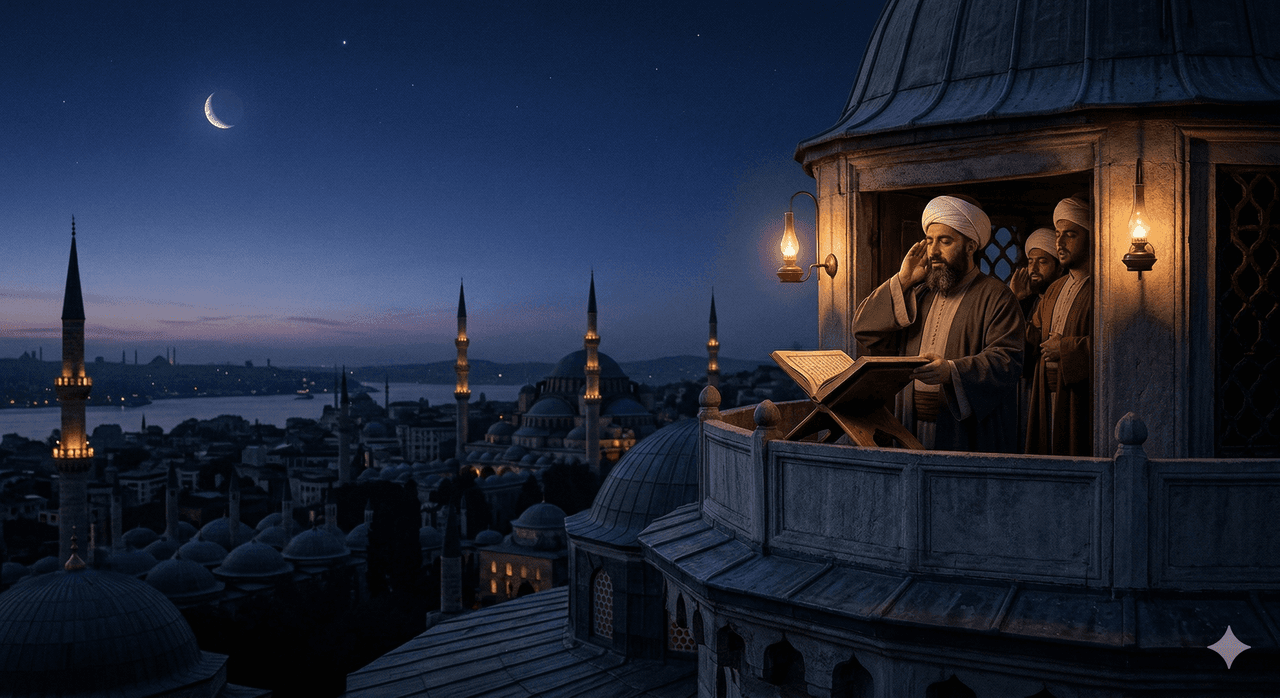
Osmanlı da Temcid Geleneği (Yapay Zeka İle Oluşturulmuştur)
Temcid is a form in Turkish religious music that, in its lexical meaning, conveys the notions of “to honor and exalt, to acclaim”; it encompasses prayers, supplications, and Allah’s invocations performed independently of the call to prayer from the minarets, including münâcâtları.【1】 This practice, found among Cami mûsikîsi traditions, is performed solo or collectively by müezzins or zâkirler, particularly during the three holy months and especially during Ramazan at the pre-dawn hours of sahur.【2】 This tradition, a religious musical heritage, is a minaret-based musical form of prayer that conveys the feeling of tawhid and recites the majesty of Allah.
Legends regarding the origins of the temcid tradition hold that it was initiated by Bilal ibn Rabah, the first muezzin of Islam. It is reported that the Prophet instructed Bilal ibn Rabah to ascend the minaret and acclaim Allah.【3】 Institutionally, it is recorded that this practice began during the final third of the night by order of Sultan Nasir al-Din, son of the Mamluk ruler Baybars I. In the Ottoman world, by the 15th century, legal and financial records in the endowment deed of Sultan Bayezid II specifying the qualifications of muezzins assigned to perform temcid and the manner of its execution demonstrate that the tradition had become an established institution supported by the waqf system.【4】
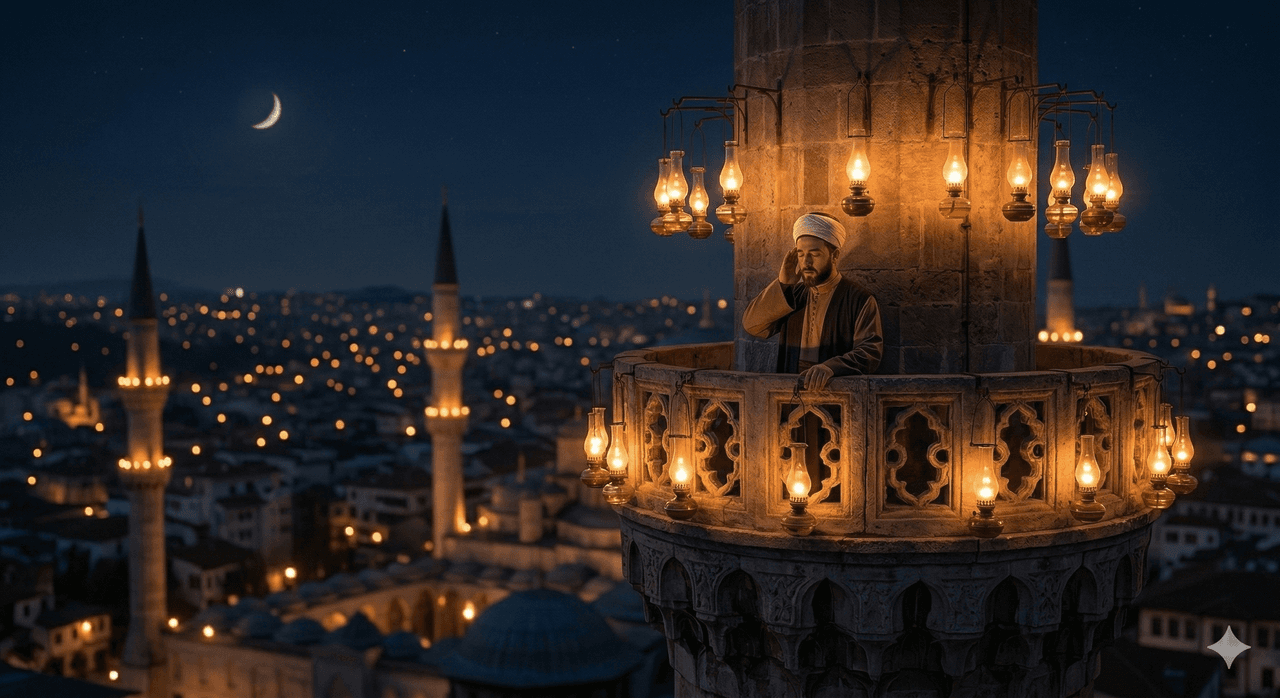
Temcid Tradition (Generated by Artificial Intelligence)
The performance of temcid typically begins with a muezzin’s high-pitched invocation, “Yâ hazreti mevlâm.” Following this, the kalima-i tawhid is recited three times, and the names of the prophets are mentioned, accompanied by Hazreti Muhammed’e salâtüselâm. Verses from Surah Al-Ahzab (33:40) or Surah As-Saffat (37:180), containing the names of Allah, are recited; the performance concludes with the communal recitation of Surah Al-Fatiha and münâcât sections.【5】
Musically, temcids are free-form compositions that can be performed in a different makam each night. Makams such as Rast, uşşak, segâh, hicaz, nevâ, hüseynî, and eviç are commonly used in this form. The temcid notation attributed to Hatip Zakiri Hasan Efendi or Buhûrîzâde Mustafa Itrî in the Irak makam, introduced into our musical tradition, is among the most significant technical examples. This form may be performed both rhythmically (measured) and freely (unmeasured).
In the Ottoman period, temcids were regularly performed from the first night of Recep until the end of Ramazan during the “three holy months.” Outside of Ramazan, temcid melodies were raised from minarets on Monday and Friday nights, as well as during special occasions such as kandil nights and Kadir nights. During Ramazan, these melodies, beginning approximately two and a half hours before imsak, signaled the approaching time of fasting.
Temcids during Ramazan were divided into two main phases: during the first fifteen nights, the arrival of Ramazan was announced with expressions such as “Merhaba yâ şehr-i ramazan merhaba!”; during the final fifteen nights, a melancholic farewell theme was expressed through phrases like “Elvedâ dost elveda.”【6】 In Istanbul, this tradition became institutionalized at major religious centers such as the Aziz Mahmud Hüdâyî and Nasûhî dergâhs in Üsküdar, the Kadirîhâne in Tophane, and the Hırka-i Şerif Camii in Karagümrük.
The Word Temcid (M. Fatih Çıtlak)
The temcid tradition has been preserved in various cities of Anatolia with distinct local characteristics.
The temcid culture in Amasya extends back to the 17th century. Particularly in Ziyaret Kasabası, temcids and temcid ilahis in the Hüseynî makam, such as “Ya Celil Ya Cabbar,” are performed collectively with active community participation. The temcids performed by Hafız Ahmed Çelebi, known as “Bülbül Çelebi,” one of the skilled performers of his time, at the Sultan II. Bayezid Camii, hold an important place in the regional musical memory.【7】
In the district of Taraklı in Sakarya, the temcid tradition was continuously practiced until the early 2000s. Centered at Yunuspaşa Camii, groups of ten performers ascended the minarets of six mosques simultaneously, creating a massive vocal chorus. In Taraklı temcids, the makams nevâ, eviç, and hicaz were employed, and mystical texts such as “Adem oldum bilmedim, nefsi boynuma kaldım” were preferred.【8】
In the history of Turkish religious music, several prominent figures composed works in the temcid form or successfully represented it from minarets. Vehbi Osman Çelebi, who gained fame during the reign of Mehmed IV, is among the notable composers of certain tesbih and temcid forms. Additionally, musicians such as Yusuf Efendi (d. 1647), who served as imam of the Sultan Selim Camii and as a tutor to princes, and Sütçüzâde are mentioned as composers who contributed to the artistic depth of this tradition.【9】
Esenler Belediyesi. "Temcid Geleneği Esenler'de Yaşatılıyor." Accessed March 8, 2026. https://esenler.bel.tr/haberler/genel/temcid-gelenegi-esenlerde-yasatiliyor/
Koç, Ferdi. "Türk Din Mûsikîsi'nde Temcidler ve Sakarya İli Taraklı İlçesinde Okunan Temcid Örnekleri". *Sakarya Üniversitesi İlahiyat Fakültesi Dergisi* 13, no. 23 (2011): 57–72. Accessed March 8, 2026. https://makale.isam.org.tr/server/api/core/bitstreams/41594df5-23d1-4209-b416-069ebc37ea43/content
Köksal, Eren. "Amasyalı Fahrî Müezzin Hacı Yunus Atak Beyefendi’den Derlenen Amasya İlâhîleri ve Temcid Kültürü (Ziyaret Kasabası Örneği)." *Geçmişten Günümüze Uluslararası Dinî Mûsikî Sempozyumu Bildiriler Kitabı*, pp. 67–76. Amasya: Amasya Üniversitesi Rektörlüğü, 2017. Accessed March 8, 2026. https://makale.isam.org.tr/server/api/core/bitstreams/16eef0cb-c45e-45c5-bf19-0965faa9491f/content
Sezikli, Ubeydullah. "Temcid." *TDV İslâm Ansiklopedisi*. Accessed March 8, 2026. https://islamansiklopedisi.org.tr/temcid
Tutal, Recep. *Türk-Din Mûsikîsinde Na't, Tesbih ve Temcîdler*. Master's thesis, Marmara Üniversitesi, 1994. Accessed March 8, 2026. https://www.proquest.com/openview/8024e0e0ee7c6163ea54fd2390fa2ef0/1?pq-origsite=gscholar&cbl=2026366&diss=y
Yeni Şafak. "Bir Ramazan geleneği: Temcid-i Şerif." Accessed March 8, 2026. https://www.yenisafak.com/ramazan/bir-ramazan-gelenegi-temcid-i-serif-2174900
Yıldız, Zeynep. "Ramazanın Kaybolan Sedası: Temcidler". In *Ramazan ve Oruç*, edited by Berat Açıl, Fahrettin Altun, Serhat Aslaner, Mustafa Demiray, and Halis Kaya, pp. 209-222. İstanbul: Ümraniye Belediyesi, 2015. Accessed March 8, 2026. https://makale.isam.org.tr/server/api/core/bitstreams/5417dea4-4b79-4091-bb35-dcf2e4679a2d/content
Çıtlak, M. Fatih. “Temcid | Ramazan Sözlüğü | M. Fatih Çıtlak #mfatihçıtlak #fatihçıtlak”. YouTube. Accessed March 8, 2026. https://www.youtube.com/watch?v=DGX7DZUetOs
[1]
Ubeydullah Sezikli, "Temcid," TDV İslâm Ansiklopedisi, accessed 8 March 2026, https://islamansiklopedisi.org.tr/temcid
[2]
Zeynep Yıldız, "Ramazanın Kaybolan Sedası: Temcidler," Ramazan ve Oruç içinde, ed. Berat Açıl vd. (İstanbul: Ümraniye Belediyesi, 2015), 210. Erişim 8 Mart 2026. https://makale.isam.org.tr/server/api/core/bitstreams/5417dea4-4b79-4091-bb35-dcf2e4679a2d/content
[3]
Zeynep Yıldız, "Ramazanın Kaybolan Sedası: Temcidler," Ramazan ve Oruç içinde, ed. Berat Açıl vd. (İstanbul: Ümraniye Belediyesi, 2015), 210. Erişim 8 Mart 2026. https://makale.isam.org.tr/server/api/core/bitstreams/5417dea4-4b79-4091-bb35-dcf2e4679a2d/content
[4]
Eren Köksal, "Amasyalı Fahrî Müezzin Hacı Yunus Atak Beyefendi’den Derlenen Amasya İlâhîleri ve Temcid Kültürü (Ziyaret Kasabası Örneği)," Geçmişten Günümüze Uluslararası Dinî Mûsikî Sempozyumu Bildiriler Kitabı (Amasya: Amasya Üniversitesi Rektörlüğü, 2017), 71. Erişim 8 Mart 2026. https://makale.isam.org.tr/server/api/core/bitstreams/16eef0cb-c45e-45c5-bf19-0965faa9491f/content
[5]
Zeynep Yıldız, "Ramazanın Kaybolan Sedası: Temcidler," Ramazan ve Oruç içinde, ed. Berat Açıl vd. (İstanbul: Ümraniye Belediyesi, 2015), 210. Erişim 8 Mart 2026. https://makale.isam.org.tr/server/api/core/bitstreams/5417dea4-4b79-4091-bb35-dcf2e4679a2d/content
[6]
Yeni Şafak, "Bir Ramazan geleneği: Temcid-i Şerif," accessed 8 March 2026,https://www.yenisafak.com/ramazan/bir-ramazan-gelenegi-temcid-i-serif-2174900
[7]
Eren Köksal, "Amasyalı Fahrî Müezzin Hacı Yunus Atak Beyefendi’den Derlenen Amasya İlâhîleri ve Temcid Kültürü (Ziyaret Kasabası Örneği)," Geçmişten Günümüze Uluslararası Dinî Mûsikî Sempozyumu Bildiriler Kitabı (Amasya: Amasya Üniversitesi Rektörlüğü, 2017), 71. Erişim 8 Mart 2026. https://makale.isam.org.tr/server/api/core/bitstreams/16eef0cb-c45e-45c5-bf19-0965faa9491f/content
[8]
Ferdi Koç, "Türk Din Mûsikîsi'nde Temcidler ve Sakarya İli Taraklı İlçesinde Okunan Temcid Örnekleri," Sakarya Üniversitesi İlahiyat Fakültesi Dergisi 13, sy. 23 (2011): 58-60. Erişim 8 Mart 2026. https://makale.isam.org.tr/server/api/core/bitstreams/41594df5-23d1-4209-b416-069ebc37ea43/content
[9]
Recep Tutal, Türk-Din Mûsikîsinde Na't, Tesbih ve Temcîdler (Master’s Thesis, Marmara University, 1994), 23-27. Erişim 8 Mart 2026. https://www.proquest.com/openview/8024e0e0ee7c6163ea54fd2390fa2ef0/1?pq-origsite=gscholar&cbl=2026366&diss=y


Osmanlı da Temcid Geleneği (Yapay Zeka İle Oluşturulmuştur)
Henüz Tartışma Girilmemiştir
"The Temcid Tradition in the Ottoman Empire" maddesi için tartışma başlatın
Historical Origins and Development
Musical Structure and Performance Practice
Temporal and Spatial Context
Regional Traditions
The Amasya Example
The Taraklı Example
Important Composers