

Bu içerik Türkçe olarak yazılmış olup yapay zeka ile otomatik olarak İngilizceye çevrilmiştir.
+1 Daha
Original Name(s) | The Truman Show | ||||||||
|---|---|---|---|---|---|---|---|---|---|
Director(s) | Peter Weir | ||||||||
Screenplay(s) | Andrew Niccol | ||||||||
Lead Roles | Jim Carrey, Ed Harris, Laura Linney, Noah Emmerich, Natascha McElhone | ||||||||
Production Company | Paramount Pictures | ||||||||
Duration | 103 minutes | ||||||||
Genre | Drama Science fiction Satire Black comedy | ||||||||
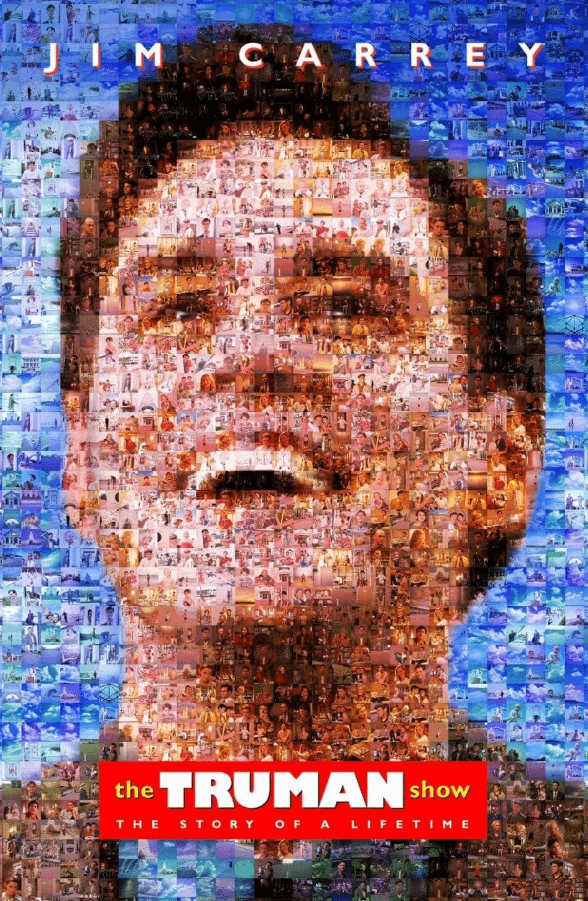
The Truman Show is a 1998 American comedy-drama science fiction film directed by Peter Weir and written by Andrew Niccol. Due to its cinematic exploration of modern media and the surveillance society, it has been frequently analyzed in contemporary cultural and communication studies. Jim Carrey stars in the lead role, with Laura Linney, Ed Harris, Noah Emmerich, and Natascha McElhone in the supporting cast.
The character Truman Burbank has lived his entire life unaware in a fabricated city called Seaheaven, as the central figure of a completely staged television program. Everyone around him is an actor, and his environment is a vast studio set. Truman’s life is broadcast live 24 hours a day to millions of viewers worldwide.
As Truman begins to notice that his life follows a repetitive pattern, inconsistencies in his surroundings draw his attention. Events such as a projector falling from the sky, recurring dialogues, and radio broadcasts describing his movements lead him to suspect that his world is artificial. The film centers on Truman’s efforts to escape this closed universe and reach the real world.

A Scene from the Film (IMDb)
The central character of the film, around whom the entire production is built. His name is a reference to the phrase “True man.” Since birth, Truman has lived in a fabricated city as part of The Truman Show, the world’s largest television production. Everything outside his awareness consists of actors, scripted scenarios, and staged advertisements.
The character symbolizes the subject seeking “truth” within a simulated world. In this artificial environment of constant surveillance, direction, and manipulation, Truman is regarded as an embodiment of the modern individual questioning the meaning of his own existence. Truman’s character development unfolds through stages of awareness, doubt, resistance, and liberation. Initially accepting the order imposed by the system, he gradually recognizes its artificiality by observing recurring anomalies in his surroundings.
The creator and director of the program. Christof maintains control over Truman under the pretense of protection.
He represents a godlike authority figure over the artificial universe. The character is a central symbol of media power and information control. He deliberately engineered Truman’s fear of water and the outside world, continuously presenting the audience with an idealized vision of life through the medium.
The actress portraying Truman’s wife. Throughout the film, she integrates promotional products into natural dialogue, functioning as a form of live advertising. In this way, she embodies the commodification mechanism of the culture industry.
Marlon is a character fabricated as Truman’s childhood friend but is in fact an actor directed by the producers. His presence is used to sustain Truman’s emotional stability and loyalty to the system.
The character of Marlon demonstrates how even the concept of friendship is re-created under media control. A fabricated friendship is scripted to manipulate Truman’s sense of trust.
Sylvia is the only person from outside the program who attempts to make Truman aware of the real world. Her real name is Lauren Garland. She defied Christof’s controlled system and told Truman that his world was artificial.
Sylvia represents the outside world and free will. The character is seen as the voice of truth within the constructed reality imposed by the system.

A Scene from the Film(IMDb)
The film demonstrates that surveillance is not only maintained by institutions but also by media and audiences. Truman’s life is watched by millions, transforming individual privacy into mass entertainment.
Truman’s world is interpreted within the context of Baudrillard’s concept of “simulation.” In the film, the boundary between reality and representation has vanished; Truman lives in a reality that exists solely for performance.
Christof’s paternalistic rhetoric represents media authority. Reality is reshaped through media and presented to audiences. This reflects the ideological function of mass communication.

A Scene from the Film(IMDb)
Truman’s story narrates the process by which an individual gains awareness and resists systems of control. The desire to escape a closed world is linked to the modern individual’s search for truth. Truman’s arrival at the door at the end of the film symbolizes his transition beyond the boundaries of the artificial world into reality.
The city of Seaheaven in the film is a symbol of a closed and controlled societal model. The space is designed as an artificial island equipped with fixed cameras. Christof observes and directs this world like a god figure. It also serves as an early representation of the synoptic form of surveillance, in which many observers watch a single subject through media technology.
The film was released in the United States in 1998 by Paramount Pictures. Filming took place in the town of Seaside, Florida. The screenplay was written by Andrew Niccol and directed by Peter Weir. The cinematographer was Peter Biziou. The film runs for 103 minutes and combines elements of drama, comedy, science fiction, and satire.
Truman Show Film Trailer(Rotten Tomatoes Classic Trailers)
The Truman Show has become a frequently studied example in sociology, communication, and cultural studies for its portrayal of the modern individual living within a “reality simulation” constructed by media and technology. This work, which engages with concepts of surveillance, individual freedom, representation, and truth, is regarded as one of the key cinematic examples of postmodern social critique.
The Truman Show. dir. Peter Weir. Hollywood: Paramount Pictures, 1998.
Ceran, Mahmut. “Bir Doyum Olarak Gözetim: The Truman Show Filminde İzleyici Konumu.” İnönü Üniversitesi İletişim Fakültesi Elektronik Dergisi (İNİF E-Dergi) 9, no. 1 (2024): 29–45. Accessed October 14, 2025. https://dergipark.org.tr/tr/pub/inifedergi/issue/84857/1330904
IMDb. "The Truman Show." Accessed October 14, 2025. https://www.imdb.com/title/tt0120382/?ref_=mv_close
Karaduman, Büşra. “Tek Taraflı Gözetimden Çift Taraflı Gözetime Geçiş: The Truman Show Filmi Analizi.” Konya Sanat 5 (2022): 93–104. Accessed October 14, 2025. https://dergipark.org.tr/tr/pub/ks/issue/74329/1191662
Rotten Tomatoes Classic Trailers. "The Truman Show (1998) Trailer." YouTube, 2:32. Accessed October 14, 2025. https://www.youtube.com/watch?v=dlnmQbPGuls
Sucu, İpek. “Gözetlenen Toplumun Gözetleyen Topluma Dönüşmesi: ‘The Truman Show’ Filmi Örneği.” Aksaray İletişim Dergisi 2, no. 1 (2020): 1–12. Accessed October 14, 2025. http://aid.aksaray.edu.tr/tr/pub/issue/52071/585142
Tyler, Adrienne. "The Real Reason Jim Carrey's Truman Only Hears Classical Music On The Radio In The Truman Show." Screen Rant. Accessed October 14, 2025. https://screenrant.com/the-truman-show-classical-music-clue-twist-factoid/
Yiğit, Zehra. “Medyaya Eleştirel Bir Bakış ve The Truman Show.” Humanities Sciences 4, no. 4 (May 2009): 258–270. Accessed October 14, 2025. https://dergipark.org.tr/tr/pub/nwsahuman/issue/19937/213364
İlic, Erdem. “The Truman Show, Into the Wild ve Hollywood Sinemasının Sahte Eleştirelliği.” SineFilozofi 4, no. 8 (2019): 180–194. Accessed October 14, 2025. https://dergipark.org.tr/tr/pub/sinefilozofi/article/634907

Original Name(s) | The Truman Show | ||||||||
|---|---|---|---|---|---|---|---|---|---|
Director(s) | Peter Weir | ||||||||
Screenplay(s) | Andrew Niccol | ||||||||
Lead Roles | Jim Carrey, Ed Harris, Laura Linney, Noah Emmerich, Natascha McElhone | ||||||||
Production Company | Paramount Pictures | ||||||||
Duration | 103 minutes | ||||||||
Genre | Drama Science fiction Satire Black comedy | ||||||||
Henüz Tartışma Girilmemiştir
"The Truman Show (Film)" maddesi için tartışma başlatın
Plot Summary
Characters
Truman Burbank (Jim Carrey)
Christof (Ed Harris)
Meryl Burbank (Laura Linney)
Marlon (Noah Emmerich)
Sylvia/Lauren (Natascha McElhone)
Themes
Surveillance Society and Media Control
Reality and Fiction
Manipulation
Freedom
Space
Production Information
Awards
Golden Globe Awards (1999)
BAFTA Awards (1999)