


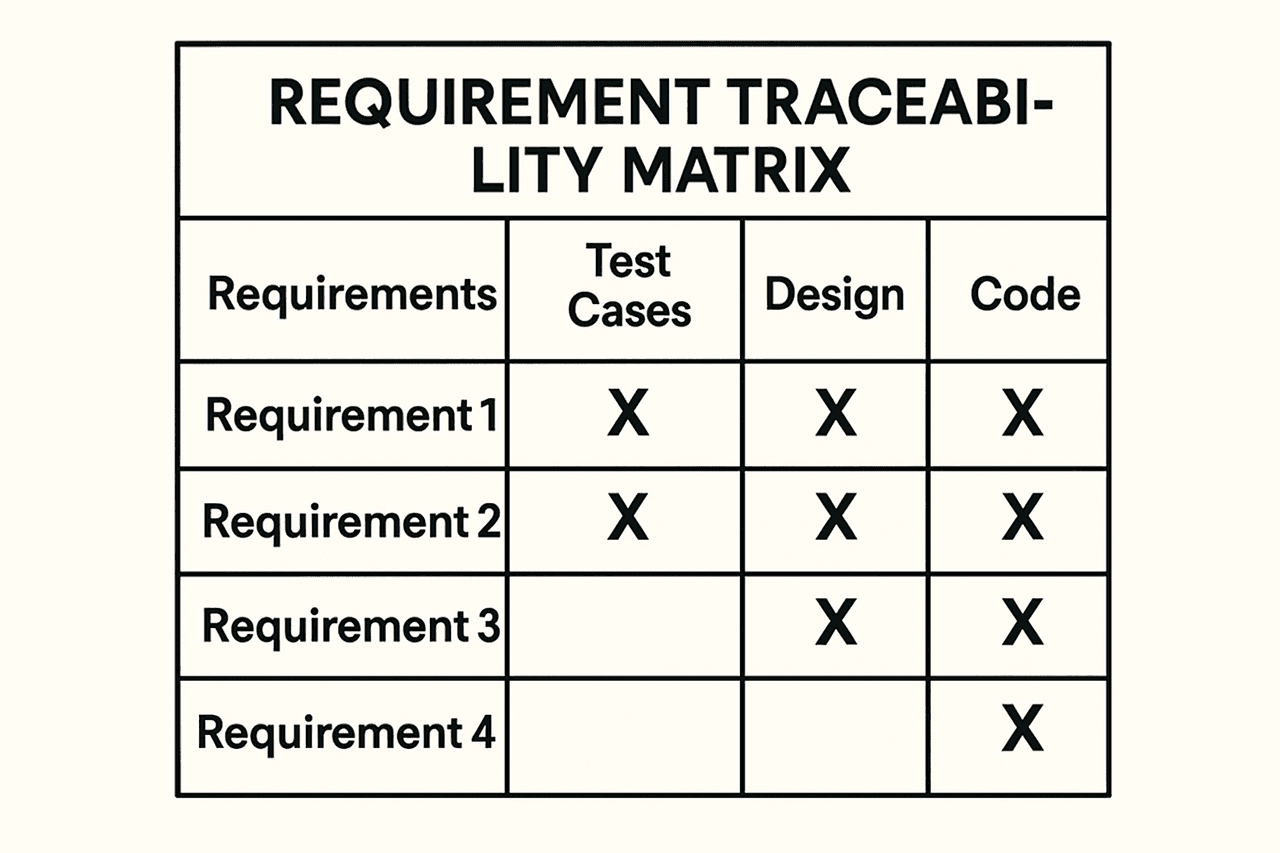
Traceability Matrix
(Generated with AI)
Objectives | Demonstrate Regulatory Compliance Facilitate Defect Management Provide Transparency In Project Management Prevent Unnecessary Workload Ensure Traceability | ||||||||
|---|---|---|---|---|---|---|---|---|---|
Key Components | Notes / Comments Priority Defect ID Test Status Test Case ID Source Requirement Description Requirement ID | ||||||||
Steps | Maintenance Validation Establish Links Design the Matrix Design Test Scenarios Collect Requirements Define Objectives | ||||||||
The Traceability Matrix is a table that links two or more key documents—typically the requirements document containing customer needs and the test plan containing test scenarios—verifying the integrity of the relationship between them. This document is commonly referred to as the Requirements Traceability Matrix (RTM). RTM ensures that all requirements provided by the customer are validated through corresponding test scenarios, guaranteeing that no functional requirement is left unverified.
The objective of the Traceability Matrix in a software development project is to ensure the traceability of all requirements requested by the customer or stakeholders throughout every stage of development and testing. This ensures that the final product is aligned with the initially defined business goals and user needs.
One of the key goals of RTM is to eliminate unnecessary workload and prevent waste of resources. By mapping each requirement directly to a test scenario, project teams avoid developing non-essential features or code segments. This helps to minimize the risk of scope creep during the project lifecycle.
Additionally, the RTM enhances transparency in project management. Since each requirement’s validation status is traceable via the associated test scenario, project teams, auditors, or regulatory bodies can verify how each requirement is addressed by the product.
Moreover, the RTM serves as a concrete tool for quality assurance. In the event of a defect, the related requirement can be traced back, facilitating rapid root-cause analysis. This accelerates the defect resolution process, clarifies test coverage, and ultimately improves the overall quality of the final product.
Today’s software projects involve a degree of uncertainty due to both technological complexity and rapidly changing requirements. This makes it difficult to fully meet all specified needs. At this point, the Traceability Matrix (RTM) plays a critical role in ensuring project success.
Firstly, the Traceability Matrix functions as an auditing mechanism in requirements management. Since each requirement can be tracked throughout the development and testing stages, project teams can verify whether all requirements are being fully addressed. This transparency is particularly beneficial during internal and external audits, serving as strong evidence for regulatory compliance.
Another key benefit of the RTM is its contribution to defect management. Errors identified during testing can be quickly traced back to their associated requirements via the RTM. This enables teams to understand the root cause and accelerate the resolution process. As a result, product quality is improved while costs associated with defects are reduced.
Furthermore, the RTM enhances communication among project stakeholders. Developers, testers, and business analysts can refer to a single shared reference point to stay informed about the status of requirements. This fosters faster information flow within the team and supports data-driven decision-making.
Finally, the RTM is indispensable in highly regulated industries such as aerospace, automotive, and medical devices. It provides traceable evidence required in audits and quality certifications, helping organizations demonstrate their compliance with legal and regulatory obligations.
In software testing processes, traceability matrices are commonly classified into three main types: forward traceability, backward (reverse) traceability, and bidirectional traceability. This classification defines how requirements and test cases are related and managed throughout the project lifecycle.
A forward traceability matrix shows which test cases validate each requirement defined at the beginning of the project. The focus here is on tracking the progression from requirements to test cases. This type of matrix ensures that all specified functions are being correctly implemented as the project evolves.
A backward traceability matrix enables test cases to be traced back to their corresponding requirements. This approach helps eliminate redundant or unnecessary test scenarios. Since unnecessary tests or features not tied to any requirement can waste time and resources, reverse traceability helps mitigate this risk and maintain project efficiency.
The most comprehensive approach, a bidirectional traceability matrix, incorporates both forward and backward traceability. It ensures that each requirement is linked to one or more test cases and that each test case can be traced back to a requirement. This dual-direction mapping guarantees complete test coverage, prevents unnecessary workload, and reveals how changes in requirements impact the system as a whole.
For a traceability matrix to be functional, it must include certain essential components. These components elevate the matrix from being a simple table to serving as a dynamic project control tool.
These components transform the Requirements Traceability Matrix (RTM) into a powerful and dynamic project management tool. Especially in large-scale projects involving hundreds of requirements and test cases, maintaining these elements accurately within the matrix is critical for effective project tracking and quality assurance.
Creating a Traceability Matrix (TM) is a critical step for ensuring that project management and software testing processes are conducted in a structured and transparent manner. The process typically follows a systematic structure consisting of the following key steps:
The Traceability Matrix is widely utilized across various industries and project types. Fundamentally, it is indispensable in fields where quality assurance and regulatory compliance are critical:
Duraisamy, Gunavathi, and Rodziah Atan. “Requirement Traceability Matrix Through Documentation for Scrum Methodology.” Journal of Theoretical & Applied Information Technology 52, no. 2 (2013): 154–159. Accessed July 19, 2025. Access Address.
GeeksforGeeks. Requirements Traceability Matrix - RTM. 2025. Accessed July 19, 2025. Access Address.
Putro, Hanson Prihantoro, and Apriliana Fajri Wibowo. “Software Verification and Validation on Object Oriented Software Development Using Traceability Matrix.” In 2018 Third International Conference on Informatics and Computing (ICIC), pp. 1–5. IEEE, 2018. Accessed July 19, 2025. Access Address.
Yang, Meihong, Jun Wang, Ping Yang, and Feng Li. “An Ontology Based Improved Software Requirement Traceability Matrix.” In 2009 Second International Symposium on Knowledge Acquisition and Modeling, vol. 1, pp. 160–163. IEEE, 2009. Accessed July 19, 2025. Access Address.

Traceability Matrix
(Generated with AI)
Objectives | Demonstrate Regulatory Compliance Facilitate Defect Management Provide Transparency In Project Management Prevent Unnecessary Workload Ensure Traceability | ||||||||
|---|---|---|---|---|---|---|---|---|---|
Key Components | Notes / Comments Priority Defect ID Test Status Test Case ID Source Requirement Description Requirement ID | ||||||||
Steps | Maintenance Validation Establish Links Design the Matrix Design Test Scenarios Collect Requirements Define Objectives | ||||||||
Henüz Tartışma Girilmemiştir
"Traceability Matrix" maddesi için tartışma başlatın
Objectives of the Traceability Matrix
The Importance of the Traceability Matrix
Types of Traceability Matrices
Forward Traceability Matrix
Backward (Reverse) Traceability Matrix
Bidirectional Traceability Matrix
Key Components of a Traceability Matrix
Steps to Create a Traceability Matrix
Use Cases of the Traceability Matrix
Bu madde yapay zeka desteği ile üretilmiştir.