


Bu içerik Türkçe olarak yazılmış olup yapay zeka ile otomatik olarak İngilizceye çevrilmiştir.
+1 Daha
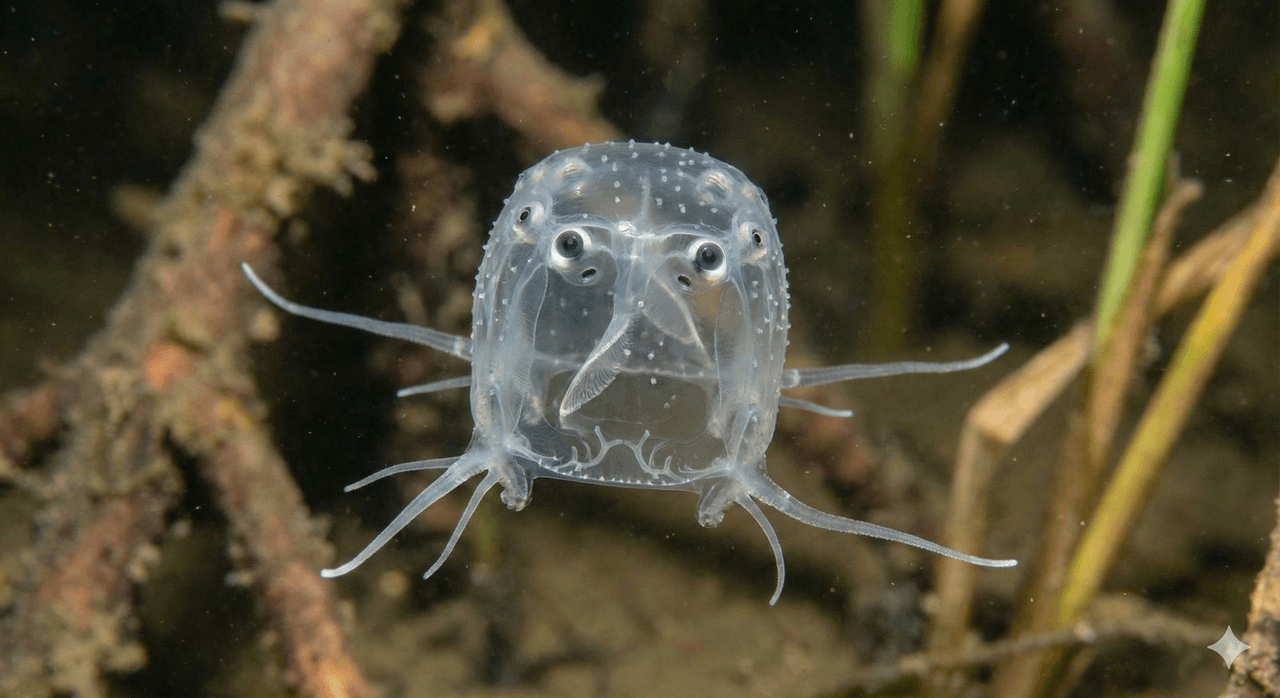
Tripedalia Maipoensis (Yapay zeka ile oluşturulmuştur)
During zoological investigations conducted in the brackish water ecosystems of the Mai Po region, the species Tripedalia maipoensis was identified as a member of the class Cubozoa, commonly known as box jellyfish. The species was recognized as an independent taxon within the family Tripedaliidae based on both morphological and genetic characteristics. The description process involved analysis of specimens collected over several years during different seasons, revealing detailed distinguishing structural and genetic traits.
New box jellyfish species discovered in Hong Kong (New Scientist)
Tripedalia maipoensis is classified within the kingdom Animalia, phylum Cnidaria, subphylum Medusozoa, and class Cubozoa. It is placed in the genus Tripedalia of the family Tripedaliidae, which belongs to the order Carybdeida. The species name derives from Mai Po, the region where the specimens were first collected, and is presented in its Latinized form. This species is the fourth to be described within the family Tripedaliidae and represents the first recorded species of this family from Chinese coastal waters.
Individuals of the species were collected from shrimp ponds located within the Mai Po Nature Reserve in Hong Kong, locally known as “gei wai.” These ponds exhibit brackish characteristics due to the mixing of freshwater and seawater and are connected to the estuarine system via tidal channels. Sampling was carried out during spring and summer months in 2020, 2021, and 2022. The consistent observation of the species during similar periods each year indicates regular use of this habitat across its life cycle.
The medusa stage of Tripedalia maipoensis possesses a transparent, colorless, and cuboidal bell structure. The bell margins are rounded and covered with nematocyst-bearing tubercles of varying sizes. The average bell height measures approximately 12–13 mm. At each of the four corners of the bell, three pedalia are present, each bearing a single tentacle. The tentacles are unbranched and richly endowed with nematocysts.

Tripedalia maipoensis (generated by artificial intelligence)
One of the most striking anatomical features of this species is its total of 24 eyes. These eyes are arranged in groups of six on each of the four rhopalia located along the bell margin. Each rhopalium contains two lensed eyes capable of image formation. The remaining four eyes on each rhopalium are slit-shaped or pit-like and serve primarily for light and dark detection. This arrangement indicates the development of a sophisticated directional sensing system responsive to environmental light conditions.
In Tripedalia maipoensis, the velarium has a smooth surface and lacks nematocyst tubercles. The velarial canals exhibit a branched and highly ramified structure, a key distinguishing feature separating this species from its close relatives within the same genus. The stomach is smooth with brush-like gastric filaments located at its corners. The manubrium extends to approximately half the height of the bell and displays a four-lobed structure.
Significant differences in gonad morphology were observed between male and female individuals. In females, the gonads are slender and wing-like in appearance, whereas in males they are broader with rounded terminations. In both sexes, the gonads extend from the stomach to the velarium. In live specimens, gonad coloration varied from pale white to light yellow.
The recognition of Tripedalia maipoensis as an independent taxon is supported not only by morphological data but also by molecular evidence. Analyses of the 16S, 18S, and 28S ribosomal RNA genes revealed that Tripedalia maipoensis is a sister species to Tripedalia cystophora. A genetic divergence of approximately 17.4% was detected in the 16S rRNA sequence between the two species, a level considered sufficient for species-level distinction. Genetic variation among individuals within the species, however, was found to be very low.
Tripedalia maipoensis has been recorded in shrimp ponds characterized by brackish water and surrounded by mangroves and reed beds. The species was observed under water temperatures ranging from 20 to 29 °C and salinities between 5.8 and 18 psu. Observations indicate that individuals concentrate in areas surrounded by water channels and dense vegetation. The connection of these ponds to estuaries via tidal systems suggests the potential for the species to occur in adjacent waters.
Although direct experimental data are limited, the eye structure and rhopalial arrangement of this species indicate a highly developed sensory system capable of phototaxis and detection of environmental obstacles. When compared with observations of other species within the same genus, Tripedalia maipoensis is inferred to exhibit similar behaviors in spatial orientation and habitat selection.
Earth.com. "Strange Creature with 24 Eyes Discovered in a Hong Kong Pond." Accessed December 15, 2025. https://www.earth.com/news/strange-cubic-tripedalia-jellyfish-with-24-eyes-discovered-hong-kong/
FOX 13 Tampa Bay. “See It Before It Sees You: New Species of Jellyfish Found with 24 Eyes.” Accessed December 15, 2025. https://www.foxweather.com/earth-space/new-species-jellyfish-found-24-eyes
Popular Mechanics. "A New Creature With 24 Eyes Can See In Every Direction At Once." Accessed December 15, 2025. https://www.popularmechanics.com/science/animals/a69656540/new-box-jellyfish/
Sputnik Türkiye. “24 Gözlü Yeni Bir Canlı Keşfedildi: Aynı Anda Her Yöne Bakabiliyor.” Anlatılanın Ötesi, Accessed December 15, 2025. https://anlatilaninotesi.com.tr/20251215/24-gozlu-yeni-bir-canli-kesfedildi-ayni-anda-her-yone-bakabiliyor-1101817797.html
Sun, Yanan, Justin Hon Yin Tsui, Rachel Ting Huen Wong, Ringo Nga Ching Cheung, Murphy Kam Pui Ng, Carmen K. M. Or, and Jian-Wen Qiu. “A New Species of Box Jellyfish (Cnidaria: Tripedaliidae: Tripedalia) from Hong Kong, China.” *Zoological Studies* 62 (2023): 17. https://pmc.ncbi.nlm.nih.gov/articles/PMC10165347/
YouTube. "New box jellyfish species discovered in Hong Kong." New Scientist, Accessed December 15, 2025. https://www.youtube.com/watch?v=oV2d8DhTrGs

Tripedalia Maipoensis (Yapay zeka ile oluşturulmuştur)
Henüz Tartışma Girilmemiştir
"Tripedalia Maipoensis" maddesi için tartışma başlatın
Taxonomic Position and Nomenclature
Discovery Process and Sampling
General Morphological Features
Sensory Structures and Eye Arrangement
Velarium and Internal Anatomy
Reproductive Structures and Sexual Dimorphism
Genetic and Phylogenetic Findings
Habitat and Ecological Characteristics
Behavior and Sensory Capabilities