

Bu içerik Türkçe olarak yazılmış olup yapay zeka ile otomatik olarak İngilizceye çevrilmiştir.
+2 Daha
Location | Çanakkale Türkiye | ||||||||
|---|---|---|---|---|---|---|---|---|---|
Opening Date(s) | 2018 | ||||||||
Highlights | Artifacts from the Troy Excavations, Archaeology of the Troad Region | ||||||||
Related Area | Ancient City of Troy (UNESCO World Heritage Site) | ||||||||
Troya Museum is an archaeological museum located at the entrance of the Ancient City of Troy, in the village of Tevfikiye, Çanakkale Province. Opened to the public in 2018, the museum was constructed based on a design selected through a national architectural competition held in 2013. Built on a 100-dunam site, the museum features a covered area of 11,200 square meters and embodies a contemporary museum concept.
The museum building is designed to symbolize the historical layers of Troy through its geometric simplicity, rusted steel surfaces, and monolithic appearance. Its structure creates the impression of rising from beneath the ground, inviting visitors on an archaeological journey. Visitor circulation follows a spiral path ascending from the ground floor to upper levels, before returning to the entrance via staircases.

Troya Museum ( Culture Portal )
The Troya Museum displays archaeological artifacts not only from the Ancient City of Troy but also from the entire Troad region. The museum’s collection includes over 2,000 objects spanning from the Prehistoric Age through the Roman and Byzantine periods. The majority of these artifacts were recovered during excavations at Troy. Notable items include gold jewelry, marble statues, glass vessels, ceramics, and funerary stelae.
The exhibition is organized around four main thematic categories:

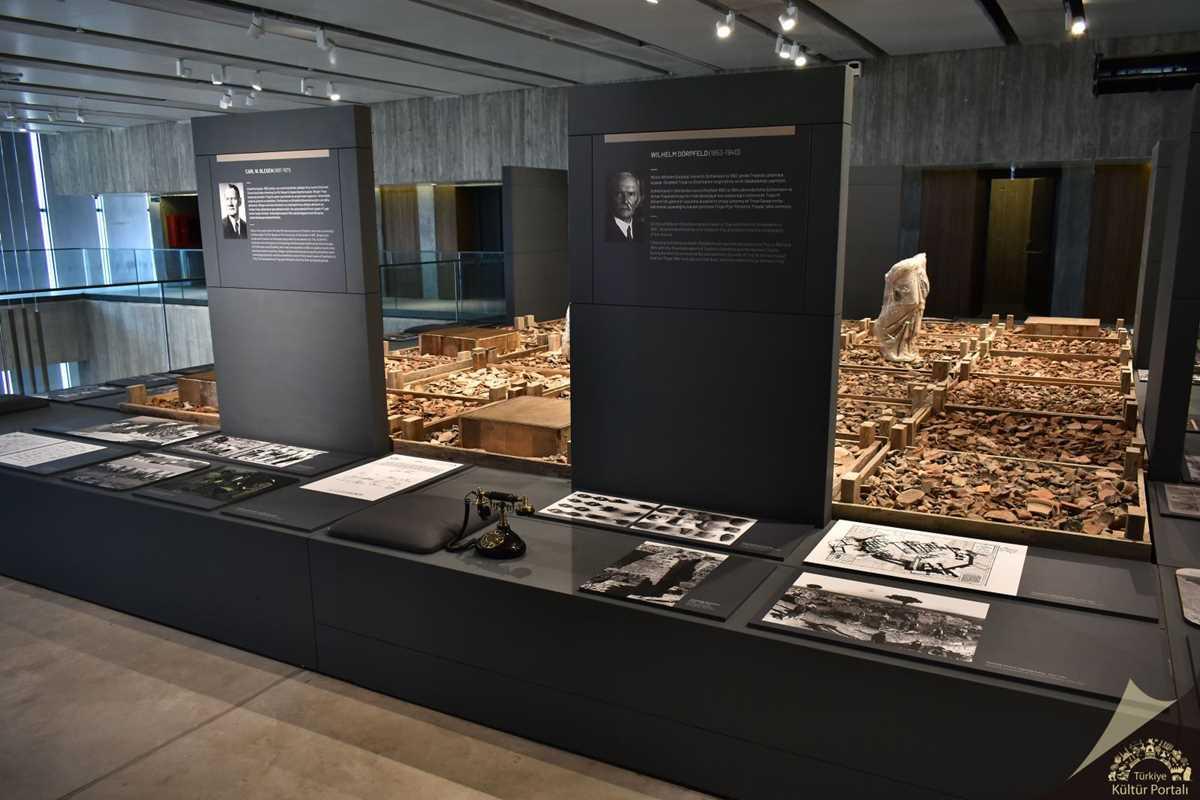
General View of Second Floor Exhibits ( Culture Portal )
The Troya Museum building has received architectural acclaim at both national and international levels. The ground floor houses temporary exhibition halls, a gift shop, a cafeteria, and multipurpose spaces, while the upper floors are dedicated to permanent exhibitions. The interior design incorporates digital interactive panels, animations, and projection-based presentations. A modeled representation of Troy’s stratigraphic layers visually conveys the city’s evolution over time.
The Troya Museum is directly integrated with the Ancient City of Troy, which is listed on the UNESCO World Heritage List. The museum serves as the first stop for visitors arriving at the ancient site, functioning as both a scientific and tourist information and orientation center.
The Troya Museum has become an international reference point in the fields of archaeology and museology, playing a vital role in the preservation of cultural heritage through its contemporary design, rich collection, and academic infrastructure.
Culture Portal. "Troya Müzesi." *Republic of Turkey Ministry of Culture and Tourism Culture Portal*. Accessed June 25, 2025. https://www.kulturportali.gov.tr/portal/troya-muzesi.
T.C. Ministry of Culture and Tourism. "Troya Müzesi." *T.C. Ministry of Culture and Tourism Museums and Archaeological Sites*. Accessed June 25, 2025. https://muze.gov.tr/muze-detay?SectionId=TRO01&DistId=TRO.
T.C. Çanakkale Valiliği. "Troya Müzesi - Ören Yeri." Çanakkale Valiliği Resmi Web Sitesi. Accessed June 25, 2025. http://www.canakkale.gov.tr/troya-muzesi---oren-yeri.
Çanakkale İl Directorate of Culture and Tourism. "Troya Müzesi." Çanakkale Kültür veTurizm İl Müdürlüğü. Accessed June 25, 2025. https://canakkale.ktb.gov.tr/TR-70510/troya-muzesi.html.

Location | Çanakkale Türkiye | ||||||||
|---|---|---|---|---|---|---|---|---|---|
Opening Date(s) | 2018 | ||||||||
Highlights | Artifacts from the Troy Excavations, Archaeology of the Troad Region | ||||||||
Related Area | Ancient City of Troy (UNESCO World Heritage Site) | ||||||||
Henüz Tartışma Girilmemiştir
"Troya Museum" maddesi için tartışma başlatın
Collection and Exhibition Layout
Museum Architecture and Design Approach
Integration with the Ancient City of Troy