


Bu içerik Türkçe olarak yazılmış olup yapay zeka ile otomatik olarak İngilizceye çevrilmiştir.
+2 Daha
Von Thünen Model is a theory developed in the 19th century by a German economist that outlines how rural hinterlands organize agricultural production around a central urban market. The model proposes fundamental patterns and principles of land use in agriculture. The roots of the theory of agricultural location extend back to Johann Heinrich Von Thünen’s 1826 work, Der Isolierte Staat (The Isolated State). The model’s key contribution lies in treating the spatial characteristics of a property as a source of land rent.
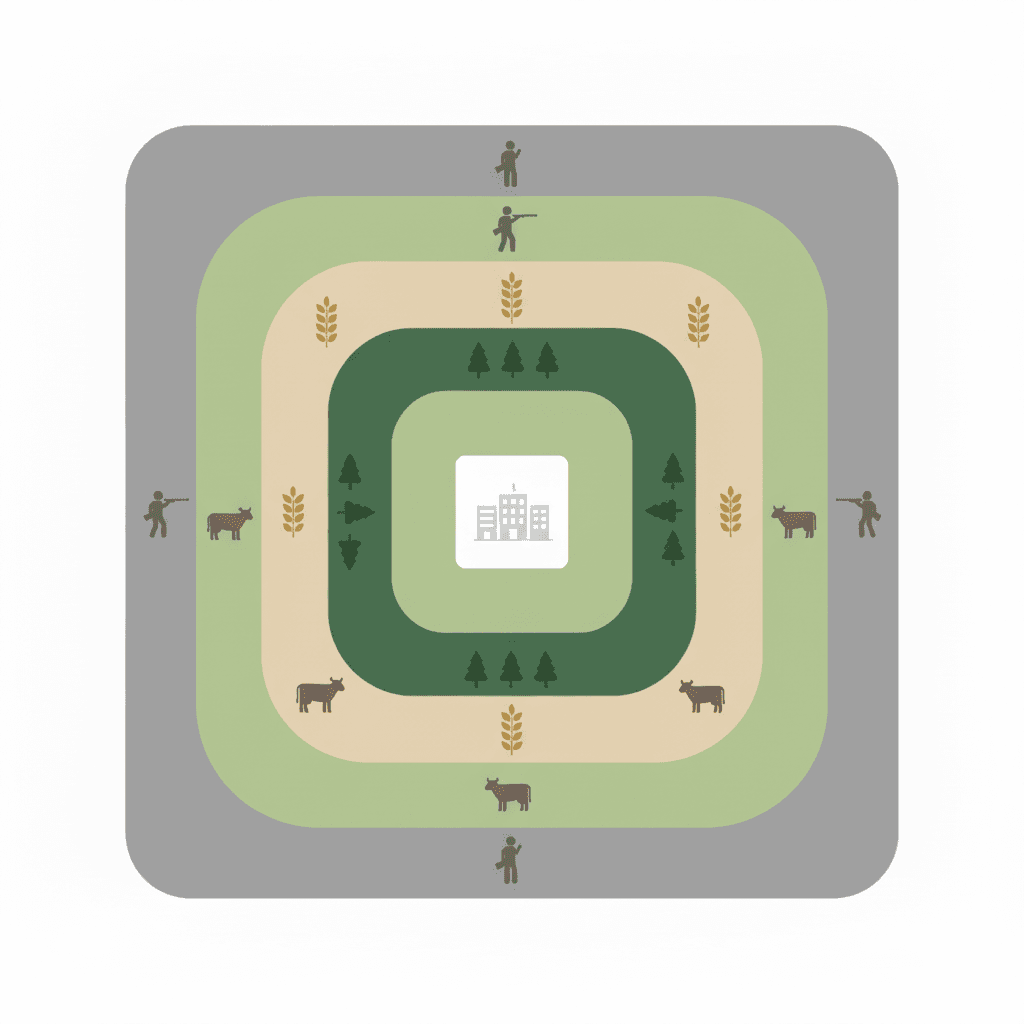
Visual Representation of the Von Thünen Model (Generated by Artificial Intelligence)
The model is based on an idealized area called the “Isolated State.” Its assumptions include perfectly rational optimizing economic behavior, a single central city, uniform topography, identical climate and soil fertility, and primitive uniform transportation conditions.
The core idea behind the model is that different locations have varying levels of accessibility. Land closer to the market (central city) entails lower transportation costs compared to land farther away. Modern urban land use theory is derived from Von Thünen’s (1826) model and posits that land values (capitalized as rent) decline with increasing distance from the central business district. According to Thünen’s model, the owner of the best land—the closest to the center—can demand higher rent because lower transportation costs make the land more profitable. This variation in land rent or net income, as Thünen defined it, is also the source of differences in product intensity.
The core of Thünen’s theory concerns the comparative advantages of intensive versus extensive agricultural operations. An intensive operation is defined as one that uses more capital and labor per unit of land. There is an inverse relationship between intensity and distance. Analyses by Garrison and Marble (1957) show that, assuming a single production function, intensity decreases with distance from the market.
The mechanism of land use choice allocates land closest to the market to products with the highest cost increases over distance. Products yielding higher rent are cultivated nearer to the market. Von Thünen stated: “As distance from the town increases, land will be devoted increasingly to products whose transportation costs relative to their value are lowest.”
As a consequence of this economic mechanism, a series of concentric rings forms around the market. In Von Thünen’s calculation for 19th century Northern Germany, six rings were identified: Horticulture and Dairy, Forestry, Intensive Cropping Rotation, Improved System, Three-Field System, and Ranching. Beyond these cultivated zones lies wilderness.
Some geographers have argued that the model is overly simplistic because it ignores historical context and assumes a “featureless plain” focused solely on transportation costs. Critics contend that the Von Thünen model is static, neglects land ownership structures, and fails to account for functional relationships between multiple urban centers. Others argue that the model has lost relevance in the internet age as improved transportation reduces costs and markets become globalized.
Conversely, it has been noted that distance to market continues to influence product selection in many regions and that concentric zone patterns similar to Von Thünen’s have been observed in places such as Ethiopia, northern India, and the United States.
The model provided the foundation for modern urban land use theory, as developed in the works of Alonso (1964), Muth (1969), and Mills (1972, 1980). Urban models assert that land values decline with distance from the central business district due to the diminishing availability of amenities such as employment and income. When a new industry—such as casinos in New Jersey—enters a region, it generates positive amenities like jobs and higher income, increasing property values; this increase diminishes with distance from the center.
However, this new industry may also generate negative externalities such as crime. In such cases, a reversed Von Thünen model has been proposed: living farther from the source of crime becomes advantageous. A study of Atlantic City showed that casinos brought jobs and higher property values to the region but also brought higher crime rates compared to the pre-casino era. Such studies demonstrate that a Von Thünen model—or its inverse—can be applied to explain the spatial distribution of crime and its impact on property values.
A study using data from China’s “One Village, One Product” (OVOP) policy tested the validity of Thünen’s theory in contemporary agricultural location. The research examined agricultural location patterns around both metropolitan centers at the provincial capital level and smaller cities at the county level.
The findings suggest that the core principles of the Thünen model remain valid.
The Von Thünen Model has been integrated with the Heckscher-Ohlin (H-O) model of international trade. This integrated model combines two approaches to determine a country’s production and trade pattern:
In this combined model, unlike in Thünen’s original analysis where workers could move costlessly, production factors (such as labor) are assumed to be geographically immobile.
This integrated approach introduces the concept of “transport intensity,” which accounts for both the transportation cost of the final product and the transportation cost of intermediate inputs used in production (e.g., imported inputs). It is expressed as the total transportation cost per unit of value added.
According to the model, predicting a country’s trade pattern requires more than just knowing its factor endowments (H-O) or its location (Von Thünen). The interaction between geography and endowments leads to the division of the world into distinct economic regions.
(All else being equal) more remote locations have lower real incomes. The cost of remoteness is already embedded in the factor prices of these distant regions (e.g., wages). This affects decisions about where to locate a new activity. Although a remote location appears disadvantageous due to high transportation costs (for both intermediate imports and final exports), this disadvantage may be offset by lower factor prices in that region.
Buck, Andrew J., Alan F. Collins, Stephen E. Robbins, Richard J. Robbins, and Joseph M. Simpson. “A von Thünen Model of Crime, Casinos and Property Values in New Jersey.” *Urban Studies* 28, no. 5 (1991): 673–686. Accessed October 24, 2025. https://journals.sagepub.com/doi/abs/10.1080/00420989120080861.
Han, Hongyun, Zhen Yuan, and Kai Zou. “Agricultural Location and Crop Choices in China: A Revisitation on von Thünen Model.” *Land* 11, no. 11 (2022): 1885. Accessed October 24, 2025. https://doi.org/10.3390/land11111885; https://www.mdpi.com/2073-445X/11/11/1885.
Venables, Anthony J., and Nuno Limao. “Geographical Disadvantage: A Heckscher–Ohlin–von Thünen Model of International Specialisation.” *Journal of International Economics* 58, no. 2 (2002): 239–263. Accessed October 24, 2025. https://www.sciencedirect.com/science/article/abs/pii/S0022199601001684.

Henüz Tartışma Girilmemiştir
"Von Thünen Model" maddesi için tartışma başlatın
Theoretical Foundations and Assumptions
Origin and Assumptions
Land Rent (Bid Rent) and Distance
Production Intensity and Land Use
Concentric Rings
Criticisms and Validity Debates
Applications and Extensions
Urban Economics and Negative Externalities
Modern Agricultural Location
International Trade Integration
The Heckscher-Ohlin-von Thünen Model
Transport Intensity
Economic Regions and Factor Prices