

The Zeugma Mosaic Museum is an important museum located in Gaziantep, where mosaics excavated from the ancient city of Zeugma are displayed. Opened in 2011, the museum is the largest mosaic museum in Turkey, covering an area of 30,000 square meters. The museum has a total exhibition area of 2,815 square meters, which includes 2,448 square meters of mosaics from the Roman and Late Antiquity periods, 140 square meters of wall paintings, 4 Roman-period fountains, 20 columns, 4 limestone statues, and a 50-square-meter tomb.
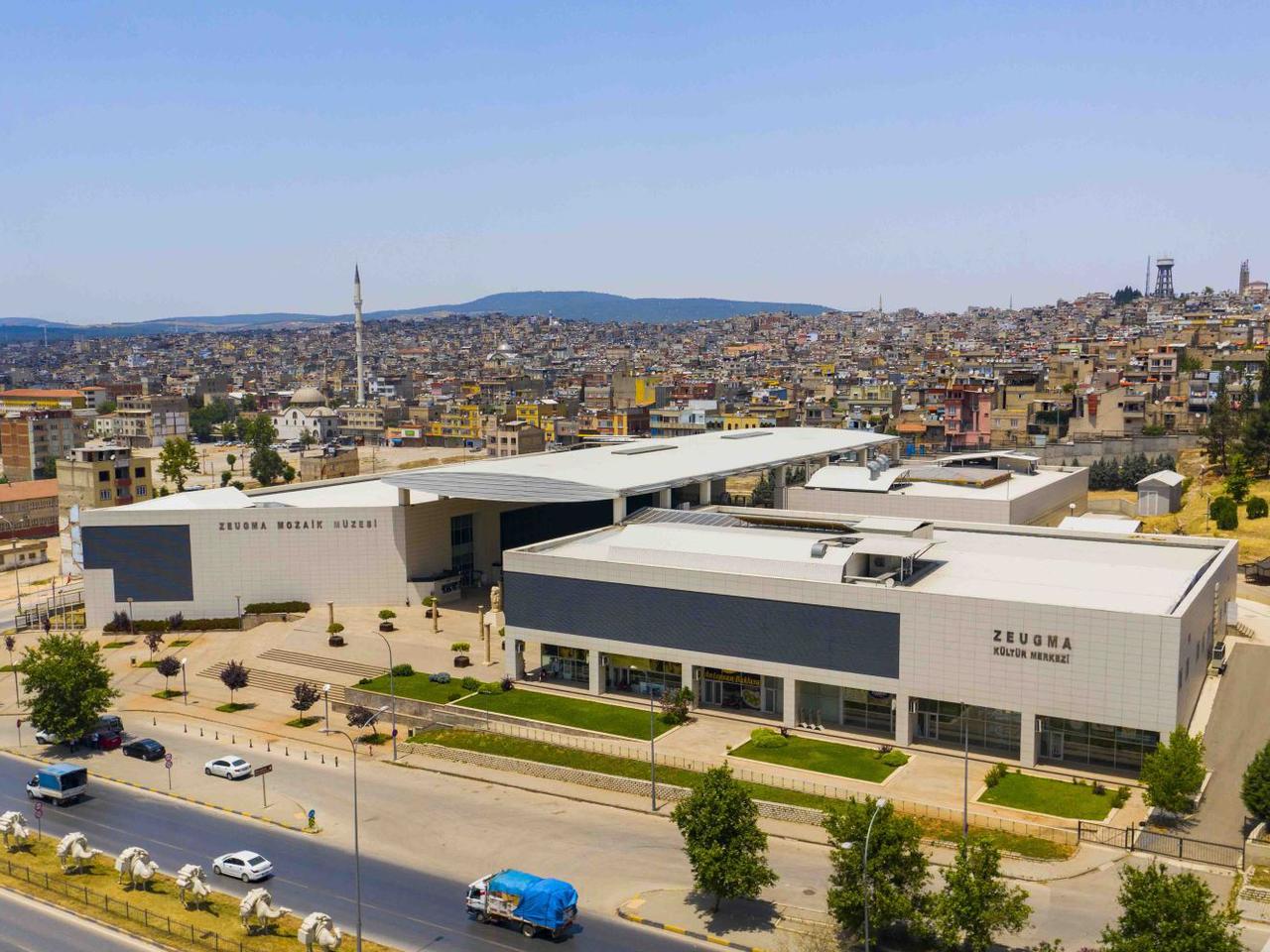
Zeugma Mosaic Museum (Photo: Official Turkish Museums)
Zeugma Ancient City was founded by Seleucus I Nicator, one of Alexander the Great’s generals. It became an important military and commercial center within the Seleucid Kingdom. Due to its strategic location, the city was constructed for military purposes and played a crucial role in the security and trade control of the region.
The city is located in the Nizip district of Gaziantep Province, west of Belkıs village, and spreads across both sides of the Euphrates River. Excavations in the Seleukeia section, located on the western bank of the Euphrates, have uncovered Paleolithic stone tools, proving that the area has a settlement history dating back to prehistoric times. Additionally, a Bronze Age cemetery (necropolis) found to the east of Belkıs village indicates that a settlement has existed in the area since 3000 BC.
One of the most notable features of the Zeugma Ancient City is the Roman villas, which have only been partially uncovered through excavations, and the mosaics that adorn the floors of these villas. These hillside villas, which can only be found in similar form in Ephesus within Turkey, are of great archaeological value. The mosaics discovered in the "A Region" excavations, covering a total area of 1,000 square meters, prove that Zeugma is indeed a mosaic city.
Due to its position at the crossroads of trade routes and its strategic importance as a military garrison, the city became an attractive center for artists of the time. Because it was a rich and secure city, even retired soldiers began to settle in the area, and some of the most skilled artists of the period flocked to Zeugma. These artists left behind valuable works such as mosaics, frescoes, and sculptures that have survived to the present day.
In addition to its economic prosperity, Zeugma continued its development in the fields of culture and art. Apameia, located directly across the river from the city, could not compete with Zeugma after the Hellenistic period and was abandoned. In the 2nd century AD, there was a wooden bridge made of tree trunks between Zeugma and Apameia. The villa-type settlements in Zeugma extended from this bridge to the foot of Belkıs Hill, which rises to about 300-350 meters in the west.
The city’s topography resembles that of a hillside city. The necropolis was located on the southern and western slopes, the neighborhoods were located to the east and northeast, and the administrative structures and legion areas were located in the northern part. At the top of Belkıs Hill, there was a temple dedicated to Tyche, the Goddess of Fortune and Fate, frequently depicted on Zeugma coins. The tradition of villas, which began in the Hellenistic period, is characterized by the preference for scenic and elevated locations, and during the Roman period, these areas were considered residential sites for the aristocracy. Thus, the city and villas were positioned on terraces toward the hills.
This mosaic, discovered in 1992 when the Zeugma excavations were not yet widely known, features a female figure whose mysterious gaze has made her a symbol of both Zeugma and Gaziantep. Initially, her identity was uncertain, but the mosaic was named "Gypsy Girl" because the woman resembled the gypsy girls. However, some sources suggest that this figure may depict the earth goddess "Gaia."
The mosaic uses a special technique to make the Gypsy Girl's gaze more striking. The simultaneous reflection of joy and sorrow on her face demonstrates the advanced nature of portrait art. The artwork was made using the "three-quarter gaze" technique, which was commonly used in Hellenistic period painting. This technique was used by many great artists in history, including Leonardo da Vinci in his famous painting, the Mona Lisa.
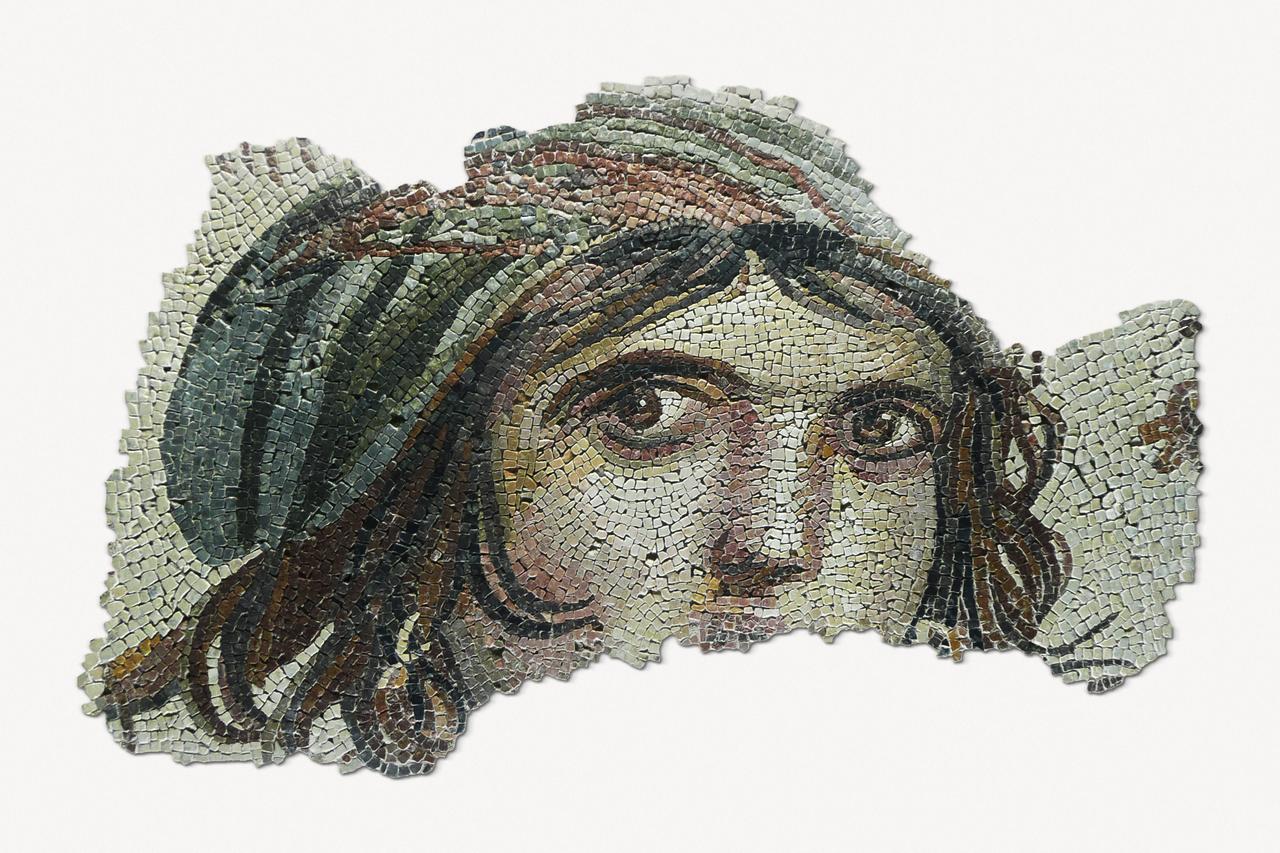
Gypsy Girl Mosaic (Photo: Rawpixel.com)
The Oceanos and Tethys Mosaic is located at the bottom of a shallow pool in the Oceanos Villa and dates back to the Early Roman Imperial Period. The mosaic depicts Oceanos, the river god and source of life, with his wife Tethys. The mosaic is framed by a geometric triple weave border, with Oceanos and Tethys at the center, surrounded by various fish species and Cupids riding dolphins, symbolizing the fertility of the sea. Oceanos is depicted with serpents and fish, which are his most frequently used symbols.
Oceanos is depicted with crab claws on his head, which are one of his most recognizable features. While some ceramic depictions show his feet replaced with an eel's tail, he is usually portrayed as a bust, with only the claws on his head.
Tethys is positioned beside Oceanos, with wings on her forehead. In between them is a mythological sea creature, a serpent-bodied Ketos (dragon). Similar to the Zeugma coins where the Euphrates River is depicted as a dragon, this figure also serves as a symbol of the river. In the upper right corner of the mosaic, there is a young man fishing from a rock. This figure is thought to represent Pan, the protector god of shepherds. The placement of the figures of the Cupids and Pan facing outward suggests that the images in the mosaic were arranged in a way that they could be viewed as one walked around the pool.
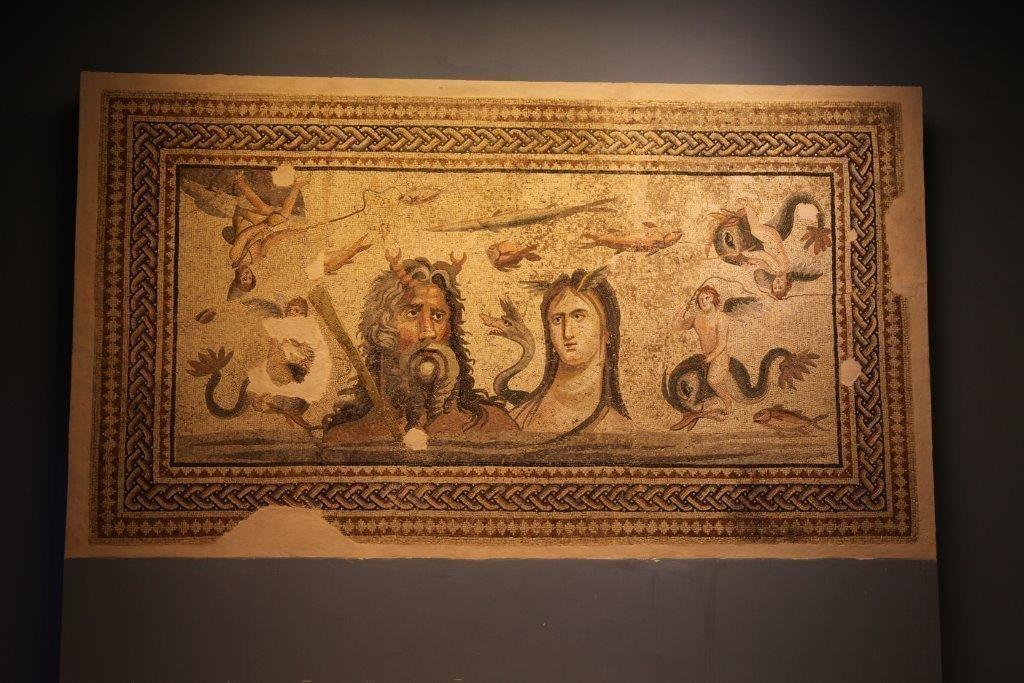
The Oceanos and Tethys Mosaic (Photo: Gaziantep Zeugma Mosaic Museum Directorate)
In 1998, the Gaziantep Museum discovered a significant mosaic during salvage excavations in Belkıs/Zeugma Kelekağzı. The mosaic depicts a scene of Akratos and Euphrosyne sitting on a couch. Akratos is filling Euphrosyne's cup with a rhyton, a drinking vessel shaped like a deer’s head, and a large drinking vessel (krater) is shown at the bottom left. Euphrosyne, one of the three Graces, symbolizes joy, beauty, and brightness. She is the daughter of Zeus and Eurynome. Akratos, on the other hand, represents a powerless and helpless man in the presence of women.
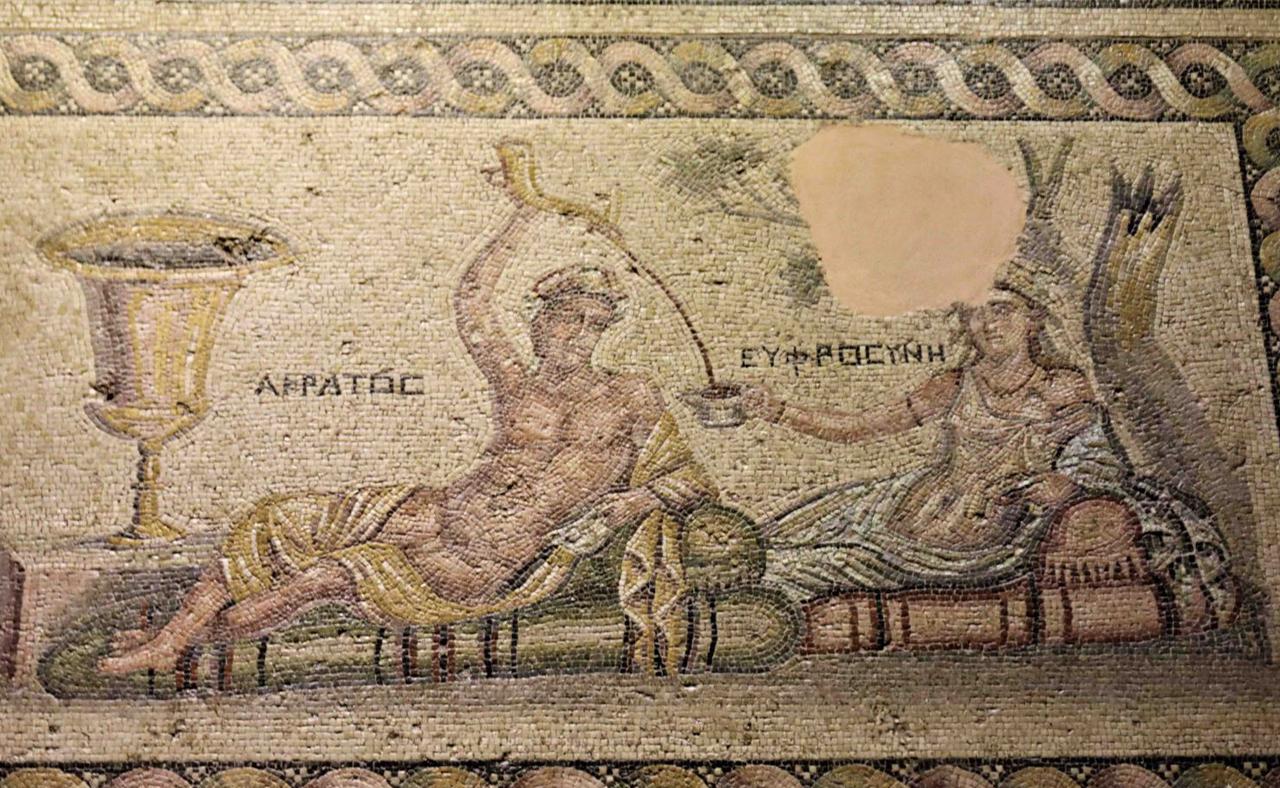
Akratos and Euphrosyne Mosaic (Photo: Gaziantep Zeugma Mosaic Museum Directorate)
In Greek mythology, Thetis, the mother of Achilles, sends him to the palace of King Lycomedes on the island of Skyros to hide, where Achilles disguises himself in women’s clothing and mingles with Lycomedes' daughters. However, prophecies begin to emerge that for Troy to be conquered, Achilles must join the war. Odysseus, knowing Achilles’ warrior identity and desire for battle, comes up with a clever plan. He enters the palace disguised as a traveling merchant, bringing clothes, jewelry, and female items that will interest the girls, along with a few weapons. As the girls become distracted with the jewelry, Achilles, unable to resist, picks up the weapons, revealing his true identity. This significant moment is depicted in a mosaic in Zeugma.
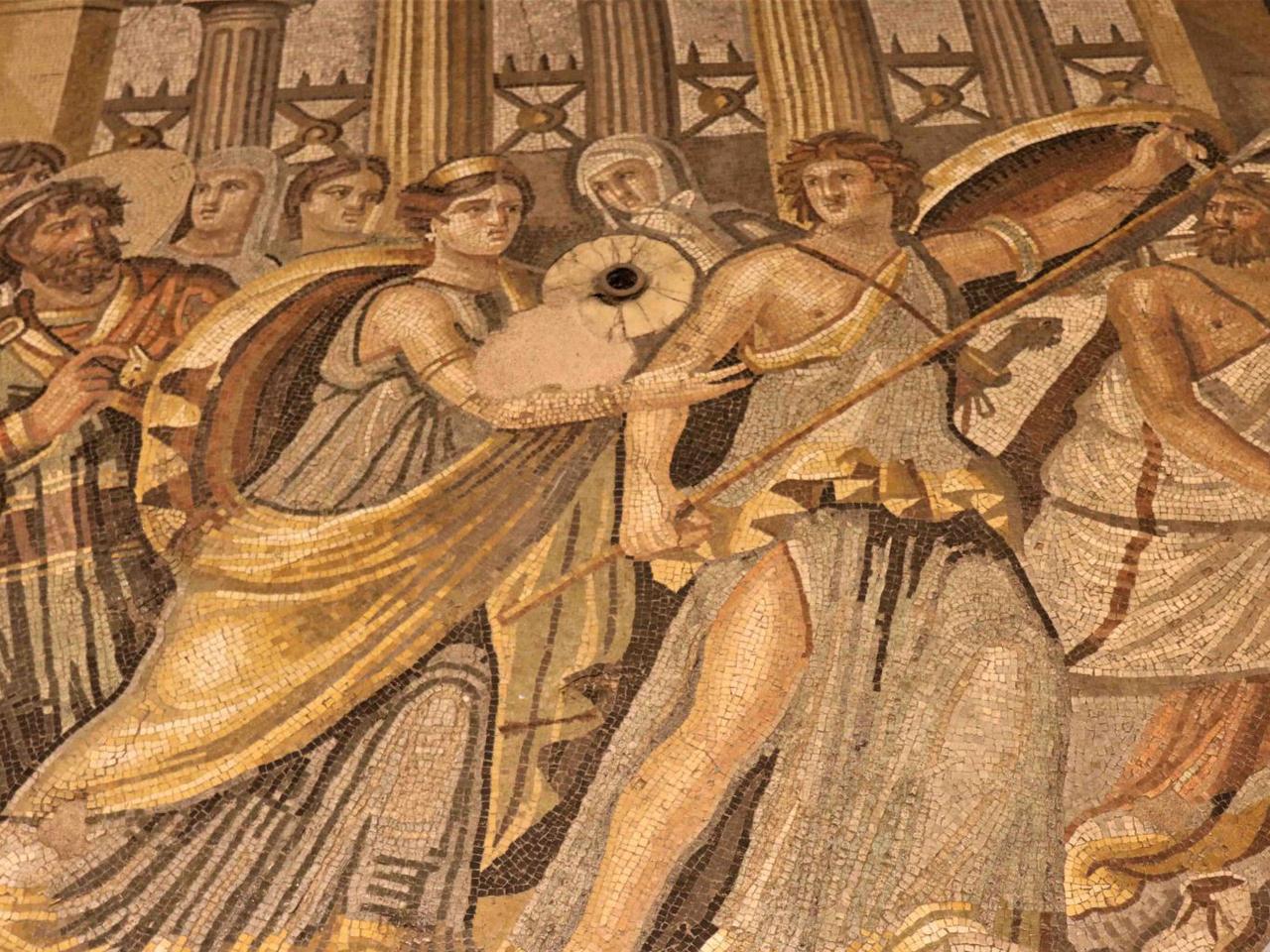
Europa Mosaic (2nd-3rd Century AD)
Europa was a very beautiful girl from Syria, with captivating eyes and glowing skin that caught everyone’s attention. She loved to travel and have fun, spending most of her days with her friends in the countryside or by the sea. One day, while she was picking flowers with her friends in a garden by the sea, Zeus saw her. Her beauty deeply affected the king of the gods. The mosaic of Europa’s Abduction depicts Zeus transforming into a bull to abduct the Syrian girl.
The mosaic was uncovered during excavations in Region B and was moved to the Gaziantep Museum just before the waters of the Birecik Dam Lake submerged the mosaic area. However, during the removal, the rising water level caused damage to Europa's face. During restoration, the figure was repositioned according to the original design using available data.
Ayhan, Kahrıman. "Zeugma Antik Kenti.” Academia, 2015. Son Erişim: 7 Ocak 2025. https://www.academia.edu/35508189/Zeugma_Antik_Kenti_Düzeltilmiş_Versiyon_
Ercan, Gülsoy. Atınç, Olcay. "Müze Hizmet Kalitesi Ölçümü: Gaziantep Zeugma Mozaik Müzesi Üzerine Bir Çalışma." GAZİANTEP UNIVERSITY JOURNAL OF SOCIAL SCIENCES 20, no. 2 (2021): 931-950.
Hannah, Arslan. “Zeugma Mozaik Müzesi’ndeki Dionysos Betimlemeleri.” Gaziantep Üniversitesi Arkeoloji. 2017.
Küçük, Celaleddin. "Zeugma Antik Kenti’ne Ait Betonlu Mozaiklerin Restorasyonu.” Makale. Son Erişim: 7 Ocak 2025. https://dergipark.org.tr/tr/download/article-file/806614
Rawpixel. "The Gypsy Girl" mosaic of Zeugma collage element psd. Remastered by rawpixel [JPG]. Erişim adresi: https://www.rawpixel.com/image/8701510/psd-face-art-vintage
Turkish Museums. Gaziantep Zeugma Mozaik Müzesi [JPG]. Turkish Museums. Erişim adresi: https://turkishmuseums.kprod.kultur.gov.tr/museum/detail/2047-gaziantep-zeugma-mozaik-muzesi/2047/1
Türkiye, Kültür Portalı. “Zeugma Mozaik Müzesi - Gaziantep." Türkiye Kültür Portalı. Son Erişim: 7 Ocak 2025. https://www.kulturportali.gov.tr/turkiye/gaziantep/gezilecekyer/zeugma-mozaik-muzesi
Zeugma. “Genel Bilgiler." Zeugma. Son Erişim: 7 Ocak 2025. https://zeugma.org.tr/genel-bilgiler/
Zeugma. “Eserler.” Zeugma. Son Erişim: 7 Ocak 2025. https://zeugma.org.tr/eserler/
Zeugma. “Fotoğraflar [JPG].” Zeugma. Erişim adresi: https://zeugma.org.tr/fotograflar/

Henüz Tartışma Girilmemiştir
"Zeugma Mosaic Museum " maddesi için tartışma başlatın
Zeugma Ancient City
Notable Artworks
Gypsy Girl Mosaic (2nd-3rd Century AD)
Oceanos and Tethys Mosaic (2nd and 3rd Century AD)
Akratos and Euphrosyne Mosaic (2nd and 3rd Century AD)
Achilles Mosaic (2nd-3rd Century AD)