

This article was automatically translated from the original Turkish version.
In resolving a language model’s output, a brief transition such as “Wait a moment” or “But what if” can prompt a reevaluation of the previously followed approach and steer it toward an alternative solution path. To analyze these transitions, one must examine not only the generated word but also the probabilities of possible continuations before that word is selected. This study, which jointly analyzes token entropy and meaningful motifs in Turkish Qwen3-8B outputs, investigates at which local contexts the reasoning chain opens up to alternatives.
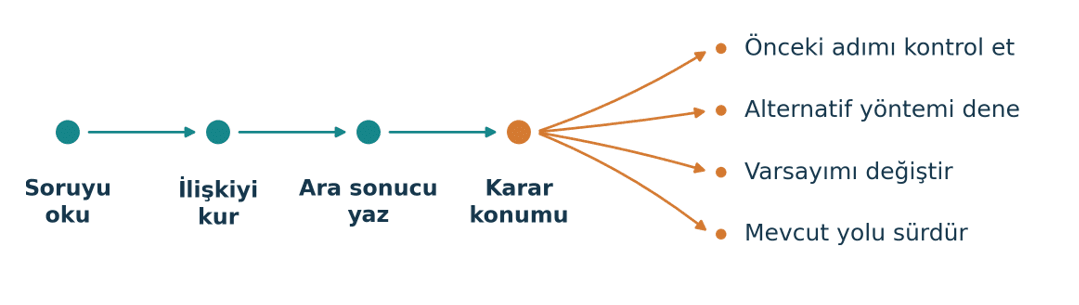
Different Possible Paths a Decision Point in a Chain of Reasoning Can Open (Generated by Artificial Intelligence.)
A language model’s reasoning output is not a complete solution prepared internally and then emitted in a single step. A model consisting solely of a decoder takes the question and all previously generated tokens as context; it computes a logit for every candidate token in its vocabulary; converts these logits into a probability distribution; and selects only the next token. A token is a unit such as a word, subword, or symbol used by the model to process text. The selected token is then appended to the context, and the same process repeats. What appears as a single cohesive solution is in fact the product of a long sequence of local decisions.
This generation method is significant for reasoning research because each link in the chain is both the outcome of prior context and the starting condition for subsequent steps. A closing parenthesis in a mathematical expression typically merely completes the current structure. In contrast, a brief transition such as “But what if” can cause the model to question its prior calculation, open up an alternative method, or revise an assumption. Even though the surface length of such a token is small, it can alter the distribution of dozens of subsequent tokens.
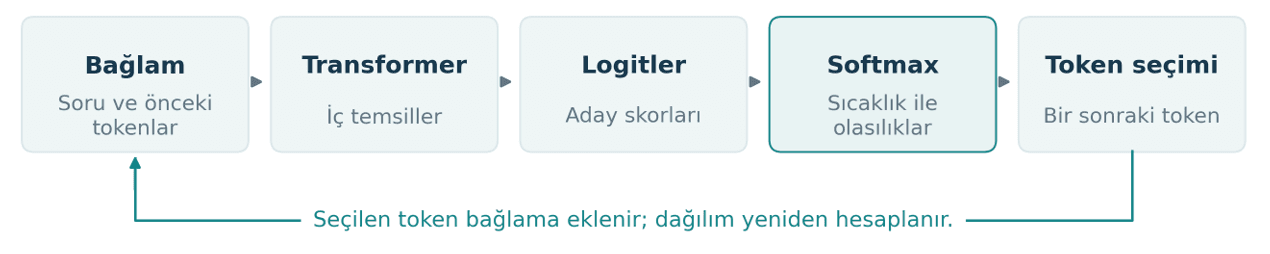
Autoregressive Token Generation Process (Generated by Artificial Intelligence.)
In this paper, “reasoning chain” refers to the visible sequence of tokens produced by the model. This sequence should not be interpreted as a direct transcript of the model’s entire internal computation; however, it provides an accessible observational surface for examining which linguistic transitions the model uses to perform calculations, where it revisits prior steps, and at which points it remains uncertain among multiple continuations. Token entropy quantifies the local choice space at these accessible points: it indicates how concentrated or dispersed the probability distribution was before the token was selected, not the identity of the selected token itself.
After a token is generated, it is not merely appended to the text—it becomes a new element in the context that attention computations will consider. Therefore, the influence of an early decision token is not confined to its position of selection. A transition such as “Let’s try an alternative approach” can activate different intermediate goals, different variables, and different validation steps in subsequent tokens. To understand the reasoning chain, one must consider not only the accuracy of individual tokens but also how these tokens shift the distribution of future ones.
Core intuition: The reasoning chain must be read not as a “long answer” but as a sequence of decisions that continuously rewrite the context. Entropy makes visible which of these decisions expand the range of available options.
The majority of tokens in a reasoning output perform the linguistic or mathematical execution of a previously selected method. Writing the next term in an equation, completing an open code block in a programming solution, adding a Turkish inflectional suffix to a sentence, or generating the final digit of an intermediate result all belong to this category. At these positions, the model’s next-token distribution is often concentrated on a single candidate; one option is clearly dominant. The generation flow continues, but the solution’s direction does not meaningfully change.
In contrast, at certain positions the model encounters a clearly wider choice space: whether to continue the current approach, backtrack, make a new assumption, reframe the problem, or switch to a different method. Shenzhi Wang et al. label these positions “forking tokens”—tokens that branch the reasoning path.【1】 In the Turkish experiment, the target structure is not a simple list of words; it is short, meaningful motifs that serve functions such as pausing, contrasting, indicating possibility, making a choice, or restructuring within the reasoning chain.

Four Functions Within the Same Chain of Reasoning (Generated by Artificial Intelligence.)
Saying “‘But what if’ is a high-entropy expression” is incomplete. Entropy is not a fixed, context-independent property of a word in the vocabulary; it is a property of the probability distribution that arises at a specific position t, given a particular question and prior token sequence. The same readable motif can function as a genuine point of disagreement in one context and as a formulaic continuation in another. Therefore, the values of the same motif across different context sets are preserved in separate rows. Differences observed in “But what if,” “Selected,” “also,” “Other,” and “Our goal” illustrate this context dependency.
This distinction explains why results cannot be interpreted merely as frequency tables. A motif may occur frequently but always within a narrow choice space; a rarer motif may strongly redirect the solution path in the few contexts where it appears. Hence, both frequency of occurrence and average entropy are reported together, and it is explicitly analyzed that these two measures do not convey the same information.
A single decision point does not by itself explain the entire solution; however, it alters the representations and targets accessible to subsequent tokens. If the model reframes a problem from “formulating an equation” to “testing with examples,” a completely different token trajectory emerges for the same question. Therefore, analysis of forking tokens seeks not to measure the importance of individual words but to identify where the reasoning trajectory is redirected.
At the t-th generation step, the model produces an unnormalized logit zₜ,ⱼ for each candidate j in its vocabulary. Logits are not probabilities themselves; their relative differences determine which candidates will dominate. The softmax function converts these scores into a probability distribution over the next token. Temperature T controls the sharpness of this distribution: as T decreases, high-logit candidates become more dominant; as T increases, probability mass spreads more widely across candidates. The following expression holds for T > 0; T = 0 corresponds to the limiting case where only the highest-scoring candidate is selected.
(pₜ,ⱼ: probability of candidate j at position t; zₜ,ⱼ: logit; T: generation temperature)
Entropy summarizes how concentrated or dispersed this distribution is in a single number.【2】 When almost all probability is concentrated on one candidate, entropy is low. When multiple candidates have similar probabilities, entropy increases. High entropy does not automatically imply good reasoning. Entropy indicates the size of the choice space; whether those choices correspond to correct, incorrect, meaningless, or alternative solution paths must be interpreted in context and through evaluation.
Entropy is computed from the entire distribution of candidates before selection, not from the identity of the selected token.
Temperature is a generation setting; entropy is a measure of the resulting distribution. The same temperature can produce vastly different entropies across different contexts. The selective temperature experiment in the source paper exploits this distinction: temperatures applied to high- and low-entropy positions were adjusted separately, demonstrating that reasoning performance is particularly sensitive to intervention at decision points.【3】
When the logarithm base is e, entropy is expressed in nats; when base 2 is used, it is expressed in bits. The theoretical upper bound for a uniform distribution over a vocabulary of size V is log(V); however, in real language generation, probability is not evenly distributed across the entire vocabulary. When comparing values, the logarithm base, temperature, vocabulary, and computation method must be identical. Therefore, it is more robust to track percentiles and rankings within each experiment’s own distribution rather than directly equating absolute entropy values from different analysis pipelines.
The tokenizer is a separate component that converts raw text into token IDs the model can process. A token may be a full word, a subword, an affix, a punctuation mark, or a segment starting with a space. Since Turkish is an agglutinative language, a single root can take many forms: surface forms such as “tasarla,” “tasarlanmış,” “tasarlanmışsa,” and “tasarlanmışsa bile” may be split into multiple subword units by existing multilingual tokenizers, even though they derive from the same root.
In this training pipeline, Qwen3-8B’s tokenizer vocabulary has not been extended; no new Turkish tokens have been added, no merging rules have been changed, and the embedding table has not been resized to accommodate a new vocabulary size. Continuous pre-training (CPT) and cold-start supervised fine-tuning (SFT) updated only the model weights. In other words, the model learned to better represent existing token sequences in Turkish contexts; however, no new, single-token “Turkish reasoning token” was created in the vocabulary.
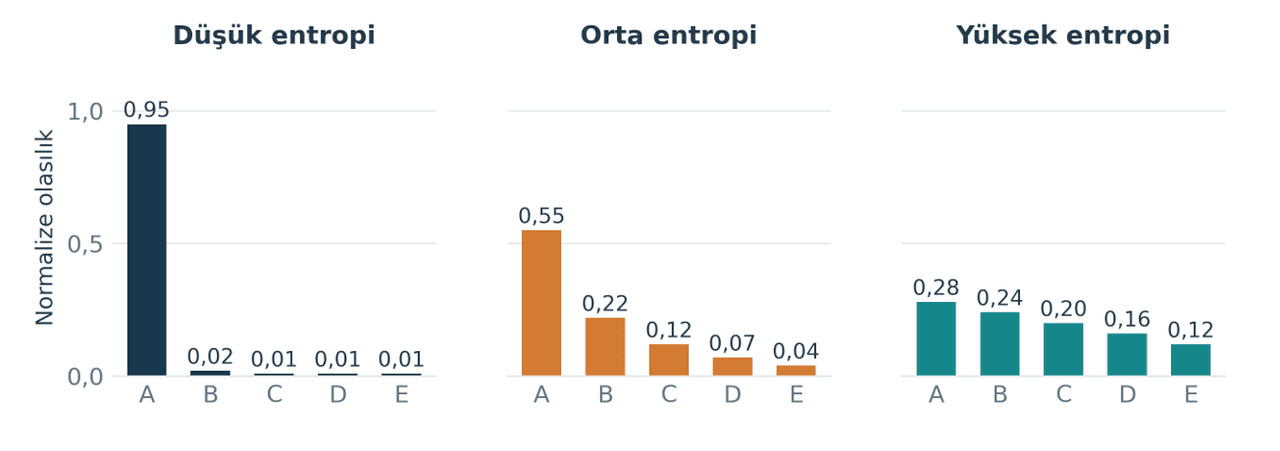
Probability Profiles of the Five Candidates Shown in the Measurements (Generated by Artificial Intelligence.)
In the figure above, each panel has been normalized by its own total and labeled with two decimal places. The original values of the first panel are 0.94 / 0.02 / 0.01 / 0.01 / 0.01, summing to 0.99. This normalization within the candidate set does not replace token entropy computed over the full vocabulary.
Ranking individual subword units directly as words would be misleading in Turkish. Some units surrounding a high-entropy position might be only affixes or halves of words. Therefore, the evaluation unit was defined as a meaningful Turkish word or short phrase formed by up to three tokenizer tokens. If a single token is already meaningful, it is preserved as-is; if meaning emerges only from the combination of two or three parts, those parts are recombined within their local context.
Key methodological distinction: This study is not a tokenizer development or vocabulary expansion experiment. Readable motifs such as “Dur bakalım,” “tasarlanmışsa,” or “Önceki aşama” were obtained by analytically recombining tokenizer segments after training.
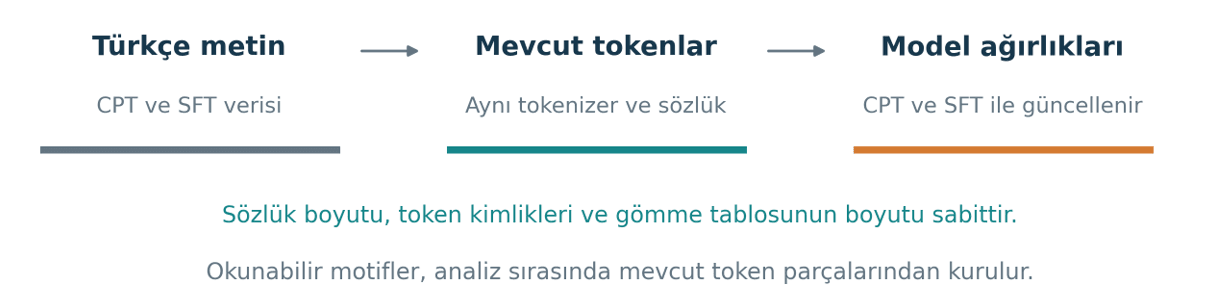
Visual showing that in Turkish CPT and SFT training, the tokenizer and vocabulary remain fixed while only the model weights are updated (generated by artificial intelligence).
The first effect is token budget: the same Turkish meaning may be represented by more tokens under a more atomic vocabulary, increasing context cost in long reasoning outputs. The second effect is measurement: high entropy can arise either from the semantic decision of a word or from uncertainty about which affix will complete a fragmented form. The up-to-three-token meaningful unit approach improves readability; future morphological tagging could more cleanly separate these two sources.
The starting point of this study is Wang and colleagues’ paper “Beyond the 80/20 Rule: High-Entropy Minority Tokens Drive Effective Reinforcement Learning for LLM Reasoning.” The researchers examined each position’s next-token entropy individually rather than aggregating all tokens under a single average. Using reasoning mode with Qwen3-8B, over a million output tokens were collected from AIME 2024 and 2025 problems. Generation temperature was fixed at T = 1.0, and token entropy was computed for each position.【4】
The resulting distribution is clearly long-tailed. Approximately 50.64% of tokens have entropy below 10⁻²; only the top 20% exceed 0.672. The low-entropy majority typically completes ongoing words, sentences, code snippets, or mathematical structures. High-average-entropy frequent tokens, however, cluster in transitions that pause, contrast, assume, or establish causality in reasoning flow—such as “wait,” “however,” “unless,” “suppose,” “assume,” “since,” and “because.”【5】

According to Wang and colleagues' findings, token shares (generated by artificial intelligence)
According to Wang et al., the middle group’s share of approximately 29.36% is derived by subtracting the reported 50.64% and 20% from 100. In the figure above, bar lengths represent token shares; the horizontal axis does not represent entropy magnitude. 0.672 is the threshold from the source distribution.【6】
The structure labeled “forking token” in the paper does not arise because a high-entropy token is a special word in itself, but because at that position, multiple reasoning continuations remain strongly plausible.【7】 The “wait” token can initiate questioning of a prior solution in some contexts; “however” can open a contrasting condition; “suppose” can trigger the establishment of a new assumption. These words do not merely link two parts of the reasoning chain grammatically—they influence which solution path will be followed.
In the Turkish experimental design, this idea was not applied as a direct word-for-word translation. The goal was not to establish an equivalence like “wait = Dur bakalım”; rather, it was to investigate whether Turkish model outputs contain high-entropy contexts where similar functions—pausing, objecting, indicating possibility, backtracking, and restructuring—are expressed by Turkish motifs. Shenzhi Wang et al.’s paper provides the theoretical and empirical motivation, while An Yang et al.’s analysis focuses on model outputs after Turkish CPT and initial SFT.
Wang and colleagues evaluated only tokens with a frequency above 100 in word clouds to avoid emphasizing random tokens that appeared only a few times.【8】 Thus, the “high average entropy” list is based on recurring linguistic functions rather than isolated noise. In the Turkish analysis, the same need was met differently: meaningful motifs were combined under context, frequency was reported separately, and rare foreign-language fragments were excluded.
A strength of Shenzhi Wang and colleagues’ work is that it does not stop at identifying high-entropy tokens as semantically interesting. In the first intervention, researchers separately adjusted the generation temperature for high- and low-entropy positions. Lowering temperature at high-entropy positions significantly degraded reasoning performance; moderately increasing it improved results. Raising temperature in the low-entropy majority did not yield the same benefit and could lead to nonsensical outputs in extreme cases.【9】
The second intervention occurred during the reinforcement learning with verifiable rewards (RLVR) phase. In Dynamic sAmpling Policy Optimization (DAPO), the policy gradient loss at the token level was applied only to the top 20% of highest-entropy positions within the batch; the gradient for the remaining 80% was masked.【10】 On Qwen3-8B, the average across six evaluation sets rose from 53.71 to 54.23, remaining close to training with all tokens. On Qwen3-14B, the average increased from 61.40 to 64.39; on Qwen3-32B, from 66.59 to 70.69. The growth in gain with model size suggests that focusing on decision points may be especially efficient for larger-capacity models.【11】
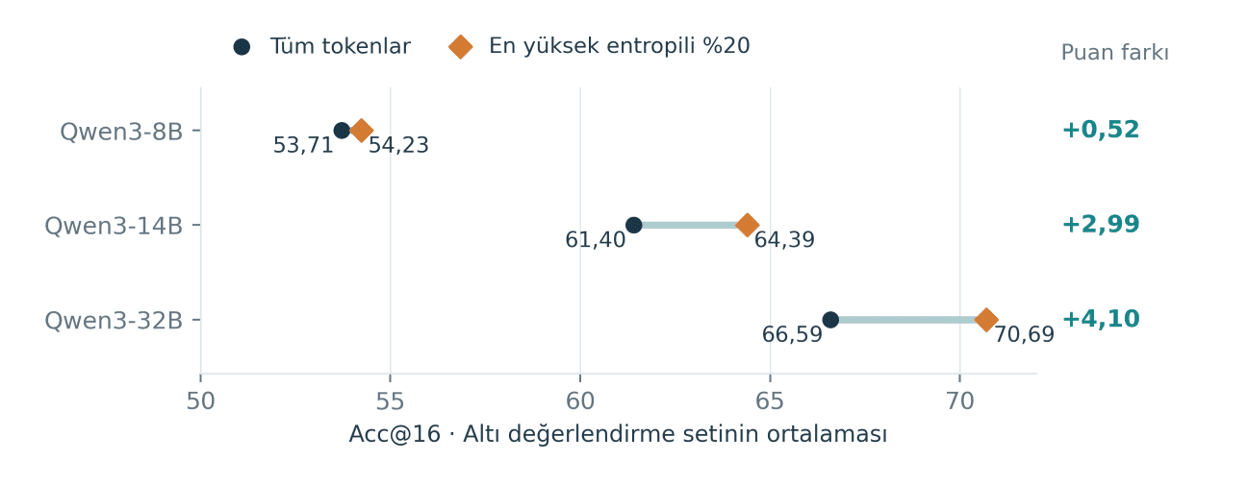
DAPO Results with All Tokens and DAPO Results Using Only the Top 20% Highest Entropy Tokens (Generated by Artificial Intelligence.)
In the graph above, accuracy is averaged over 16 generations per evaluation set. The reported differences are calculated from rounded extreme values; for the 8B model, the difference is +0.52 based on these extremes, not +0.53 as in the source table.【12】
These results were not directly replicated for Turkish RLVR; the study is at an earlier stage. After Turkish CPT and initial SFT, meaningful Turkish motifs occurring in high-entropy local contexts were extracted. Thus, the focus shifted from the source paper’s question “On which tokens should the gradient be retained?” to the prior question: “In Turkish, what linguistic structures manifest as decision points?”
This approach also narrows the target space for future intervention experiments. Studies such as control-point comparisons, selective temperature, branching analysis, and entropy-masked RLVR can be more meaningfully designed only after we understand how the Turkish entropy map looks, how tokenization affects it, and which motifs recur.
Another key finding in Shenzi Wang et al.’s paper is that the highest-entropy positions are largely preserved during RLVR. For Qwen3-14B, the overlap between the top 20% positions of the base model and the final RLVR model remained at 86.67% at the end of training.【13】 Changes were especially concentrated in regions already high in entropy, while low-entropy token values moved within a narrower range. This finding makes comparing base model → CPT → SFT control-point maps especially valuable in the Turkish study.
The starting point of the experiment is the Qwen3-8B Base model.【14】 In the first stage, multi-domain continuous Turkish pre-training was applied. The CPT corpus did not consist solely of mathematical, logical, or reasoning-chain data; it used a general data distribution covering diverse areas of Turkish, expression styles, and types of knowledge. This choice aimed not only to teach specific reasoning templates but to strengthen a broader foundation of Turkish syntax, morphology, discourse flow, and cross-domain language use.
The CPT stage retained the next-token prediction objective. The model relearned, through its weights, which token sequences are natural in Turkish texts, which affixes and subwords co-occur in which contexts, and how discourse structures vary across domains. Since the tokenizer remained fixed, development occurred not by creating new tokens but by altering the representations of existing token sequences in embeddings, attention, multilayer perceptron (MLP), and residual connection computations.
In the second stage, a small initial SFT was applied using Turkish reasoning data. The goal of this stage is not to produce a final, RL-optimized reasoning model. Rather, it aims to instill initial behavior: enabling the model to articulate Turkish solutions, explicitly express intermediate steps, and use transitions such as comparison and backtracking. The initial SFT represents the supervised phase that initiates the reasoning style and basic solution habits before any subsequent RLVR stage.
General Turkish CPT and reasoning SFT fulfill different objectives. CPT establishes a broader Turkish representation base within language and knowledge distribution; initial SFT guides the model to use these representations for problem-solving, writing intermediate steps, and concluding. Training solely on reasoning data might constrain Turkish to a few rigid solution patterns. Training solely on general CPT might not provide sufficient usage schemas to explicitly demonstrate reasoning behavior. Thus, the two stages complement each other in achieving the study’s initial reasoning goal.
Central question of the experiment: After this training pipeline, where in the model’s high-entropy Turkish contexts do meaningful words and short phrases concentrate? How do these motifs make visible reasoning functions such as pausing, generating alternatives, backtracking, modeling, and selecting?
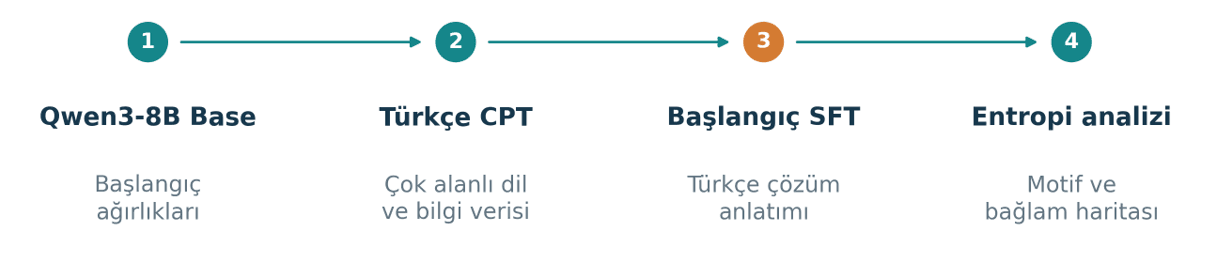
Turkish Language Line (Generated with Artificial Intelligence.)
Supervised reasoning data quickly gives the model a readable solution format; however, it can also strongly imitate the unique trajectories and discourse patterns in teacher answers. Therefore, after initial fine-tuning, one must examine not only evaluation set scores but also motif diversity, context dependency, and whether high-entropy positions have narrowed. The subsequent RLVR stage can extend this initial behavior toward broader solution paths using verifiable reward signals.
General CPT is followed by initial SFT and entropy analysis. The tokenizer vocabulary remained fixed throughout training.
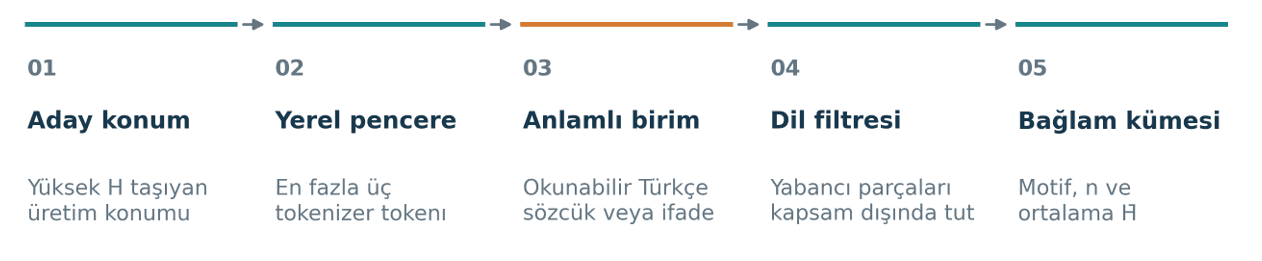
Conversion of High-Entropy Candidate Positions into Meaningful Turkish Motifs of at Most Three Tokens (Generated by Artificial Intelligence.)
Reporting high-entropy positions by individual token IDs did not yield interpretable results for Turkish. Since the current tokenizer represents some words as single units and others as two or three subword units, the analysis unit was defined as a local, meaningful motif. At each candidate position, up to three tokenizer tokens were evaluated. If a single token already forms a meaningful Turkish word or transition, the motif is complete; if meaning requires two tokens, two are combined; if a third is needed, up to three are merged.
Thus, the method is not a fixed-length trigram mining. Each record does not need to consist of exactly three tokens; it may be one, two, or three tokens long. The “up to three” limit balances two goals: reconstructing fragmented Turkish words or short transitions without blurring the association between the local phrase and the high-entropy position by incorporating distant sentence context.
Since Qwen3-8B is a multilingual base model, rare Chinese character fragments and tokens from other foreign languages occasionally appear in outputs. Because the study focuses on Turkish, these units were excluded from the motif table. In the original analysis pipeline, their share in the candidate distribution was recorded as below 1%; raw counts of filtered candidates and total candidates are not included in this version.
This note serves as a quality control indicator that foreign-language fragments constitute a limited share in the main distribution. However, since raw counts and denominators are not preserved, the ratio cannot be recalculated. The 40 distinct motif surfaces, 45 context–motif rows, and 234 occurrences analyzed here represent the Turkish aggregates after filtering. The share of foreign-language fragments is below 1% in the analysis record; raw filtered counts are not available.
The local window was not determined solely by mechanical token proximity; the emerging unit had to form a readable Turkish word or short functional expression. Thus, subword fragments within words, units consisting only of Unicode symbols, or foreign-language fragments disconnected from context were not counted as separate motifs. This choice ensured the table remained interpretable linguistically without hiding tokenizer technical details.
Cleaned meaningful units were grouped together under the same readable motif and similar local context. Each row contains three key pieces of information. “Motif” is the Turkish word or short phrase reconstructed from tokenizer fragments. Frequency n indicates how many times this motif reoccurred in the relevant context set. Average entropy H̄ is the arithmetic mean of the H values across all generation positions assigned to the same set. This metric is used to examine relative rankings and context differences among motifs.
(n(m): number of occurrences in the relevant context–motif set; H⁽ʳ⁾(m): entropy at the r-th occurrence assigned to the set.)
Token entropy was computed using the Shannon entropy definition over the full vocabulary.【15】 In previous analysis tables, the H_LB and avgH_LB fields are now denoted as H and H̄ respectively; field names have been simplified, but numerical results remain unchanged. The 0.672 value in Shenzi Wang et al.’s study is the 80th percentile threshold of their million-token distribution.【16】 Using the same formula does not imply this numerical threshold corresponds to the same percentile in Turkish output distributions.
Since entropy is not a fixed property of a word, the same readable motif is kept separate across different context sets. “But what if” has values of 2.7285 and 2.4332 in two contexts; “Selected” has 2.4544 and 2.3522; “also” has 2.4278 and 2.3812; “Other” has 2.4301 and 2.4059; “Our goal” has 2.4393 and 2.4256. Without this distinction, different reasoning functions would merge into a single average, obscuring the contribution of context.
Frequency indicates how often the model uses a motif; average entropy summarizes the relative choice space at the positions where the motif appears. A frequently used word can be generated with low uncertainty as part of a formulaic sentence continuation. A rarer transition may decisively open new solution paths in the few contexts where it appears. Thus, in the table, “standard” has the highest frequency at 59 occurrences but ranks 38th in average entropy; “Dur bakalım” appears only six times but has the highest average entropy.
Table: Guide to Reading Motif Measurements
Language filter note: The share of foreign-language fragments was below 1% in the original record; raw counts are not available. The 45 context–motif rows and 234 occurrences are post-filtering aggregates.
To reproduce the analysis at the individual occurrence level, the original token IDs, individual context windows, entropy values, question or task IDs, model control point, generation settings, computation version, and filtering decisions must be preserved alongside the motif text. This document presents aggregated tables containing source identifiers, motifs, frequency, and average entropy. Individual token IDs, context windows, entropy measurements, and task IDs are not included in this version.
After filtering and grouping, 45 distinct context–motif rows representing 40 different motif surfaces and a total of 234 occurrences remain. Average entropy values range from 2.3175 to 2.7300. The median per row is 2.4256, the arithmetic mean is 2.4334; the frequency-weighted mean is 2.4131. The weighted mean is lower due to the most frequent motif, “standard,” appearing at 2.3458 in the lower half of the ranking.
At the top of the list are not domain-specific object names but transitions that regulate the reasoning flow. “Dur bakalım” and “Peki ama” interrupt the current solution; “ihtimal” opens an alternative possibility; “Önceki aşama” and “Önceki çözüm” signal backtracking; “Basitleştir” and “Modelleme” propose procedural moves that change the problem representation. “Detaylar,” “Pratikte,” and “Araştırma yap” can introduce the next subtask regarding the level or method of continuation.
The top 10 context–motif rows occurred a total of 37 times, corresponding to approximately 15.8% of the 234 occurrences. However, this share reflects only the internal distribution of the selected motif table; it cannot be interpreted as the proportion of all generated tokens in the high-entropy segment. The study’s value lies not in translating the 20% ratio from the source paper into Turkish, but in detailing which short meaningful units in Turkish outputs occupy the upper tier relatively.
Motifs in the 2.40–2.50 range constitute a large and functionally diverse portion of the table. Expressions such as “Araştırma yap,” “listele,” “Önceki çözüm,” “Seçilen,” “Geriye,” “Amacımız,” and “Gözlem” appear here. Since reasoning does not consist solely of a few extreme decision points, this mid-range provides a distinct data field for examining transitions where decision and execution functions overlap and usage patterns vary by task.
The quantitative results of the first nine rows are as follows: “Dur bakalım” at 2.7300; “Peki ama” context 1 at 2.7285; “Detaylar” at 2.5759; “ihtimal” at 2.5620; “Basitleştir” at 2.5194; “Önceki aşama” at 2.5172; “Kaçış” at 2.5146; “Modelleme” at 2.5142; and “Pratikte” at 2.5104. This ranking reflects relative average entropy within the same experiment.
“Dur bakalım” and “Peki ama” appear consistent with functions of pausing and reevaluating. “ihtimal,” “Alternatif yol,” “Varsayım,” and “Şüphe” make the epistemic choice space visible; “Önceki aşama,” “Önceki çözüm,” “Geriye,” and “Önceki analiz” make prior reasoning paths accessible again within context.
“Kaçış,” with a value of 2.5146, suggests a likelihood of departing from the current solution path; this interpretation is not a quality judgment derived solely from the motif surface. Motifs within the same semantic family can have different average entropy values across different context sets.
“Basitleştir,” “Modelleme,” “Detaylar,” “listele,” and “Araştırma yap” align with functions of task management and representation change. “Pratikte” can ground abstract inferences in practical conditions. These observations do not claim that these words improve reasoning quality or that high average entropy implies better reasoning.
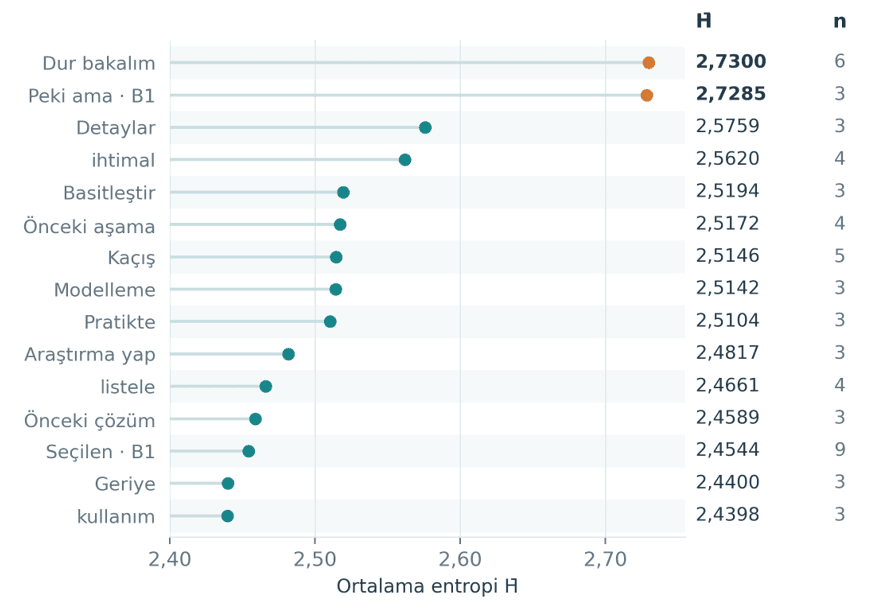
Top 15 Context-Motif Rows According to Average Entropy (Generated by Artificial Intelligence)
The table also contains content- or context-dependent words; however, process-regulating expressions are more visible in the upper tier. The lexical surface is not the same as the local reasoning function; interpretation must be made in conjunction with the context set in which the motif appears.
In the graph above, n denotes the number of occurrences, and B1 denotes the first context set for the corresponding motif. Four-decimal values match the full results table in Section 2.
In addition to ranking individual motifs, grouping expressions by their dominant functions within context provides a second layer of interpretation. The pause/backtrack family relates to suspending the current path and making prior steps accessible again; the contrast/alternative family is associated with patterns that open new possibilities or opposing conditions.
In the contrast/alternative family, “Peki ama,” “ihtimal,” “Alternatif yol,” “Varsayım,” “Şüphe,” and “Kesinlik” are functionally aligned with expanding the epistemic choice space. The choice/goal and observation/validation families distinguish between target, method, practical outcomes, and comparison actions.
In the structure/process family, “Basitleştir,” “Modelleme,” “Detaylar,” “listele,” “Araştırma yap,” and “Detaylandırılması” are linked to actions that change the problem representation, level of detail, or subtask. Belonging to the same semantic family does not imply motifs will have the same average entropy; surface form alone does not determine reasoning function.
Table: Dominant Functions of Motifs
If initial SFT data consists only of linear and flawless reasoning trajectories, natural moves such as backtracking, error control, alternative methods, and representation changes may not appear sufficiently. In data design, these functions can be diversified using different problems and natural Turkish surfaces; motif analysis provides an observational map to inform this design, not a causal recipe.
The goal is not to append “Dur bakalım” to every answer or artificially replicate a specific pattern. Backtracking, error control, alternative methods, and representation changes can be expressed through diverse Turkish syntactic structures. The goal is functional and contextual diversity, not lexical repetition.
This section has shown how short expressions matching high-entropy positions in Turkish reasoning outputs were extracted and which functions they prominently serve. With a fixed tokenizer, outputs from the model updated by CPT and initial SFT were analyzed across 40 distinct motif surfaces and 45 context–motif rows. The top expressions align with actions of pausing, opening alternatives, backtracking, and changing representation. However, the mere appearance of a motif does not prove solution quality.
In the second part of this series, we first examine why frequency and entropy must be interpreted separately and how the same motif changes across contexts; then we present the full 45-row results table. Next, we proceed to a six-condition, reference-based expert evaluation of 480 continuation texts generated after these decision points. The prompts used, accuracy rates, behavior scores, and error profiles are analyzed together to explain why the 4–8 band appears balanced and within what boundaries it should be interpreted.
Continue reading: Reasoning Pathways Part 2: Context Comparisons and Expert Evaluation
Shannon, Claude E. “A Mathematical Theory of Communication.” *The Bell System Technical Journal* 27 (1948): 379–423, 623–656. Accessed October 24, 2026.https://people.math.harvard.edu/~ctm/home/text/others/shannon/entropy/entropy.pdf
Wang, Shenzhi, Le Yu, Chang Gao, et al. “Beyond the 80/20 Rule: High-Entropy Minority Tokens Drive Effective Reinforcement Learning for LLM Reasoning.” arXiv (2025): 1–25. Accessed October 24, 2026.https://arxiv.org/pdf/2506.01939v1
Yang, An, Anfeng Li, Baosong Yang, et al. “Qwen3 Technical Report.” *arXiv* (2025): 1–35. Accessed October 24, 2026.https://arxiv.org/pdf/2505.09388
Yu, Qiying, Zheng Zhang, Ruofei Zhu, et al. “DAPO: An Open-Source LLM Reinforcement Learning System at Scale.” *arXiv* (2025): 1–16. Accessed October 24, 2026.https://arxiv.org/pdf/2503.14476v2
[1]
Shenzhi Wang Le Yu, Chang Gao, et al. "Beyond the 80/20 Rule: High-Entropy Minority Tokens Drive Effective Reinforcement Learning for LLM Reasoning," *arXiv* (2025): 5. Accessed October 24, 2026.
[2]
Claude E. Shannon, “A Mathematical Theory of Communication,” *The Bell System Technical Journal* 27 (1948): 11. Accessed October 24, 2026.
[3]
Shenzhi Wang v.d., 5.
[4]
Shenzhi Wang v.d., 4.
[5]
Shenzhi Wang v.d., 5.
[6]
Shenzhi Wang v.d., 5.
[7]
Shenzhi Wang v.d., 5.
[8]
Shenzhi Wang v.d., 5.
[9]
Shenzhi Wang v.d., 5.
[10]
Qiying Yu Zheng Zhang, Ruofei Zhu et al. "DAPO: An Open-Source LLM Reinforcement Learning System at Scale," *arXiv* (2025): 6. Accessed October 24, 2026. Shenzhi Wang et al., 7.
[11]
Shenzhi Wang v.d., 8.
[12]
Shenzhi Wang v.d., 8.
[13]
Shenzhi Wang v.d., 6.
[14]
An Yang, Anfeng Li, Baosong Yang et al., “Qwen3 Technical Report,” *arXiv* (2025), 7. Accessed October 24, 2026.
[15]
Claude E. Shannon, 11.
[16]
Shenzhi Wang v.d., 5.

How Does a Language Model Generate a Reasoning Text?
Reasoning Text Is Not the Same as Internal Computation
Why Is Context Redefined at Every Step?
Following a Chosen Path Is Different from Choosing a New One
Why Is Entropy Not a Fixed Property of a Word?
The Growing Impact of Local Decisions Along the Chain
Logits, Softmax, Temperature, and Token Entropy
Temperature and Entropy Are Not the Same Concept
Unit and Upper Bound of Entropy
What Does Turkish Tokenization and a Fixed Vocabulary Mean?
How Did This Distinction Affect the Analysis Method?
Two Effects of a Fixed Tokenizer on Training and Measurement
Why Might High-Entropy Minority Tokens Be Important?
The Concept of Forking Tokens
How Was Average Token Entropy Cleaned in the Source Study?
From Observation to Training: Policy Gradient Only at Decision Points
Key Inference for the Turkish Study
Preserving Entropy Patterns with RLVR
Turkish CPT and Initial SFT Training Pipeline
Why CPT First, Then a Small Reasoning SFT?
Why Initial SFT Is Not the Final Model, But the Starting Point
Analysis Unit: Up to Three-Token Meaningful Turkish Motifs
Filtering Chinese and Other Foreign Language Fragments
Why Was Meaning Prioritized During Grouping?
How to Interpret Motif Frequency and Average Entropy?
Why Is the Same Motif Listed in Multiple Rows?
Frequency Is Not a Measure of Importance
Metadata to Preserve for Reproducibility
Functional Map of High-Entropy Turkish Motifs
What Do the Top Motifs Reveal?
Functional Interpretation of Motifs
Grouping Motifs by Reasoning Functions
Inference from Data Design
From Motif Map to Part Two