



Acid - Base
In the world of chemistry, we frequently encounter acids and bases, which appear everywhere in our lives. The sour taste of a lemon, the slippery feel of soap, or the ability of detergent to clean clothes—all are related to acids and bases. So, what exactly are acids and bases? Let us explore this fascinating world!

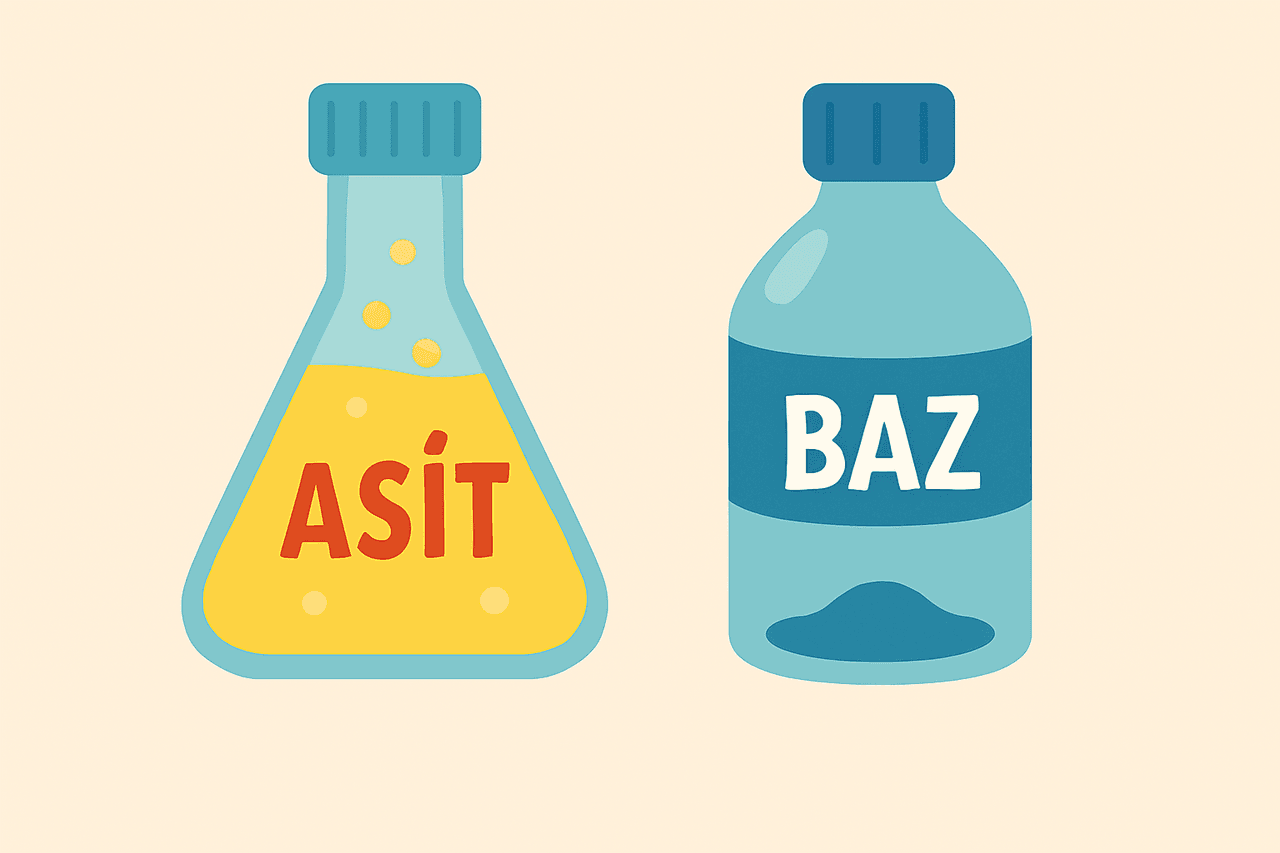
Acid - Base (Generated with Artificial Intelligence)
What Is an Acid?
Acids are substances with a sour taste. For example, lemon juice, orange juice, and vinegar are all acids. The word “acid” comes from the Latin word “acidus,” meaning sour. When acids dissolve in water, they produce a special particle called the hydronium ion (H₃O⁺). This ion is responsible for the sour taste and sometimes the corrosive nature of acids.
Properties of Acids:
- Sour taste: The sourness you feel in your mouth when eating a lemon or orange comes from acids.
- Corrosive: Some acids are strong and can damage materials, so they must be handled with care!
- Turns litmus paper red: Acids change a special paper used in chemistry to red.
- React with bases: When acids combine with bases, they form salt and water. This is called neutralization.
Examples of acids: Hydrochloric acid (HCl), sulfuric acid (H₂SO₄), citric acid in oranges, and acetic acid in vinegar.
What Is a Base?
Bases behave as the opposite of acids. Things like soap or detergent exhibit basic properties and feel slippery to the touch. When bases dissolve in water, they produce hydroxide ions (OH⁻). This ion is responsible for the slippery feel of bases.
Properties of Bases:
- Slippery feel: When you hold soap in your hand, you feel its slippery texture.
- Bitter taste: Bases generally have a bitter taste (but do not try tasting them!).
- Turns litmus paper blue: Bases change the special paper to blue.
- React with acids: When bases combine with acids, they produce salt and water.
Examples of bases: Sodium hydroxide (NaOH), ammonia (NH₃), and detergents.
Ways to Identify Acids and Bases
Scientists define acids and bases in different ways. Let us learn the three most common definitions:
- Arrhenius Definition: Acids produce hydronium ions (H₃O⁺) in water, while bases produce hydroxide ions (OH⁻). For example, hydrochloric acid (HCl) produces H₃O⁺ in water, and sodium hydroxide (NaOH) produces OH⁻.
- Brønsted-Lowry Definition: Acids are proton (H⁺) donors, while bases are proton acceptors. For example, ammonia (NH₃) is a base because it accepts a proton to become NH₄⁺.
- Lewis Definition: Acids are electron pair acceptors, while bases are electron pair donors. For instance, ammonia is a base because it donates an electron pair.
How Are Acids and Bases Distinguished? (Basfi and Experimental Science))
What Is the pH Scale?
The pH scale is used to measure the strength of acids and bases. This scale indicates whether a substance is acidic, basic, or neutral:
- pH below 7: Acidic! For example, lemon juice has a pH of around 2.
- pH above 7: Basic! Soap has a pH of around 8 to 9.
- pH 7: Neutral! Pure water has a pH of exactly 7, meaning it is neither acidic nor basic.
pH is calculated based on the concentration of hydronium ions in water. Pure water contains equal amounts of hydronium and hydroxide ions, which is why it is neutral.
Strong and Weak Acids and Bases
Acids and bases can be strong or weak:
- Strong acids: Completely dissolve in water and produce many hydronium ions. Examples: Hydrochloric acid (HCl), sulfuric acid (H₂SO₄).
- Weak acids: Dissolve only slightly in water. Examples: Acetic acid in vinegar, citric acid in oranges.
- Strong bases: Completely dissolve in water and produce many hydroxide ions. Examples: Sodium hydroxide (NaOH).
- Weak bases: Dissolve only slightly in water. Examples: Ammonia (NH₃).
Amphoteric Substances
Some substances can behave as both acids and bases; these are called amphoteric substances. For example, water (H₂O) can sometimes donate a proton and act as an acid, or accept a proton and act as a base. Ammonia (NH₃) and some metal oxides can also be amphoteric.
What Is Neutralization?
When acids and bases combine, a neutralization reaction occurs. In this reaction, salt and water are produced. For example:
- Hydrochloric acid (HCl) + Sodium hydroxide (NaOH) → Sodium chloride (NaCl, that is, salt) + Water (H₂O).
Acids and Bases in Everyday Life
Acids and bases are everywhere! Our stomach acid helps digest food. The detergents we use to wash clothes are basic. But be careful! Some acids, such as acid rain, can harm the environment. Acids and bases help us understand how substances react in chemistry.
You now know why a lemon tastes sour, why soap feels slippery, and why litmus paper changes color! The world of chemistry is quite fascinating, isn’t it?