



Ammonia
Ammonia is a colorless gas with a pungent odor, known by the chemical formula NH₃. It dissolves easily in water and, being a light substance, disperses rapidly in air. It is found in various cleaning agents both in laboratories and in everyday life. Children can better understand the fundamental principles of chemistry by observing how this gas dissolves.

(Generated by Artificial Intelligence.)
History and Discovery
Ammonia has been known for many years. Humans previously used it in agriculture and cleaning, while scientists explored its properties and applied it in various fields of chemistry. Thanks to ammonia, scientists have been able to study plant growth and chemical reactions more effectively.
Physical Properties
Ammonia is a colorless gas with a sharp odor. It dissolves readily in water and is also used in cooling systems. In its gaseous state, ammonia spreads quickly in air, making its use in open areas safer. These properties are important for understanding its roles in scientific experiments and industrial applications.
Use in Education
In laboratories, ammonia is used in safe doses to help children learn the fundamental principles of chemistry. Its dissolution, ability to form reactions, and function in nature can be observed. This fosters curiosity and enhances scientific thinking skills during experiments.
Use in Agriculture
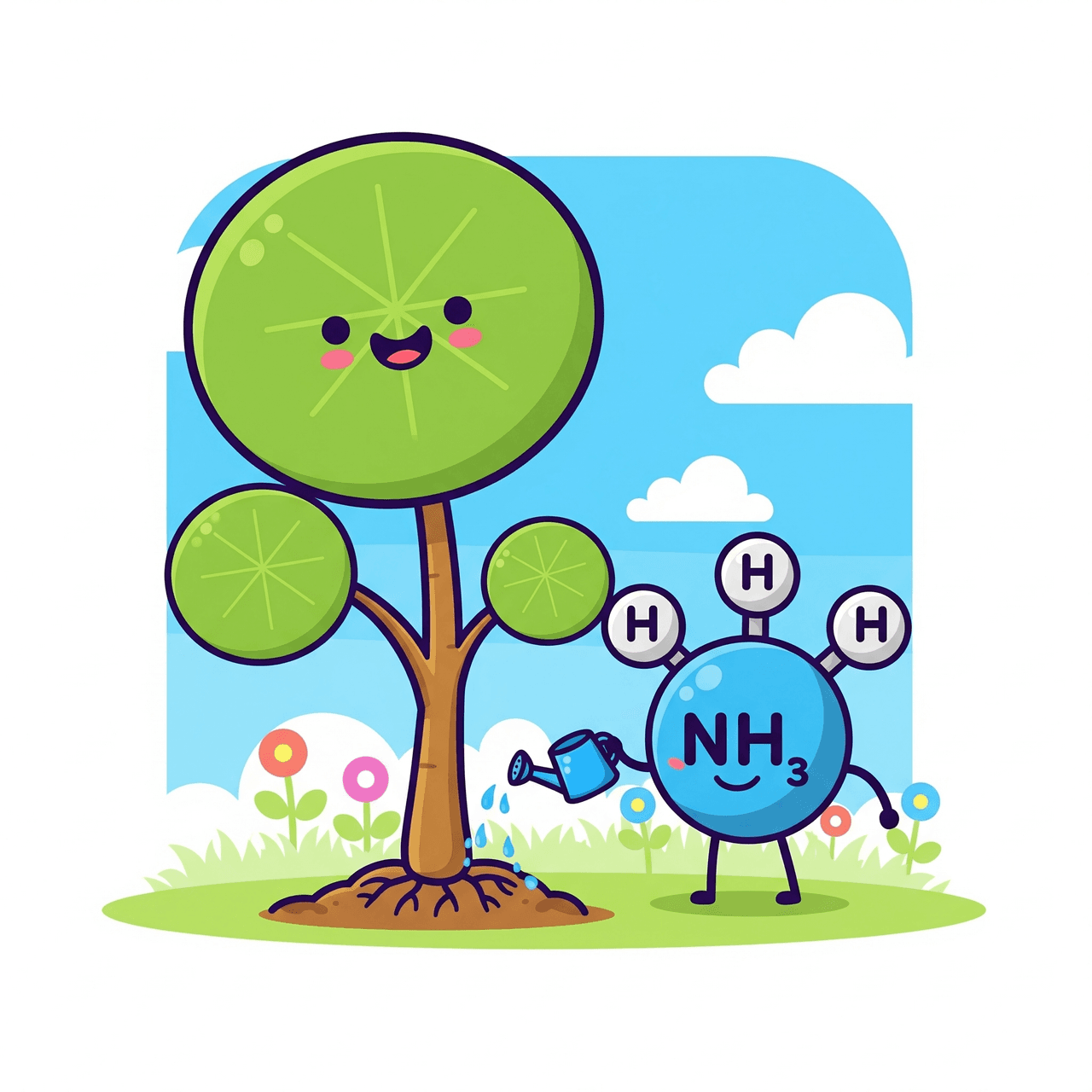
Ammonia provides the nitrogen essential for plant growth. In agriculture, it is applied to soil in liquid or gaseous form to support healthy plant development, resulting in more productive and robust crops. It also supports the movement of nitrogen in natural cycles, helping to maintain ecosystem balance.

(Generated by Artificial Intelligence.)
Use in Homes and Industry
Ammonia is found in some household cleaning products. It is also used in laboratories and chemical research for various reactions. Its use must be handled with care, as direct contact or inhalation can be hazardous. Children should observe this gas only during safe experiments and under adult supervision.

(Generated by Artificial Intelligence.)
Role in Nature
Ammonia is an important source of nitrogen for soil and plants in nature. It plays a role in the nitrogen cycle and supports healthy plant growth within ecosystems. This ensures a balanced food chain for plants and animals in the natural environment.

(Generated by Artificial Intelligence.)
Health and Safety
Ammonia is hazardous to the human body. Inhalation, ingestion, or direct contact can damage the eyes and skin. Therefore, both children and adults should use it only in safe experiments and under supervision. Proper protective equipment further prevents accidents and enhances safety.