


This article was automatically translated from the original Turkish version.
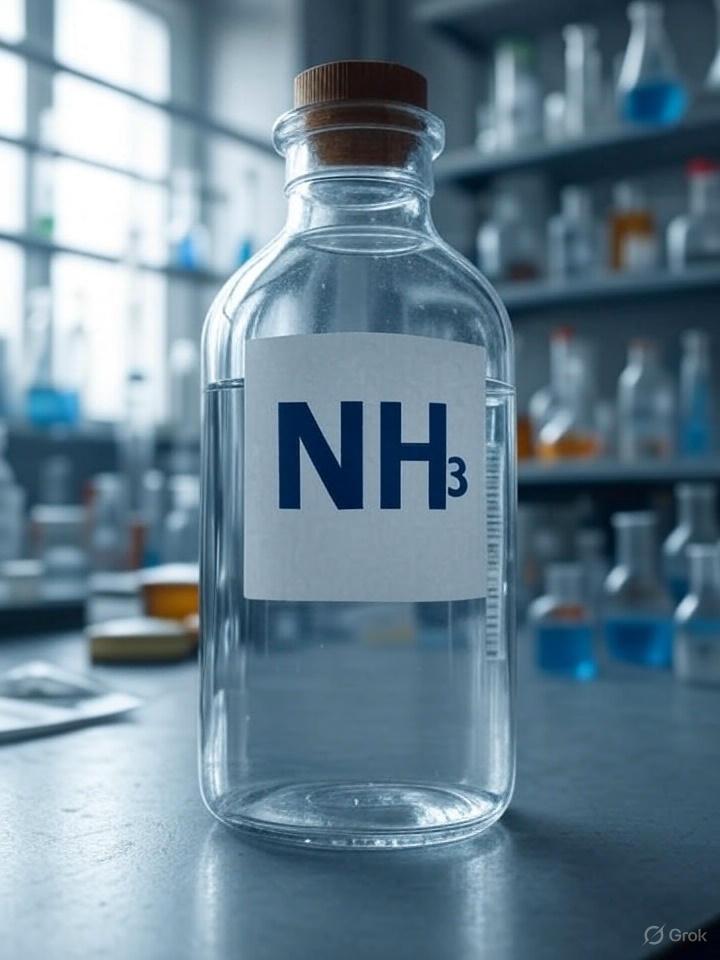
Ammonia (NH₃)
Chemical Formula | NH₃ | ||||||||
|---|---|---|---|---|---|---|---|---|---|
Appearance | Colorless, pungent-smelling gas | ||||||||
Molecular Weight | 17.03 g/mol | ||||||||
pH Value | 11–12 (Basic) | ||||||||
Structure(s) | Covalent (Trigonal Pyramidal Molecular Structure) | ||||||||
Boiling Point | −33.34 °C | ||||||||
Melting Point | −77.73 °C | ||||||||
Acid-Base Behavior | Weak base – NH₃ + H₂O ⇌ NH₄⁺ + OH⁻ | ||||||||
Area(s) of Use | Fertilizer production water treatment chemical synthesis intermediate explosive production cleaning products refrigeration systems | ||||||||
Ammonia (NH₃) is a colorless, pungent-smelling, polar gaseous compound formed by the covalent bonding of one nitrogen (N) atom with three hydrogen (H) atoms. It is an essential component of the nitrogen cycle and plays a role in numerous biological and industrial processes. Chemically a weak base, ammonia forms ammonium ions (NH₄⁺) and hydroxide ions (OH⁻) when dissolved in water.
NH₃ is widely obtained in nature through microbial activity and industrial production. It occurs naturally in trace amounts in the atmosphere and is released through the decomposition of animal waste and certain plant processes. Industrially, the most common production method is the Haber-Bosch synthesis process. China, India, the United States and Russia are among the leading countries in ammonia production.
Although ammonia was chemically identified as a compound in the 18th century, substances containing ammonia were used in ancient Egypt for mummification processes. The name ammonia derives from the term “sal ammoniacus” (ammonium salt), which was collected near the Temple of Amun in ancient Egypt, dedicated to the god Amun.
In 1774, Swedish chemist Carl Wilhelm Scheele successfully isolated ammonia in a laboratory setting; in 1785, English chemist Claude Louis Berthollet determined its composition of nitrogen and hydrogen elements.
Modern ammonia production began in the early 20th century with the Haber-Bosch process developed by German chemists Fritz Haber and Carl Bosch. This method gained strategic importance during World War I for the production of explosives and fertilizers. The process remains the foundation of ammonia production today.
Throughout history, ammonia has been used as a natural fertilizer to enhance agricultural productivity. During the Green Revolution, the widespread adoption of synthetic nitrogen fertilizers enabled global agricultural output to be supported by ammonia-based products. During wartime, ammonia derivatives were used in explosive manufacturing, establishing their strategic chemical status.
Ammonia (NH₃) is a colorless gas with a pungent odor at room temperature. Its molecular structure is trigonal pyramidal and it is polar due to its dipole moment. Its molecular weight is 17.03 g/mol. Its boiling point is −33.34 °C and its melting point is −77.73 °C. At 25 °C, its density is approximately 0.73 kg/m³ (in gaseous form). It can be liquefied under pressure and this form is used for transportation. It is highly soluble in water and behaves as a weak base in solution.
The weak base behavior of ammonia (NH₃) when dissolved in water to form ammonium ions (NH₄⁺) and hydroxide ions (OH⁻)
As a result, ammonia solutions have a slightly basic pH of approximately 11. Chemically, ammonia exhibits reducing properties and can react with substances such as chlorine, hypochlorite and nitric acid to form nitrogen oxides. In the presence of oxygen, it is combustible and typically burns with a yellowish-green flame to produce nitrogen and water vapor.
The Haber-Bosch process, the primary method for ammonia production, was developed in the early 20th century by German chemists Fritz Haber and Carl Bosch. This process relies on the chemical reaction of nitrogen (N₂) and hydrogen (H₂) gases under high temperature and pressure to produce ammonia (NH₃). The reaction equation is as follows:
This reaction is exothermic, meaning it releases heat. Although it is more efficient at lower temperatures, industrial production requires a specific temperature range to increase the reaction rate. Therefore, the process is typically carried out at temperatures of 400–500 °C and pressures of 150–300 atmospheres.
To improve reaction yield, catalysts based on iron (Fe) are commonly used. These catalysts enhance the efficiency of the reaction without being consumed; they merely accelerate the process.
The nitrogen used in the Haber-Bosch process is obtained directly from the atmosphere, as it consists of approximately 78% nitrogen gas. Hydrogen gas is primarily supplied through methane steam reforming. In this process, methane (CH₄) reacts with steam at high temperatures to produce hydrogen and carbon monoxide.
Ammonia is naturally produced in the body as a byproduct of protein metabolism and is toxic. It is converted into urea by the liver and excreted in urine. However, its accumulation in the body (hyperammonemia) can lead to serious neurological problems in conditions such as liver failure or metabolic disorders. It also serves as an energy source for soil microorganisms and becomes available to plants through the nitrification process.
Ammonia can irritate the eyes, nose and respiratory tract when inhaled directly. At high concentrations, it is toxic. Excessive emissions, particularly from agricultural sources, can cause eutrophication in aquatic environments, reducing oxygen levels and leading to fish kills.
Additionally, NH₃ reacts in the atmosphere with other pollutants (NOₓ, SOₓ) to contribute to the formation of fine particulate matter (PM2.5). This poses risks to human health and air quality. For example, the U.S. Environmental Protection Agency sets an 8-hour time-weighted average exposure limit for atmospheric ammonia at 25 ppm, while the European Union limits ammonia levels in drinking water to 0.5 mg/L.
Chemical Safety Facts. "Ammonia." ChemicalSafetyFacts.org. Accessed June 26, 2025. https://www.chemicalsafetyfacts.org/chemicals/ammonia/
Koç Üniversitesi İş Sağlığı ve Güvenliği. "Amonyak Malzeme Güvenlik Bilgi Formu." Ku.edu.tr. Accessed June 24, 2025. https://isg.ku.edu.tr/sites/isg.ku.edu.tr/files/laboratuvar/sosb49/msds/Amonyak.pdf
National Center for Biotechnology Information. “Ammonia.” *PubChem Compound Summary for CID 222*. Accessed June 25, 2025. https://pubchem.ncbi.nlm.nih.gov/compound/Ammonia
National Institute of Standards and Technology. "Ammonia." NIST Chemistry WebBook. Accessed June 26, 2025. https://webbook.nist.gov/cgi/cbook.cgi?Name=Ammonia&Units=SI

Ammonia (NH₃)
Chemical Formula | NH₃ | ||||||||
|---|---|---|---|---|---|---|---|---|---|
Appearance | Colorless, pungent-smelling gas | ||||||||
Molecular Weight | 17.03 g/mol | ||||||||
pH Value | 11–12 (Basic) | ||||||||
Structure(s) | Covalent (Trigonal Pyramidal Molecular Structure) | ||||||||
Boiling Point | −33.34 °C | ||||||||
Melting Point | −77.73 °C | ||||||||
Acid-Base Behavior | Weak base – NH₃ + H₂O ⇌ NH₄⁺ + OH⁻ | ||||||||
Area(s) of Use | Fertilizer production water treatment chemical synthesis intermediate explosive production cleaning products refrigeration systems | ||||||||
History
Physical and Chemical Properties
Haber-Bosch Process
Applications
Biological Role and Importance
Environmental Impacts