


This article was automatically translated from the original Turkish version.
+1 More
Nitrogen fixation is the process by which molecular nitrogen gas (), which is abundant in the atmosphere but unusable by most living organisms, is converted into forms such as ammonium () that plants and other organisms can utilize. Nitrogen is an essential nutrient for all living organisms because it is a structural component of fundamental organic compounds such as proteins, nucleic acids, chlorophyll, and enzymes. Despite constituting approximately 78% of the atmosphere, nitrogen deficiency is one of the most common nutrient limitations. Nitrogen fixation is the primary mechanism enabling atmospheric nitrogen to enter the biosphere. This process can occur through non-biological (atmospheric), industrial, and biological pathways.
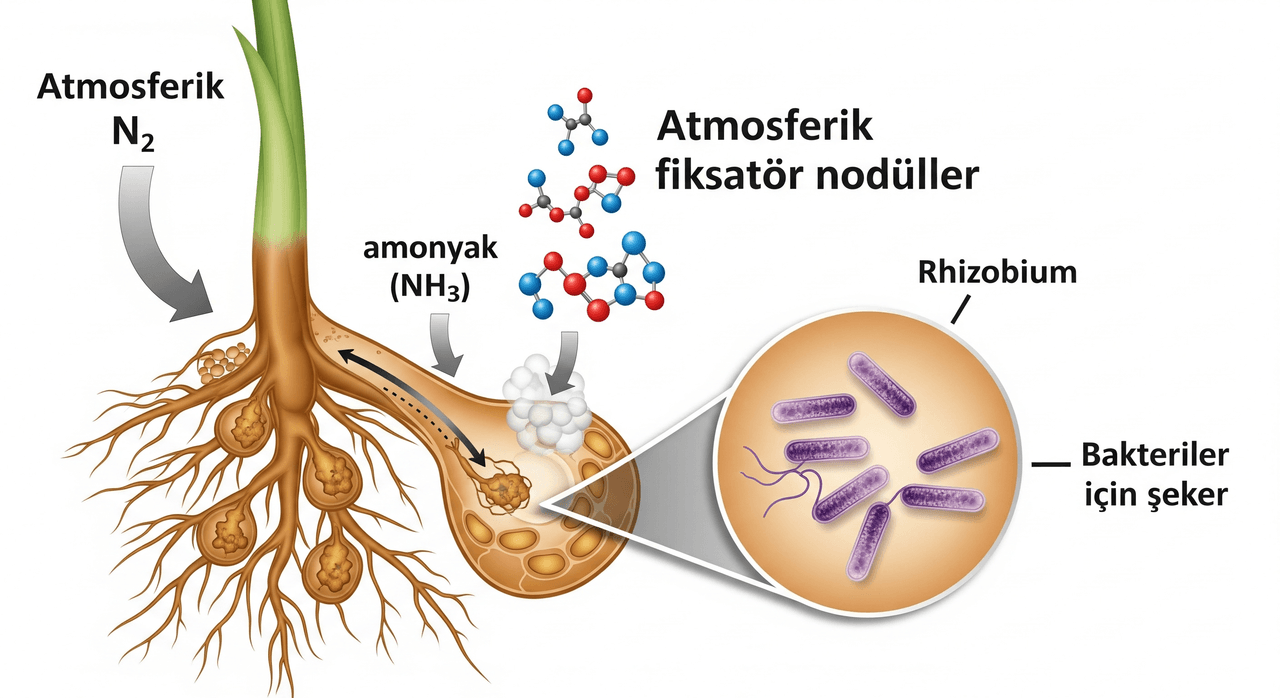
Biological Nitrogen Fixation via Nodules on Legume Roots (Generated by Artificial Intelligence)
This process, also known as atmospheric nitrogen fixation, occurs during high-energy natural atmospheric events such as lightning and thunderstorms. These events break the strong triple bond between nitrogen molecules in the atmosphere, allowing nitrogen to combine with oxygen to form nitrogen oxides. These compounds are subsequently deposited into the soil via rainfall as nitrate () and ammonium (). The amount of nitrogen fixed by this method is lower compared to other fixation types. It is estimated that the amount of nitrogen added to the soil via precipitation ranges from 1.8 to 38 kilograms per hectare annually.
Industrial nitrogen fixation is primarily achieved through the Haber-Bosch process, which produces synthetic ammonia-based fertilizers. This process requires high temperatures (400°C) and high pressures (200–350 atm). This substantial energy demand is largely met by non-renewable fossil fuels such as petroleum. Despite its high energy input, approximately 40 million tons of nitrogen are produced annually through this method.
Biological nitrogen fixation is the conversion of atmospheric molecular nitrogen into ammonia by certain microorganisms possessing the enzyme nitrogenase. This process accounts for approximately 75% of total nitrogen fixation globally, with an estimated 175 million tons of nitrogen fixed annually through this route. Biological nitrogen fixation is considered one of the most important biochemical processes on Earth after photosynthesis. It occurs primarily through two main mechanisms: symbiotic and non-symbiotic.
This type of fixation is carried out by free-living microorganisms in soil and aquatic ecosystems. It is estimated that approximately 30 million tons of nitrogen are fixed annually through this method. The main groups of microorganisms performing non-symbiotic fixation include:
It has been reported that Azotobacter species can fix up to 90 kilograms of nitrogen per hectare annually under optimal conditions.
Symbiotic nitrogen fixation occurs through a mutually beneficial relationship between a microorganism and a host plant. This process accounts for approximately half of all biologically fixed nitrogen. The best-known symbiotic relationship is established between bacteria of the genus Rhizobium and plants of the family Leguminosae. In this relationship, the bacterium receives carbohydrates from the host plant as an energy source and, in return, supplies the plant with nitrogen fixed from the atmosphere. The bacteria form specialized structures called "nodules" on the plant roots, where nitrogen fixation takes place.
This symbiosis is highly specific; each Rhizobium species interacts with a particular group of legumes. Examples include:
Through the legume-Rhizobium symbiosis, between 200 and 300 kilograms of nitrogen per hectare annually can be made available to the plant, with some cases reaching up to 600 kilograms. Alfalfa is known as one of the plants with the highest nitrogen fixation capacity, capable of fixing 125–335 kilograms of nitrogen per hectare annually.
The formation of nodules where symbiotic fixation occurs proceeds through three main stages:
Nitrogen fixation begins approximately 10–21 days after infection. An active, nitrogen-fixing nodule appears reddish or pinkish when cut open due to the presence of the pigment leghemoglobin. A greenish or brownish internal color indicates that the nodule is inactive.
When a particular legume crop is being grown for the first time in a field, the soil may not contain sufficient numbers of effective Rhizobium bacteria specific to that plant. In such cases, "bacterial inoculation" is required to ensure effective nitrogen fixation. Inoculation involves introducing a bacterial culture with high nitrogen-fixing capacity to the seedbed or directly to the seeds.
This method involves spreading soil collected from a field previously cultivated with the same legume onto the new field. However, this approach is less preferred because it requires large quantities of soil (up to 400 kg per decare), is costly, and carries the risk of introducing pathogens, pests, and weed seeds along with the soil.
This is the most common and practical method. In this approach, a bacterial culture (usually in a peat-based carrier) is applied to slightly moistened seeds. A sticky agent such as sugar water may be used to improve bacterial adhesion to the seed. Inoculated seeds must be protected from direct sunlight and planted within a few hours at the latest to prevent loss of bacterial viability.
Research has shown that alternative methods such as seedbed pulverization inoculation can be more effective than traditional seed inoculation. Inoculated seeds must not be directly exposed to lime or inorganic fertilizers.
The efficiency of biological nitrogen fixation is influenced by a range of genetic and environmental factors.
A genetic compatibility between the host plant and the Rhizobium strain is essential for fixation to occur. The fixation efficiency of different bacterial strains can vary on the same plant species.
Both low and high temperatures negatively affect fixation. Low temperatures delay root infection and inhibit nitrogenase activity. Generally, temperatures above 30°C reduce nodule formation and activity.
Symbiotic nitrogen fixation is highly sensitive to drought. Water stress reduces nodule number and size, limits the transport of photosynthetic products to nodules, and decreases nitrogenase activity. Excess soil water reduces oxygen levels in the root zone, impairing nodule formation and function.
Rhizobium bacteria generally perform best under near-neutral conditions (pH 6.8). Low pH (acidic soils) inhibits bacterial growth, hinders root infection, and can lead to toxic levels of elements such as aluminum (Al) and manganese (Mn).
High salt concentrations in the soil cause osmotic stress (physiological drought) and ion toxicity, negatively affecting both the host plant and the bacteria. Salinity reduces root hair infection, nodule number, nodule respiration, and leghemoglobin content.
Increasing atmospheric CO2 concentrations enhance photosynthesis in plants. This leads to greater transport of carbohydrates (energy) to roots and nodules, promoting nodule development, increasing nodule number and size, and stimulating nitrogenase activity. Consequently, elevated CO2 conditions generally have a positive effect on biological nitrogen fixation.
Müftüoğlu, N. Mücella, and Tuncay Demirer. “Toprakta Azot Bilançosu.” *Atatürk Üniversitesi Ziraat Fakültesi Dergisi* 29, no. 1 (1998). Accessed August 16, 2025. https://dergipark.org.tr/en/download/article-file/35439.
Sahin, Esin, Kenan Karagöz, Ramazan Çakmakçı, and Metin Tosun. “Azot Fiksasyonu ve Fosfat Çözücü Bitki Gelişimini Teşvik Edici Bakteri Aşılamalarının Arpa Gelişimine Etkisi.” (2010): 45–49. Accessed August 16, 2025. https://orgprints.org/id/eprint/27655/.
Uyanık, Mesut, Kiarash Afshar Pour Rezaeieh, Yavuz Delen, and Bilal Gürbüz. “Baklagillerde Bakteri Aşılaması ve Azot Fiksasyonu.” *Ziraat Mühendisliği* 357 (2011): 8–12. Accessed August 16, 2025. https://dergipark.org.tr/tr/pub/zm/issue/52109/680918.
Yavaş, İlkay, and Aydın Ünay. “Baklagillerde Kök, Nodül Oluşumu ve Azot Fiksasyonu Üzerine Bazı Küresel İklim Değişikliği Parametrelerinin Etkisi.” *Uluslararası Tarım ve Yaban Hayatı Bilimleri Dergisi* 4, no. 2 (2018): 270–78. Accessed August 16, 2025. https://dergipark.org.tr/en/download/article-file/593468.
İşler, Erdinç, and Ali Coşkan. “Farklı Bakteri Bradyrhizobium japonicum Aşılama Yöntemlerinin Soyada Azot Fiksasyonu ve Tane Verimine.” Journal of Agricultural Sciences 15, no. 4 (2009): 324–31. Accessed August 16, 2025. https://dergipark.org.tr/en/download/article-file/1507771.

Methods of Nitrogen Fixation
Non-Biological Nitrogen Fixation
Industrial Nitrogen Fixation
Biological Nitrogen Fixation (BNF)
Non-Symbiotic (Asymbiotic) Fixation
Symbiotic Fixation
Nodule Formation Process (Nodulation)
Bacterial Inoculation
Soil Inoculation
Seed Inoculation
Factors Affecting Nitrogen Fixation
Bacterial Strain and Host Compatibility
Nutrient Elements
Temperature
Soil Moisture (Drought and Waterlogging)
Soil pH
Salinity
Atmospheric Carbon Dioxide (CO2) Increase