


This article was automatically translated from the original Turkish version.
Lightning flashes occur due to the sudden and powerful discharge of a large electrical potential difference between a cloud or between a cloud and the ground. Lightning is typically observed within or around cumulonimbus clouds, which are storm clouds. During the discharge, the temperature of the air rises above 30,000 °C, transitioning into a plasma state and producing a brilliant flash of light along with a powerful sound burst (thunder).

Lightning Flashes and the Electrical Balance of the Atmosphere (Generated by Artificial Intelligence.)
The formation of lightning flashes is based on the sudden and intense discharge of accumulated electrical charges in the atmosphere. Within storm clouds, upward and downward air movements (convective currents) separate positive and negative charges. The upper parts of the cloud typically become positively charged while the lower parts become negatively charged. This charge separation leads to the electric field within the cloud gradually reaching a critical threshold. When the electric field strength exceeds approximately three million volts per meter, the air loses its insulating properties and conductive plasma channels form. At this stage, a lightning flash begins.
During a lightning event, negative charges attempt to connect with positive charges on the ground or in the upper part of the cloud. In this process, a preliminary plasma channel called a “leader” is formed. As the leader channel advances, the ionization of the air increases and electrons rapidly propagate through the atmosphere. During this phase, branched pathways known as “step leaders” develop, preparing the final discharge channel for the lightning. Once this channel is fully established, a massive electric current discharges in an extremely short time. This instantaneous current can reach enormous values of up to 30,000 amperes.
The energy released during the discharge causes the air to abruptly transition into a plasma state and emit bright light. Simultaneously, the surrounding air expands rapidly, generating shock waves. These shock waves produce the sound of thunder, which reaches our ears seconds later. Thus, lightning and thunder are two different manifestations of the same physical phenomenon. The light and sound effects of lightning flashes provide important clues for meteorological observers and can be used to assess storm intensity.
In addition to these physical processes, lightning flashes play a vital role in maintaining the electrical balance of the atmosphere. A continuous electrical equilibrium exists between the ionosphere and the Earth’s surface. Lightning continuously readjusts the electrical charge balance between clouds and the ground. Thus, lightning flashes function as a natural “discharge” mechanism for the buildup of static electricity in the atmosphere.
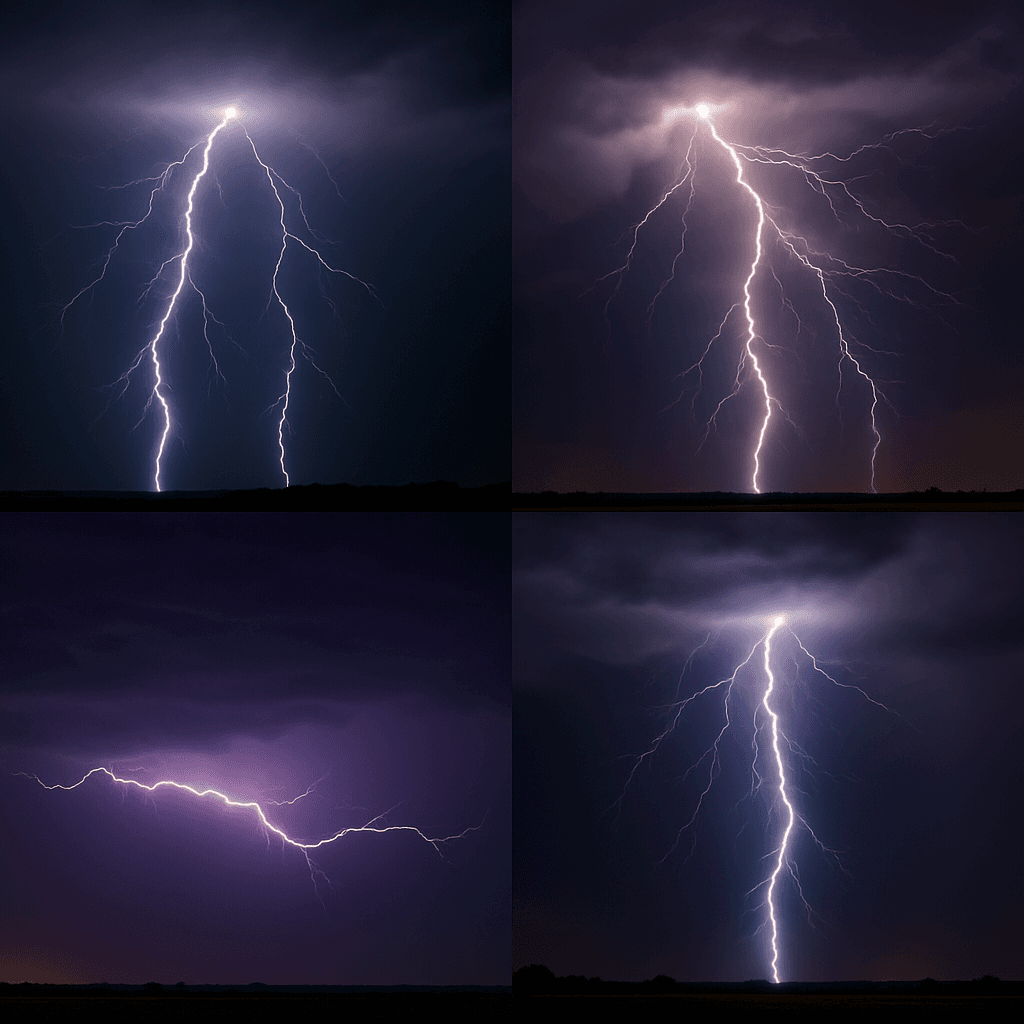
Types of Lightning and Their Visual Characteristics (Generated by Artificial Intelligence.)
Various types of lightning occur under different conditions, each exhibiting unique visual and physical properties. The most common type is cloud-to-ground lightning (CG), which results from the sudden discharge of a large electrical potential between a cloud and the ground. These lightning flashes occur due to the rapid discharge of voltage between the Earth’s surface and the lower part of the cloud and are typically characterized by their bright, branched structure.
In addition, intra-cloud lightning (IC) is frequently observed. These flashes result from discharges between positive and negative charge centers within the same cloud. Intra-cloud lightning usually causes the cloud to glow brightly and produces flash-like light trails visible in the night sky. IC lightning does not reach the ground and therefore has more limited local effects compared to CG lightning. However, it provides valuable information about storm intensity.
Another less well-known type is called cloud-to-cloud lightning (CC). In this type, lightning establishes a charge balance between two different cloud systems and travels along a long, horizontal path. Cloud-to-cloud lightning represents impressive phenomena that reveal the extent and electrical complexity of storm systems. Particularly in large storm clusters, CC lightning can create brilliant pathways stretching for kilometers and temporarily illuminate the sky.
Another interesting type of lightning is known as positive lightning. Positive lightning occurs when positive charges in the upper part of a cloud interact with negative charges on the ground or in the lower part of other clouds. These lightning flashes are typically much stronger than CG lightning and can cover longer distances. Due to their higher energy, positive lightning flashes can trigger natural disasters such as forest fires and pose a serious risk to aircraft.
Visually, lightning generally forms branched, luminous pathways. This branching occurs because the electrical discharge progresses through multiple channels and the ionization rates in the atmosphere vary. The color of a lightning flash, ranging from brilliant white to bluish-purple, is determined by temperature and ionization density. Thus, each lightning flash presents a mesmerizing image, like a temporary “light sculpture” in the atmosphere.
Lightning flashes are not merely spectacular visual displays of the atmosphere; they also play a significant role in the dynamic balance of weather and climate systems. Lightning restores the electrical balance in the atmosphere by completing the atmospheric electrical cycle. This natural discharge mechanism regulates the electrical potential difference between the ionosphere and the Earth’s surface and continuously neutralizes static electrical charges to maintain equilibrium.
Another important atmospheric role of lightning flashes is the production of nitrogen oxides (NOx). During a lightning discharge, the extreme temperatures of the air—reaching up to 30,000 °C—cause nitrogen and oxygen molecules to react. This reaction produces nitrogen oxides, which contribute to atmospheric ozone chemistry and indirectly influence the greenhouse gas balance. Thus, lightning flashes can affect local air quality and also play a role in long-term climatic processes.
Additionally, lightning, particularly as part of strong convective storms in tropical regions, contributes to vertical energy transfer in the atmosphere. During convective uplift, warm and moist air rises rapidly, supporting lightning formation. In this process, energy and moisture are transferred between the lower and upper layers of the atmosphere. Thus, lightning flashes are not merely electrical discharges; they are also an integral component of the internal dynamics of storm clouds.
The impact of lightning on the climate system has become a major focus in climate change research. Rising temperatures and humidity levels due to global warming may increase the frequency of convective storms and, consequently, lightning activity. Recent studies suggest that the increasing frequency of lightning flashes may be linked to climate change. Therefore, the role of lightning in atmospheric and climatic interactions is becoming a factor that shapes not only current weather events but also future climate projections.
The atmospheric role of lightning flashes can also determine the intensity of local weather events. Severe thunderstorms accompanied by lightning are harbingers of extreme weather phenomena such as sudden rainfall, hailstorms, and strong winds. Consequently, the observation and analysis of lightning flashes constitute a critical input for weather forecasting models. Meteorologists use the intensity and distribution of lightning flashes to predict the severity of approaching storms.
In conclusion, lightning flashes are an essential component of the dynamic structure of the atmosphere and climate system. By directly and indirectly influencing electrical charge balance, ozone chemistry, convective energy transfer, and weather forecasting, they represent far more than a mere visual spectacle in the sky. Therefore, the role of lightning in atmospheric and climate systems remains an indispensable subject in meteorological and climate science research.
Lightning flashes have fascinated humans for thousands of years. Today, this natural phenomenon is a significant subject of research in modern meteorology and atmospheric science. Observing lightning is no longer limited to the naked eye; it is now conducted using advanced technologies and scientific methods. These observational techniques greatly enhance our understanding of lightning dynamics and the overall structure of the atmosphere.
The most basic observation method is ground-based optical observation. Especially during storm seasons, meteorological stations directly record lightning flashes to update their databases. This data provides important insights into the geographic distribution and frequency of lightning. However, modern meteorology has developed far more sensitive and detailed methods for lightning observation. Among these, devices called “sferics” that detect radio frequencies are foremost. Radio waves emitted during lightning flashes are recorded by these devices, providing detailed information on the location, direction, and intensity of the lightning.
In addition, satellite-based observation systems track lightning flashes on a global scale. Modern satellites such as NASA’s Geostationary Lightning Mapper (GLM) precisely record the time and location of lightning events. This data provides vital information on the size and development rate of storm systems, contributing to the improvement of weather forecasting models. Satellite observations are particularly critical for analyzing the relationship between lightning activity in tropical regions and global climate.
Modern research examines not only the frequency and location of lightning flashes but also their energy structure and chemical effects. In particular, the amount of nitrogen oxides (NOx) produced by lightning and the impact of these gases on stratospheric ozone balance constitute an important area of climate science research. These studies represent a fundamental step toward understanding how lightning can be integrated into long-term climate projections.
Moreover, the effects of lightning on aircraft and infrastructure are also a focus of modern research. The aviation industry uses high-resolution sensors such as radar and lidar to understand the impact of lightning flashes on flight safety. Similarly, protecting energy and communication lines from lightning strikes is a major focus of engineering research. Therefore, lightning research holds significant importance both in fundamental science and applied engineering.
In conclusion, the observation and analysis of lightning flashes is one of the most exciting areas in modern atmospheric science. Supported by satellites, radar, and ground-based sensors, these studies unravel the electrical nature and dynamics of the atmosphere, providing valuable data for weather forecasting, climate modeling, and engineering safety. Thus, lightning flashes are not merely a visual spectacle of nature; they have become a window that expands the frontiers of science.
The electrical balance of the atmosphere is shaped by the continuous potential difference between Earth’s ionosphere and surface. This difference is approximately 300,000 volts and forms a global equilibrium system known as the “global electric circuit.” This continuous atmospheric electrification is sustained by sources such as radioactive processes on Earth’s surface and cosmic rays. However, this static electrical charging can become unbalanced over time and, when it reaches a certain threshold, triggers sudden discharges such as lightning flashes. Thus, lightning acts as a natural regulator that maintains the electrical cycle of the atmosphere.
The regulatory role of lightning flashes helps maintain the electrical flow between the lower and upper layers of the atmosphere. For example, while positive charges accumulate in Earth’s ionosphere, the surface is typically negatively charged. The electric currents generated during lightning flashes reduce this charge imbalance and restore equilibrium to the global electric circuit. This process ensures a stable structure for storm systems and general atmospheric circulation by preserving the electrical balance of the atmosphere.
This regulatory role is also critically important for life on Earth and technological systems. Without discharge mechanisms such as lightning flashes, the accumulated massive electrical potential in the atmosphere could lead to a continuous increase in local electric fields and potentially cause destructive electrical discharges. Lightning ensures that these sudden discharges occur in a controlled and regular manner, thereby relieving the “tension” in the atmosphere.
Research shows that the frequency and intensity of lightning flashes directly affect the electrical balance of storm systems. In regions where lightning is frequent, the global electric circuit becomes more active, and regional fluctuations occur in the atmospheric electrical cycle. Particularly in tropical regions, millions of lightning flashes occurring annually serve as the primary regulator of the global electrical balance. Thus, lightning behaves like an “energy regulator” of the atmosphere, preserving weather and climate stability.
The role of lightning in maintaining this electrical balance is a significant area of research in modern meteorology and atmospheric science. Scientists use ground-based electric field measurements and satellite-derived data to understand how lightning contributes to the global electric circuit. This data provides critical information for modeling climate change and potential atmospheric risks.
In conclusion, lightning flashes are not merely sudden discharges of atmospheric electrical charges; they are vital processes that preserve the planet’s electrical equilibrium. This continuous balance is maintained by the activation of lightning and ensures a safe atmospheric environment for life on Earth. Therefore, the role of lightning in the electrical cycle is recognized as one of the cornerstone elements of both fundamental atmospheric physics and global climate science.
Christian, Hugh J., Richard J. Blakeslee, Dennis J. Boccippio, William L. Boeck, Dennis E. Buechler, Kevin T. Driscoll, Steven J. Goodman, John M. Hall, William J. Koshak, Douglas M. Mach, and Michael F. Stewart. "Global Frequency and Distribution of Lightning as Observed from Space by the Optical Transient Detector." *Journal of Geophysical Research: Atmospheres* 108, no. D1 (2003). https://doi.org/10.1029/2002JD002347
Rakov, Vladimir A., and Martin A. Uman. *Lightning: Physics and Effects*. Cambridge: Cambridge University Press, 2003. https://books.google.com.tr/books?hl=tr&lr=&id=NviMsvV
Stolzenburg, Maribeth, W. David Rust, Bradley F. Smull, and Thomas C. Marshall. "Electrical Structure in Thunderstorm Convective Regions: 1. Mesoscale Convective Systems." *Journal of Geophysical Research: Atmospheres* 103, no. D11 (1998): 14097–14108. https://doi.org/10.1029/97JD03546
Williams, Earle R. "The Electrification of Thunderstorms." *Scientific American* 259, no. 5 (1988): 88–99. https://www.jstor.org/stable/24989265

Physical and Electrical Properties of Lightning Flashes
Types of Lightning and Their Visual Characteristics
Atmospheric and Climatic Role of Lightning Flashes
Observation and Modern Research on Lightning Flashes
The Relationship Between Lightning and the Electrical Balance of the Atmosphere