


Ergenekon Epic: The Rebirth of the Turks
History is like a vast memory that records the events of societies, their victories, injustices suffered, and struggles for survival. Yet some events do not remain confined to history books; they are passed from mouth to mouth, transforming into enchanting tales known as "epics." Epics are long and deeply rooted narratives that convey a nation’s character, dreams, and stance in the face of adversity. Today, we will examine the Ergenekon Epic, which symbolizes the struggle for existence and deliverance from a harsh geography, The Turks'.
The Ergenekon Epic is more than just an ancient war story. This narrative describes how a people, facing total annihilation, took refuge in a hidden valley between steep mountains, patiently multiplied there, and centuries later achieved freedom by melting a mountain of iron. Think of the game of hide-and-seek in a child’s world: hiding in the safest place, growing stronger, then emerging into the open. But here, it is not one or two individuals who are hiding—it is an entire nation.
In this text, we will examine in the finest detail what Ergenekon means, why the Turks took refuge in this valley, how they established life there, and how, through the ingenuity of a master smith, they overcame the impassable mountains. In our narration, we will follow step by step the information provided by historical sources with an impartial gaze. If you are ready, let us step into the world of iron mountains and blue-maned wolves.
🤔The Origin and Meaning of the Name Ergenekon
Investigating the origins of words reveals how people in the era when those words were first used perceived the world. Although the word "Ergenekon" appears as a single term, it is in fact formed from the combination of two distinct concepts. According to sources, this name derives from the union of the words "Ergene" and "Kon."
The word "Ergene" in ancient language means "steep," "precipitous," or "a place extremely difficult to reach or climb." Imagine the steepest slope of a mountain; this refers to cliffs so high that walking up them is nearly impossible, accessible only to birds in flight.
The word "Kon" means "pass," "mountain ridge," or "settlement." It describes flat areas or paths between mountains where people could pitch tents and live.
When we combine these two words, "Ergenekon" means "Steep Mountain Pass" or "Precipitous Mountain Ridge." This name corresponds exactly to the geography described in on the stand. The place where the Turks took refuge was surrounded by mountains impossible to cross, hidden from outsiders, yet internally suitable for life. Some researchers suggest that the name may have Mongolian origins, with "Ergene" referring to a mountainous region and "Kon" denoting steep slopes. Regardless of its linguistic origin, the name tells us that this place was a protected and mysterious fortress.

Depiction of Ergenekon (Generated by artificial intelligence.)
⏳Time Travel: The Göktürks and the Iron Age
To fully understand this story, we must board our time machine and travel back approximately 1,500 years to the present day. At that time, across the vast steppes of Asia, a great state known as the "Göktürks" ruled. The Göktürks were the first political community in history to use the name "Turk" as an official state designation.
The Ergenekon Epic is generally regarded as the founding myth of the Göktürk State or as an event experienced by its ancestors. Historians record that the Göktürk State was established in The Göktürks' 552 and endured until 744. However, the events described in the epic predate the founding of this state, perhaps belonging to a time before detailed historical records were kept.
During this period, the most important material for people was "iron." Iron was used both for everyday tools (knives, scissors, pots) and for weapons used in hunting and defense. Historical sources frequently emphasize that the ancestors of the Göktürks were a community skilled in metallurgy and expert in working iron. In fact, Chinese sources state that the ancestors of the Göktürks were renowned for their ironworking. Therefore, the liberation in the Ergenekon Epic occurring through the melting of an iron mountain is no coincidence; it reflects the most familiar craft and technology of that society.

⚔️ A Hard Beginning: The Great Struggle and Escape
Every epic typically begins with a great hardship or catastrophe. In the Ergenekon Epic, events commence with a devastating defeat suffered by the Turks. According to the epic, the Turks were led by a ruler named "Ilhan." His kingdom was attacked by a large enemy army formed by the union of neighboring tribes.
The battle was extremely fierce. Unfortunately, the Turkish army was defeated. The enemies did not merely defeat the soldiers; they rendered nearly everyone in the land powerless. This situation marked a critical moment when a people stood on the brink of disappearing from the historical stage. Yet, as every dark night has its dawn, even within this catastrophe lay a glimmer of hope.
Only two individuals managed to escape the battlefield: Ilhan’s young son "Kıyan" (recorded in some sources as Kayı) and his nephew "Nüküz" (or Tokuz). These two young men, taking their wives with them, fled rapidly to avoid capture by the enemy. Their goal was to survive and preserve their family lineage. Hiding on open plains was impossible, so they drove their horses toward the mountains, into the steep cliffs where no one dared to go.

Depiction of survivors after the defeat (Generated by artificial intelligence.)
🌲 In the Embrace of Nature: Discovery of the Ergenekon Valley
Kıyan and Nüküz passed through narrow, perilous paths even wild goats struggled to traverse, fleeing from enemy pursuit. As they climbed toward the mountain peaks, the air grew colder and the wind stronger. Yet they did not give up. At the end of a long and exhausting journey, they noticed a narrow pass hidden between the mountains.
When they entered through this pass, they could hardly believe their eyes. Unlike the steep, rocky terrain outside, a paradise-like valley stretched before them. This valley, shaped like a massive basin, was enclosed on all sides by mountains rising to the sky. The mountains were so high that they completely concealed the valley from the outside world.
Clear streams flowed gently through the valley. Everywhere, the land was covered with lush green meadows, fruit trees, and colorful flowers. More importantly, numerous game animals lived in the valley. This meant a source of both water and food for Kıyan, Nüküz, and their families. This place was like a safe fortress gifted to them by nature. It was impossible for enemies to find it. The two families decided to settle in this valley and named it "Ergenekon," after the arduous path they had traversed.
👨👩👧👦 Population Growth and Development: Four Centuries of Waiting
The Ergenekon Valley became a new homeland for the Turks. Kıyan and Nüküz erected their tents and adopted a settled way of life. Over time, they had children, and their children had children. Generations succeeded one another.
According to sources, the Turks lived in this valley for exactly 400 years. Four hundred years is an extremely long time. Think of your great-great-grandfather; that is how long this period lasted. The population, initially consisting of only two tents, grew over time to hundreds and then thousands of tents. The people engaged in animal husbandry, worked iron, wove cloth, and developed their own culture.
Yet over time, the valley began to become insufficient for this growing population. Pastures were overgrazed, and people struggled to find flat land for building homes. What had once seemed a spacious and safe refuge now felt cramped. This situation was the clearest evidence that the community had regained its strength and reached its former numbers. The great defeat suffered by their ancestors was now a distant memory. Their new goal was clear: to leave Ergenekon and return to the vast lands once inhabited by their ancestors.
🔍 Searching for an Exit and Despair
The people unable to fit within the valley convened a council to assess their situation. The decision was unanimous: "We can no longer fit here; we must return to our ancestral homeland." Yet a major problem existed. The narrow pass through which their ancestors had entered the valley 400 years earlier had closed, perhaps due to natural events such as a landslide or rockfall. Or perhaps, over the centuries, the location of this hidden path had been entirely forgotten.
The bravest scouts and mountaineers of the people searched every side of the surrounding mountains. For days, for weeks, they sought an exit, a path, a crevice. But the mountains stood like impassable walls, offering no passage. Wherever they went, they encountered sheer cliffs.
This situation caused growing anxiety among the people. They were strong and numerous, yet they were imprisoned. They could not escape. It was precisely at this moment of despair that the solution emerged not through physical force, but through "reason" and "knowledge."

🔥 The Smith’s Brilliant Idea and the Power of Science
Among the people lived a wise master smith whose trade was ironworking. While examining one of the mountains, he noticed a crucial detail: the rocks of this mountain differed from those of others. Using his experience, he realized that this mountain contained a rich deposit of iron.
The smith immediately went to the leaders of the people and presented his idea: "There is iron inside this mountain. If we melt this iron, we can open a passage wide enough for us." This idea, unprecedented until then, was wild yet scientific. Digging through the mountain with tools would take years, but using fire to melt it meant harnessing nature’s power through technical knowledge.
This proposal reflects the technological capabilities of the Turks during the Iron Age period. At that time, understanding and working iron was as valuable and advanced a skill as writing computer programs today. The smith in this epic is not merely a laborer; he emerges as a hero who saves his people through intellect.

Depiction of the smith explaining his plan to the people (Generated by artificial intelligence.)
🌬️ Seventy Bellows and Collective Effort
The smith’s proposal was accepted, but this task was not one that a single person could accomplish. Melting an entire mountain required a massive fire and a powerful airflow to sustain it.
The people immediately set to work. They piled layers of wood and coal at the most suitable spot on the mountain. To raise the fire’s temperature to the level required to melt iron (approximately 1,500 degrees), they needed tools known as "bellows." A bellows is a tool made of leather that, when compressed, expels a strong blast of air from its nozzle, used by smiths.
Men, women, young, and old brought their animal hides. Craftsmen fashioned these hides into exactly seventy large bellows. They strategically placed these seventy bellows around the fire and the mountain.
When preparations were complete, the fire was lit. Hundreds of people took their places at the bellows. At the command "One, two, three!" they all pulled the bellows simultaneously. The air from the seventy bellows fanned the flames. The fires rose into the sky. This scene is the finest example of the saying "Unity creates strength." No one alone could melt the mountain, but when everyone combined their strength, the impossible became possible.

Depiction of the mountain being melted (Generated by artificial intelligence.)
🐪 A Loaded Camel’s Passage and Freedom
After long efforts and much sweat, the awaited moment arrived. The iron portions of the mountain began to melt under the intense heat. As the molten iron flowed like a river, a cavity, a tunnel, formed within the mountain.
When the fire was extinguished and the smoke dispersed, the people erupted in joyous cries. Before them lay a gateway to the outside world. Sources describe the width of this newly opened passage using a concrete measure: "Wide enough for a loaded camel to pass."
Why "a loaded camel"? Because the camel was the largest transport animal of that era. For a camel, laden with belongings (tents, food, cauldrons), to pass through meant the entire population could migrate comfortably with all their possessions. This expression indicates that the passage was neither too narrow nor unnecessarily wide, but precisely suited to their needs.
The Turks emerged from Ergenekon through this passage. Four centuries of captivity had ended; they had regained their freedom. This event is regarded in Turkish history as a "rebirth."

Depiction of the passage out of Ergenekon (Generated by artificial intelligence.)
🐺 The Guiding Guide: The Gray Wolf
The exit from Ergenekon had been achieved, but had the outside world changed over 400 years? Who remembered the old paths? In this section of the epic, the "Gray Wolf" (Börteçine), one of its most powerful symbols, appears on the scene.
According to legend, before the newly opened passage, a noble wolf appeared with fur shimmering like the blue sky. This wolf did not attack like a wild beast; instead, it stood with a reassuring demeanor. The wolf’s eyes sparkled with intelligence.
The Gray Wolf stepped ahead of the herd and began to walk. The people believed this wolf was a guide sent by God and followed it. The wolf showed them the safest routes, the most fertile pastures, and the location of their ancestral homeland.
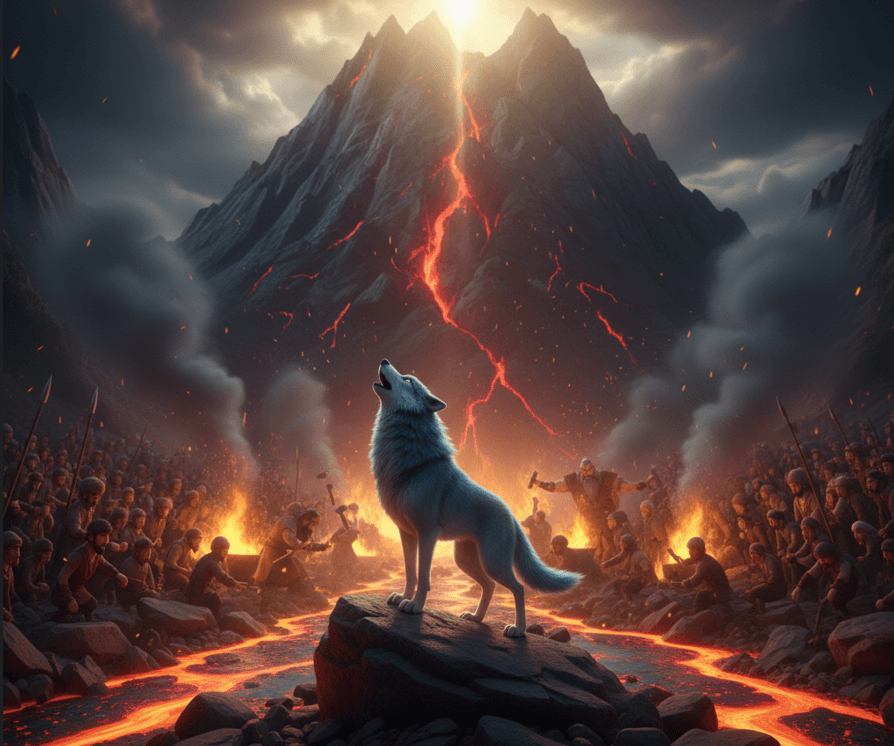
Here, the "Gray Wolf" is not merely an animal but also a symbol of "reason," "strategy," and "independence." Wolves, by nature, are devoted to freedom and cannot be domesticated. The Turks identified themselves with this trait. Moreover, the wolf’s color being described as "sky" (blue) symbolizes its connection to the ancient Turkic belief in "Gök Tanrı" (Sky God) and signifies a sacred mission.

Depiction of the Gray Wolf guiding the Turks (Generated by artificial intelligence.)
🎉 Nowruz Festival: Celebrating the Exit from Ergenekon
The day the Turks melted the iron mountain and exited Ergenekon coincides with a special date in the historical calendar. Sources indicate that this great exit occurred on March 21. March 21 is also the "Spring Equinox," when day and night are of equal length and winter ends, giving way to spring.
In Turkish culture, this day is called "Nowruz." Nowruz means "New Day" in literal terms. Just as nature awakens from its winter slumber and flowers bloom, the Turkish nation emerged from Ergenekon and returned to the historical stage. Therefore, Nowruz is not merely the arrival of spring for the Turks; it is also a national "Day of Liberation."
For centuries, Turkish communities held grand celebrations every year on March 21 (or, according to some calendars, March 9). These festivities reenact the exit from Ergenekon.

Representative Nowruz celebrations (Generated by artificial intelligence.)
🔨 Tracing the Tradition: The Iron Hammering Ceremony
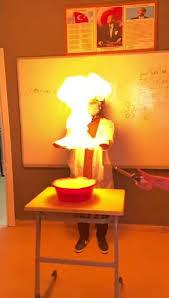
The most vivid surviving remembrance of this event is the "Iron Hammering" tradition. This ritual, always performed during Nowruz celebrations, symbolizes the melting of the iron mountain by their ancestors.
The ceremony follows these steps:
- A piece of iron is heated in a fire until it glows red-hot.
- The red-hot iron is placed on a hard iron anvil called an "örs."
- The leader of the community, the khan, or the most respected elder takes a hammer in hand.
- The hammer strikes the hot iron, shaping it.
This act carries the message: "We are a people who melted iron and overcame mountains, who triumphed over adversity." It is known that Bumin Kağan and İstemi Yabgu, the founders of the Göktürks, upheld this tradition and held great respect for metallurgy. Iron is called "Kök-Temir" (Sky Iron) in Turkish culture and is regarded as a sacred, powerful, and unshakable material.
✍️ Written Sources: How Did the Story Reach Us?
The Ergenekon Epic was kept alive for centuries through oral tradition—told by grandfathers to grandchildren and sung by bards accompanied by the kopuz. Yet for a story to survive intact until today, it must be written down.
The person who recorded the epic in the most detailed form was Ebulgazi Bahadır Han, who lived in the 17th century. Ebulgazi Bahadır Han was both a state ruler and a historian. In his famous work, "Şecere-i Terakime" (Genealogy of the Turkmens), he recorded the Ergenekon Epic as he had heard and researched it.
In his work, he emphasized that Ergenekon was not a fairy tale but a historical truth describing the origins of Turkish tribes and how they spread. Important information about this epic is also found in the 14th-century work "Cami’ü’t-Tevarih," written during the Ilkhanid period. Thanks to these written sources, we can now clearly understand what our ancestors experienced 1,500 years ago.
🌍 The Importance of the Epic Today
The Ergenekon Epic does not merely recount the past to children and adults; it also imparts vital lessons for the future.
First, the preservation of hope. The Turks never gave up, even after losing everything and standing on the brink of extinction. They endured for 400 years. This teaches us that even in the most desperate circumstances, a way out always exists.
Second, the power of science and reason. Force alone could not overcome the mountains; salvation came through the geological knowledge and engineering intelligence of a master smith. It demonstrates the importance of valuing knowledge in solving problems.
Third, unity and solidarity. The bellows were not pulled by one person, but by seventy people and the entire community. Great achievements can only be won when society works together.

(Generated by artificial intelligence.)