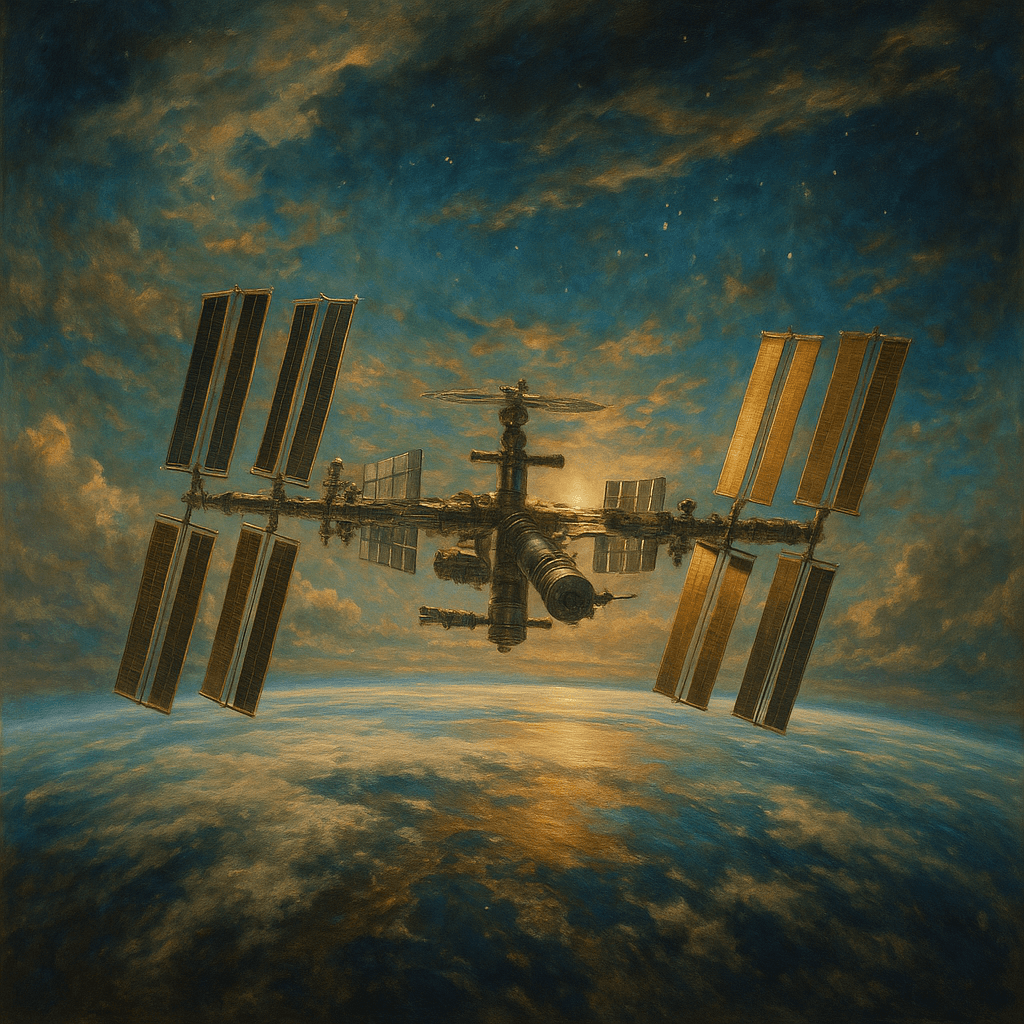




International Space Station (ISS)
A Giant Home in Space
The International Space Station (ISS) is a space station orbiting Earth. It travels approximately 400 kilometers above the planet's surface, moving at a speed of 28,000 kilometers per hour and completing one full orbit around Earth in just 90 minutes. As a result, astronauts aboard the station witness 16 sunrises and sunsets each day!

(Generated by Artificial Intelligence.)
How Was It Built?
The ISS began with the launch of its first module in 1998. Subsequent components were added by the United States, Russia, Europe, Japan, and Canada. Today, the station is as large as a football field and contains laboratories, living quarters, and massive solar panels.
What Do Astronauts Do There?
Astronauts live, work, and conduct experiments on the ISS. They study how plants grow in space, test the effects of medications, and investigate how the human body changes in microgravity. For example, they exercise daily to prevent muscle and bone loss.

(Generated by Artificial Intelligence.)
Why Is It Important?
The ISS is not only a scientific laboratory but also a symbol of international cooperation. Scientists from different countries work together in the same location, gathering valuable knowledge for humanity. Moreover, research conducted on the ISS helps prepare for future missions to the Moon and Mars.