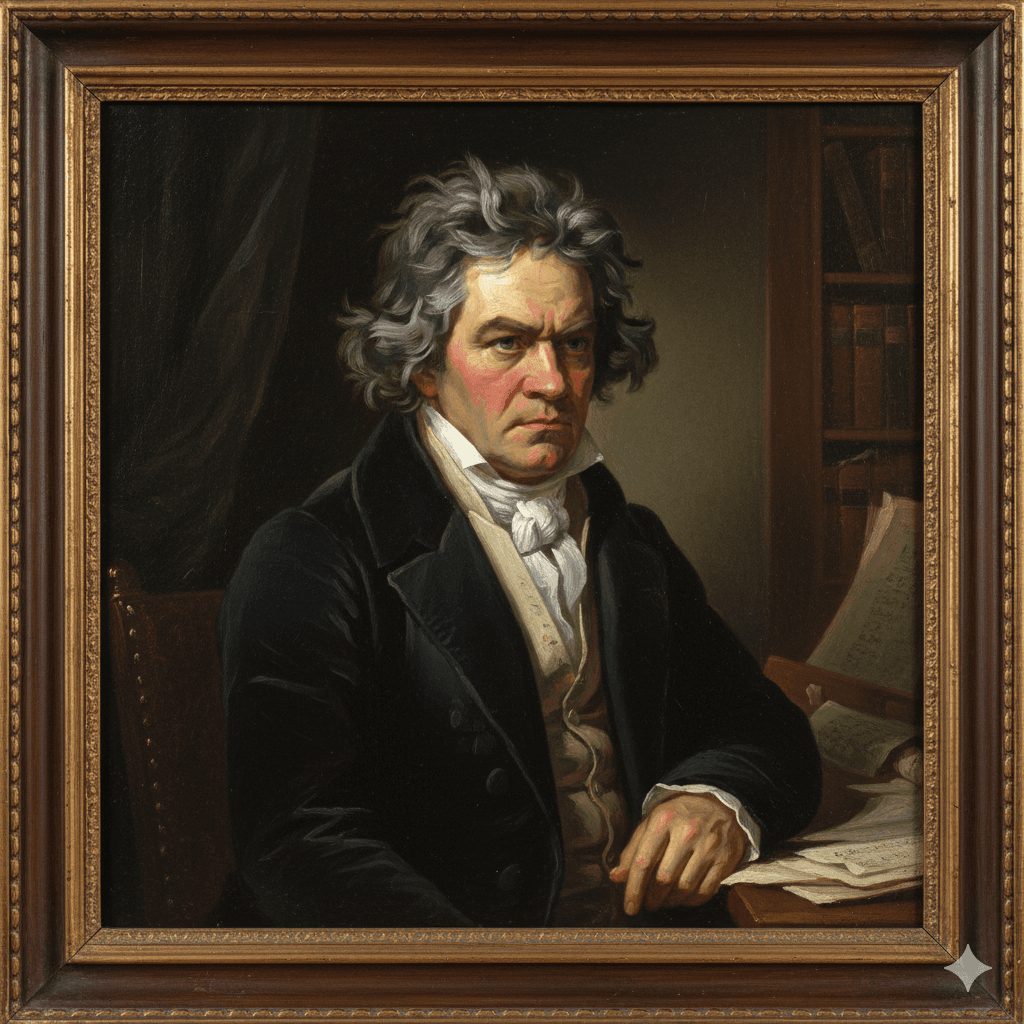




Ludwig van Beethoven
Beethoven, who developed a deep fascination with music at an early age and whose passion only grew stronger as he matured, is one of music’s most unforgettable geniuses. Even after losing his hearing, he never abandoned composing music. His life is an inspiring story of determination and the power of creativity.
👶 Birth
Beethoven was born in 1770 in the city of Bonn, Germany. His family was deeply immersed in music; his father was also a musician. Music often echoed throughout their home. Even as a very young child, Beethoven discovered the magic of music by touching the piano keys.

Representative image of Beethoven’s childhood (Image generated by artificial intelligence).
💡 Interest in Music
Beethoven was an exceptionally curious child and never grew tired of experimenting with instruments such as the piano, violin, and organ. By the age of eleven, he could read musical notation and compose his own melodies. His teacher, Christian Gottlob Neefe, recognized his extraordinary talent. Thanks to Neefe, Beethoven began performing the works of great composers like Bach. This opened the doors of the musical world to him completely.

Representative image of Beethoven with his violin and piano (Image generated by artificial intelligence).
👂🏽 Loss of Hearing and Inner Strength
Beethoven began experiencing hearing problems at a young age. Over time, he heard sounds less clearly and eventually became almost completely deaf. Yet this did not stop him. He no longer experienced music through his ears but through his heart and mind. While playing the piano, he felt the vibrations of the notes through his hands and recreated every sound within his inner world. In this way, despite being unable to hear, he composed some of the most powerful melodies in history!
🎓 Education
Beethoven’s musical education began at an early age. His first teacher was his father, but his true development occurred under the guidance of his teacher Neefe. Neefe taught him not only how to play the piano but also how to compose music. As time passed, Beethoven studied music theory, wrote his own compositions, and practiced relentlessly. He never ceased striving for self-improvement; each new work was stronger than the one before it.

Representative image of Beethoven taking a piano lesson with his teacher Neefe (Image generated by artificial intelligence).
🎶 Compositions
Beethoven composed numerous works that shaped classical music. His music was both emotional and powerful. Some of his most famous compositions include:
🎼 Waldstein Sonata: An energetic piece that storms across the piano keys.
🔥 Appassionata Sonata: A passionate work that reflects the most intense emotions.
🎹 Hammerklavier Sonata: A technically demanding yet profoundly moving composition.
Beethoven broke the rules of classical music to discover new sounds and emotions. His compositions are not merely notes—they are stories that express the human soul.
🌍 Global Recognition
Today, Beethoven’s name is revered around the world. His music has become the language of emotion.

Students performing Beethoven’s works on violin today (Image generated by artificial intelligence).
His symphonies, sonatas, and concertos are still performed in concert halls today. He is regarded as a pioneer who bridged the Classical and Romantic eras. Through his music, Beethoven inspired hope, courage, and love in people everywhere.