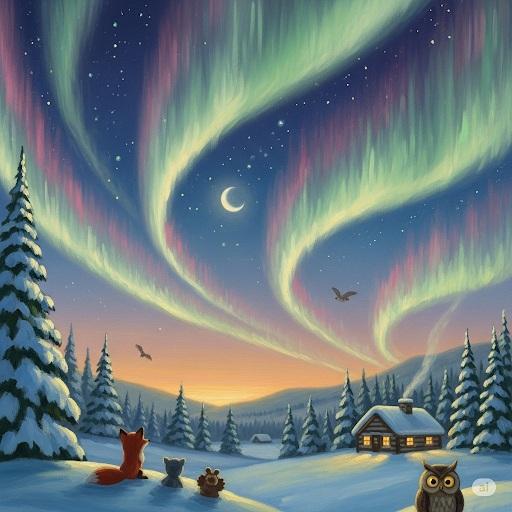




Northern Lights 🌌
Northern lights are a colorful light display that dances across the sky. This natural phenomenon, visible at night especially in regions near the poles, produces glowing lights in shades of green, pink, purple, and blue. The scientific name for these lights is Aurora Borealis.
How Are They Formed? ☀️
The formation of northern lights results from an interaction between charged particles from the Sun and gases in Earth’s atmosphere. Eruptions on the Sun send streams of charged particles into space, known as the solar wind. When these particles collide with Earth’s magnetic field, they are guided by the planet’s protective shield toward the poles.
At the poles, these particles collide with gases in Earth’s atmosphere such as oxygen and nitrogen. As a result of these collisions, gas molecules gain energy and release it in the form of light. This is how the colorful light display is created.

(Generated by artificial intelligence.)
What Colors Are Seen? 🌈
The color of the northern lights depends on the type of particle involved and the altitude of the collision.
- Green: The most common color, produced by oxygen molecules colliding at approximately 100 kilometers altitude.
- Red: Occurs at higher altitudes, around 300 to 400 kilometers, due to collisions with oxygen.
- Blue and Purple: Result from collisions with nitrogen gas.

(Generated by artificial intelligence.)
Why Are They Only Visible Near the Poles? 🗺️
Earth’s magnetic field acts like a magnet, drawing charged particles from the Sun toward the poles. As a result, northern lights (Aurora Borealis) are typically seen in countries around the North Pole such as Iceland, Norway, Sweden, Finland, Canada, and Alaska, while southern lights (Aurora Australis) appear around the South Pole. However, during intense solar storms, these lights can be visible at lower latitudes, and sometimes even in Türkiye.

(Generated by artificial intelligence.)