This article was automatically translated from the original Turkish version.
+1 More
Region(s) | 55°–70° South auroral oval | ||||||||
|---|---|---|---|---|---|---|---|---|---|
Colors and Altitude | Pink (<100 km) Blue/Purple (100–200 km) Red (>200–300 km) Green (100–200 km) | ||||||||
Effect | GPS signal disruption, radio wave obstruction, power grid outages | ||||||||
Measurement | Kp Index (0–9) | ||||||||
Layer | Thermosphere (100–400 km) | ||||||||
Speed | 20,000 km/s (1/10 the speed of light) | ||||||||
Source | Solar wind (charged plasma) | ||||||||
History | 32,000 years (at least) | ||||||||
Latin Name | Aurora Australis | ||||||||
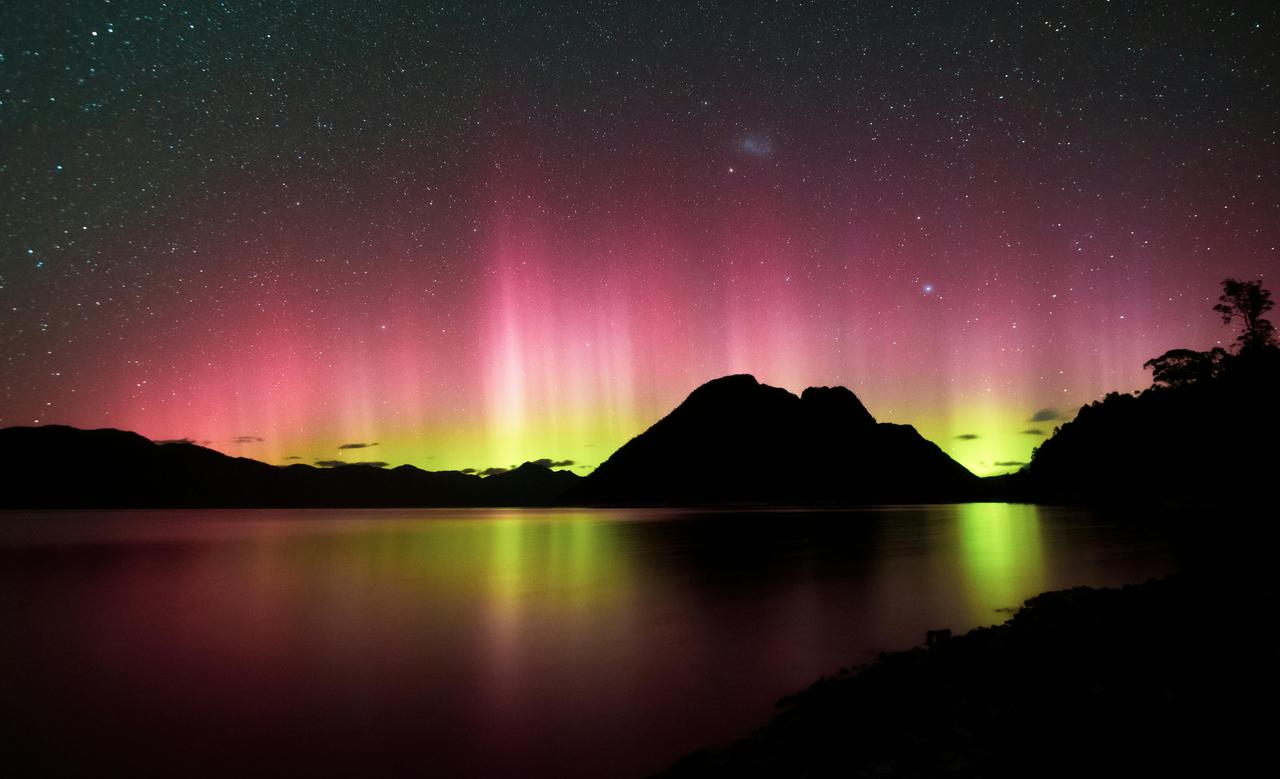
Southern Lights or Aurora Australis is a natural light phenomenon that occurs around the South Pole as a result of charged particles from the Sun interacting with Earth’s magnetic field and atmosphere. The name is derived from the Latin words aurora, meaning “dawn,” and australis, meaning “southern.”

Aurora Australis - New Zealand (Flickr)
Scientific data and cave paintings indicate that this phenomenon has been observed by humans for at least 32,000 years. In 1619, Galileo Galilei named the lights visible in the northern hemisphere “aurora borealis” and suggested they were caused by sunlight reflected from the atmosphere. However, modern scientific research has demonstrated that these lights result from complex energy transfers in the magnetosphere, contrary to Galileo’s reflection theory.
The primary source of auroras is the solar wind, a stream of charged particles—electrons and protons—in plasma form that flows continuously from the Sun into space. Earth’s powerful magnetic field, generated by its molten iron core, forms a protective shield called the magnetosphere that defends the planet from this radiation. When the solar wind strikes the magnetosphere, it bends the magnetic field lines, creating a vast magnetic tail extending in the opposite direction from the Sun. Particles trapped in this tail accelerate along the magnetic field lines toward the polar regions, reaching speeds of about one-tenth the speed of light (approximately 20,000 km/s), and enter the upper layers of the atmosphere. In the thermosphere layer (100–400 km altitude), these high-energy particles collide with atoms and molecules in the atmosphere, transferring energy to them (excitation). As these excited atoms return to their lower energy states, they release the excess energy in the form of photons (light). Because the particle flow reaches both poles simultaneously, southern (australis) and northern (borealis) lights typically occur at the same time.
The color of the aurora varies depending on the type of gas involved and the altitude at which the collision occurs:

Aurora in New Zealand (Pexels)
The intensity and frequency of auroras are directly linked to the Sun’s approximately 11-year magnetic activity cycle. Intense solar events such as Coronal Mass Ejections (CMEs) or coronal holes increase the density of particles reaching Earth, triggering geomagnetic storms. This level of activity is monitored using the Kp index (ranging from 0 to 9), which determines the brightness of the aurora and how far equatorward it extends; as the index rises, the lights become visible at lower latitudes. For instance, during an extreme geomagnetic storm in May 2024, the southern lights were observed as far north as Queensland, while the northern lights were seen in regions such as Italy and California. A similar event occurred in 2011, when rare full-red auroras were observed at unusually low latitudes, including in Missouri, USA.
Aurora Australis is primarily observed within a ring known as the “auroral oval,” located between 55° and 70° south latitude. The continent of Antarctica offers the most stable viewing conditions; however, several strategic locations in the Southern Hemisphere are favored due to their proximity to populated areas:
The aurora phenomenon is not unique to Earth; it has also been detected on other planets such as Jupiter, Saturn, Uranus, and Neptune, which possess both atmospheres and magnetic fields.
Beyond their visual appeal, auroras are electromagnetic events that can disrupt technological systems due to their high-energy charged particles. This energy flow can interfere with radio communications and GPS signals, cause power grid outages, increase satellite orbital drag leading to trajectory deviations, and create operational risks.
To mitigate these risks, satellites positioned at the L1 Lagrange point, approximately 1.5 million kilometers from Earth, continuously monitor the solar wind. This allows aurora forecasts to be generated 15 to 45 minutes before geomagnetic effects reach Earth.
Barton, Jared. "Yeni Zelanda'da Aurora." Accessed February 12, 2026. https://www.pexels.com/tr-tr/fotograf/yeni-zelanda-da-aurora-30108442/
Dobson, Trevor. "Aurora Australis at Sugarloaf Rock - Dunsborough, Western Australia.” Flickr. Accessed February 12, 2026. https://www.flickr.com/photos/trevor_dobson_inefekt69/55066838549/in/explore-2026-01-29/
Erol, Mesut. "Kutup Işıkları Nasıl Oluşur?" *Bilim ve Teknik*, December 2021. Accessed February 12, 2026. https://bilimteknik.tubitak.gov.tr/wp-content/uploads/sites/154/2025/09/a69a022e-4a3b-4336-a1c9-c51eddd33612-1.pdf
National Aeronautics and Space Administration (NASA). "Auroras." Accessed February 12, 2026. https://science.nasa.gov/sun/auroras/
Pokornyi, Tristan. "Peyzaj Manzara Dağlar Doğa." Accessed February 12, 2026. https://www.pexels.com/tr-tr/fotograf/peyzaj-manzara-daglar-doga-12369076/
Salimpour, Saeed. "What is the Aurora Australis and why should you experience it?" *This.* (Deakin University). Accessed February 12, 2026. https://this.deakin.edu.au/society/what-is-the-aurora-australis/
Shellie. "Aurora Australis/Southern Lights- Twizel, Mackenzie Country, New Zealand *Explored!*” Flickr. Accessed February 12, 2026. https://www.flickr.com/photos/flyingkiwigirl/51658605825
Space Weather Prediction Center (NOAA). "Aurora Tutorial." Accessed February 12, 2026. https://www.swpc.noaa.gov/content/aurora-tutorial
UCAR Center for Science Education. "Auroras: The Northern and Southern Lights." Accessed February 12, 2026. https://scied.ucar.edu/learning-zone/sun-space-weather/aurora


Region(s) | 55°–70° South auroral oval | ||||||||
|---|---|---|---|---|---|---|---|---|---|
Colors and Altitude | Pink (<100 km) Blue/Purple (100–200 km) Red (>200–300 km) Green (100–200 km) | ||||||||
Effect | GPS signal disruption, radio wave obstruction, power grid outages | ||||||||
Measurement | Kp Index (0–9) | ||||||||
Layer | Thermosphere (100–400 km) | ||||||||
Speed | 20,000 km/s (1/10 the speed of light) | ||||||||
Source | Solar wind (charged plasma) | ||||||||
History | 32,000 years (at least) | ||||||||
Latin Name | Aurora Australis | ||||||||
No Discussion Added Yet
Start discussion for "Southern Lights (Aurora Australis)" article
Formation Mechanism
Color Spectrum and Altitude Relationship
Geomagnetic Activity
Geographical Distribution and Observation Points
Technological Impacts