


This article was automatically translated from the original Turkish version.
+2 More
The magnetosphere is a complex region of space plasma that surrounds a planet or other celestial body, dominated by the interaction between the body’s intrinsic magnetic field and external plasma flows such as the solar wind. Earth’s magnetosphere is a dynamic structure extending tens of thousands of kilometers from the planet’s surface, serving as a vital shield that protects it from high-energy solar particles and cosmic rays. This structure forms as a result of the interaction between the supersonic plasma flow of the solar wind and the magnetic field generated by Earth’s planetary dynamo. The magnetosphere consists of numerous subregions containing interwoven and distinct plasma populations and physical processes, including the bow shock, magnetosheath, magnetopause, plasmasphere, radiation belts, and magnetotail.
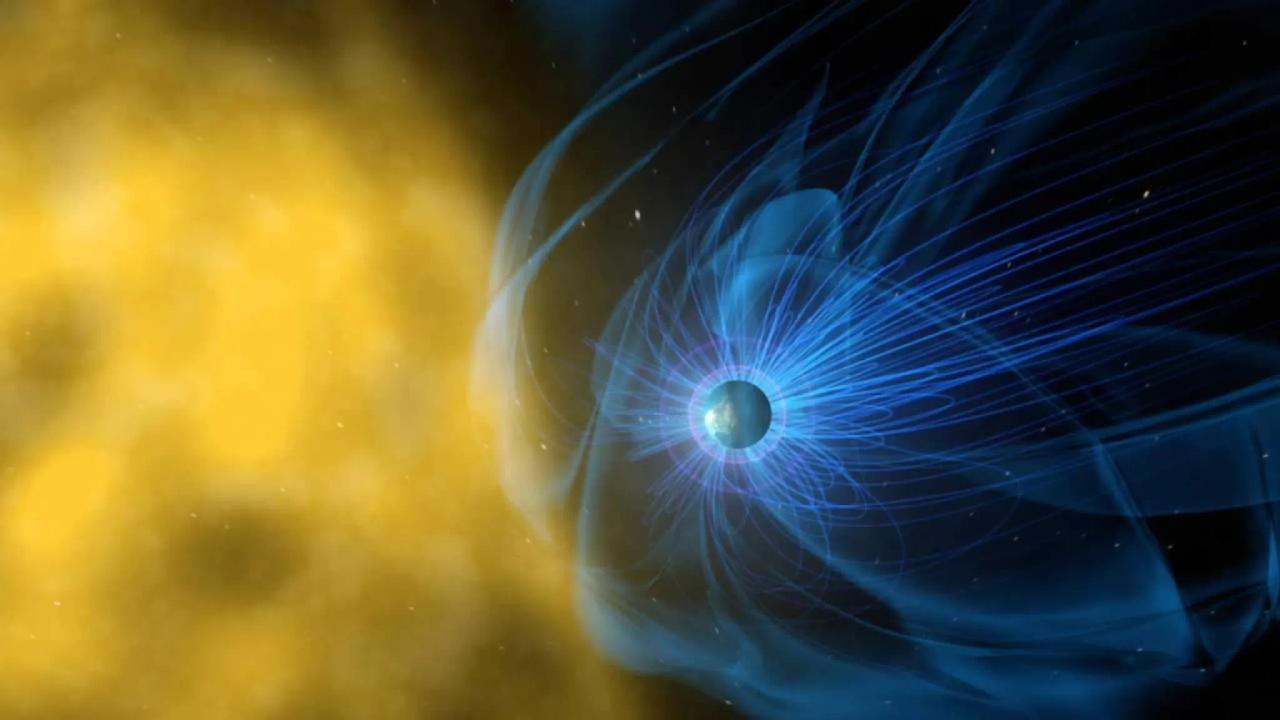
The existence and structure of Earth’s magnetosphere result from the interaction between two fundamental elements: the planet’s intrinsic magnetic field and the solar wind.
The Earth's Magnetosphere (NASA)
Earth’s magnetosphere is divided into distinct regions based on differences in plasma density, temperature, composition, and magnetic field behavior.
The bow shock is the outermost boundary of the magnetosphere. It is the region where the supersonic solar wind encounters the magnetospheric barrier, abruptly slowing to subsonic speeds, heating up, and compressing. On Earth’s dayside, it is located approximately 12 to 15 Earth radii (RE) from the planet’s center. Its position varies continuously depending on the speed and density of the solar wind.
This region lies between the bow shock and the magnetopause and contains plasma that has passed through the bow shock, slowed down, heated, and become highly turbulent. Plasma in the magnetosheath flows around the magnetopause toward the magnetotail.
The magnetopause is the sharp boundary separating the plasma controlled by the planet’s magnetic field from the solar wind-originated plasma of the magnetosheath. Its location is determined by the balance between the dynamic pressure of the incoming solar wind and the magnetic pressure from within. Typically located at about 10 RE on the dayside, this boundary can be compressed to as close as 6 to 7 RE during intense solar storms.
This region, located inside the magnetopause, is dominated by plasma populations primarily controlled by Earth’s own magnetic field and ionosphere.
The magnetotail is the portion of the magnetosphere on the nightside, stretched hundreds of Earth radii downstream by the solar wind. It consists of two main lobes (north and south), with magnetic field lines pointing toward Earth in the north lobe and away from Earth in the south lobe. These two lobes are separated by a hotter and denser plasma region called the plasma sheet.
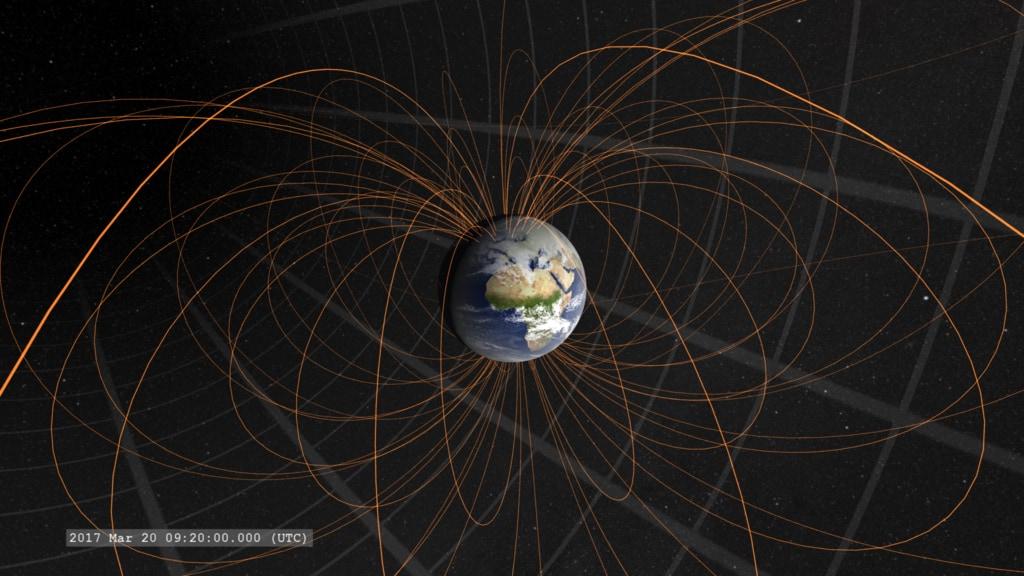
The Earth's Magnetosphere (NASA)
The magnetosphere is not a static structure; it is a dynamic system that constantly changes in response to conditions originating from the Sun.
Magnetospheres are not unique to Earth. Other planets with strong intrinsic magnetic fields also possess magnetospheres.
"The Magnetosphere." University of Alaska Fairbanks, Geophysical Institute. Accessed July 7, 2025. https://www.gi.alaska.edu/monitors/magnetometer
European Space Agency (ESA). "Earth's magnetosphere." Accessed July 7, 2025.
NASA Science. "Magnetospheres." Accessed July 7, 2025.
NASA. "Auroras." Accessed July 7, 2025. https://science.nasa.gov/sun/auroras/
NASA. "Earth's Magnetosphere." Accessed July 7, 2025.
NASA. "Earth's Magnetosphere." Accessed July 7, 2025.
NASA. "Earth's Magnetosphere." Accessed July 7, 2025. https://www.nasa.gov/image-article/earths-magnetosphere-2/
NASA. "Earth’s Magnetosphere and Plasmasphere." Accessed July 7, 2025. https://www.nasa.gov/image-article/earths-magnetosphere-plasmasphere/
NOAA Space Weather Prediction Center. "Geomagnetic Storms." Accessed July 7, 2025. https://www.swpc.noaa.gov/phenomena/geomagnetic-storms

Formation Mechanism: Interaction Between the Solar Wind and the Planet’s Magnetic Field
Main Regions of the Magnetosphere
Bow Shock
Magnetosheath
Magnetopause
Inner Magnetosphere
Magnetotail
Magnetospheric Dynamics and Space Weather
Magnetospheres of Other Planets