


This article was automatically translated from the original Turkish version.
+2 More
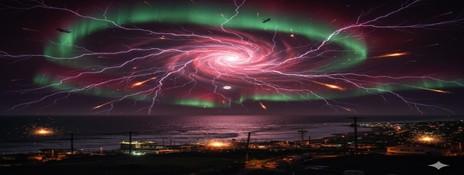
Geomagnetic Storms (Generated by Artificial Intelligence.)
Unit of Measurement | Kp-index (severity scale from 0 to 9) | ||||||||
|---|---|---|---|---|---|---|---|---|---|
Technological Impact | Radio signal disruptions, GPS errors, fluctuations in power grids | ||||||||
Visual Spectacle | Auroras (polar lights) occurring in regions near the poles | ||||||||
Duration of Effect | From several hours to several days | ||||||||
Source | Sunspots, solar flares, magnetic eruptions | ||||||||
Geomagnetic storms are temporary disturbances in Earth’s magnetosphere caused by solar flares and coronal mass ejections, lasting for hours or even days.【1】 The interaction between shock waves and magnetic field clouds from the solar wind and Earth’s magnetic field leads to energy transfer and major changes in ionospheric currents. This natural phenomenon is one of the most critical components of space weather, with effects ranging from modern technological systems to the navigational abilities of biological organisms.

Geomagnetic Storm (Generated by Artificial Intelligence)
The primary trigger of geomagnetic storms is sudden energy releases in active regions of the Sun. Solar flares, caused by the breaking and reconnection of magnetic field lines near sunspots, along with accompanying coronal mass ejections, propel clouds of charged particles into space at speeds of millions of kilometers per second. When these plasma clouds reach Earth, they collide with the planet’s protective shield, the magnetosphere.
The intensity of the storm depends on the speed, density, and most importantly, the direction of the magnetic field carried by the solar plasma. If the incoming magnetic field’s “z-component” is oriented southward, it interacts with Earth’s northward-pointing magnetic field lines, initiating a process called magnetic reconnection. This process allows the vast energy of the solar wind to flow into Earth’s inner magnetosphere, intensifying ring currents. This increase in ring current causes a sudden drop in the strength of the magnetic field at ground level, which defines the main phase of a geomagnetic storm.【2】
Solar flares are massive bursts of radiation resulting from the sudden release of magnetic energy in the Sun’s atmosphere. These flares emit energy across the entire electromagnetic spectrum, from radio waves to X-rays and gamma rays. However, the primary cause of geomagnetic storms is usually the coronal mass ejections that accompany them. CMEs are enormous structures of plasma and magnetic fields ejected from the Sun’s corona into space.
When a CME moves toward Earth, it strikes the planet’s magnetic field like a hammer. As a result, the sunward side of the magnetosphere compresses while the opposite side stretches into a tail millions of kilometers long. When the energy accumulated in this tail is suddenly released, particles accelerate rapidly toward the polar regions, intensifying the storm.
Various indices and scales have been developed to determine the intensity of geomagnetic storms and predict their potential impacts. The most widely used is the G-scale, developed by the National Oceanic and Atmospheric Administration:【3】
In academic studies, storm intensity is typically measured using the Dst (Disturbance Storm Time) index. A more negative Dst value indicates greater weakening of Earth’s magnetic field at the surface. For example, during major storms observed in 2024, Dst values reached levels of -400 nT.
Modern society’s complete dependence on electricity and digital communication has made geomagnetic storms a matter of national security.
During a storm, rapid magnetic field changes in the upper atmosphere induce secondary electric fields on Earth’s surface according to Faraday’s law of induction. These fields generate Geomagnetically Induced Currents (GIC) along long transmission lines. GIC can saturate the magnetic cores of transformers, causing overheating and equipment failure.
High-energy particle showers cause “single event effects” in satellite electronic components. Additionally, atmospheric heating and expansion create a drag effect on low-orbit satellites. This can lead to altitude loss and increased risk of atmospheric burn-up. In 2022, approximately 40 Starlink satellites were lost due to such a storm.
Irregularities in ionospheric electron density caused by storms lead to refraction and scintillation of radio signals from satellites. This results in meter-scale errors in GPS data, endangering autonomous systems, maritime navigation, and aviation safety.
The most spectacular visual effect of geomagnetic storms is the aurora. Charged particles from the Sun follow Earth’s magnetic field lines into the atmosphere, where they collide with oxygen and nitrogen atoms. Oxygen atoms typically emit green and red light, while nitrogen atoms produce blue and purple emissions. As storm intensity increases, the “auroral oval” expands, making these lights visible even from mid-latitude countries such as Türkiye.
The most intense geomagnetic storm recorded in human history occurred in 1859 and is known as the Carrington Event. During this event, telegraph lines caught fire, operators received electric shocks, and auroras were observed as far south as the Caribbean. Today, a similar storm is estimated to cause trillions of dollars in economic damage and months-long power outages. The strongest storm in the past two decades, which occurred in May 2024, provided critical data on the resilience of modern systems to such events.【4】
Solar activity is monitored in real time by satellites such as NASA’s SDO, SOHO, and ACE. When a coronal mass ejection is detected, its arrival time at Earth is calculated and warnings are issued. These early warnings allow power grid operators to activate backup capacity, airlines to reroute flights away from polar regions, and satellite operators to place sensitive components into protective mode.
Anadolu Ajansı. "ABD'de Güneş Patlamasının Ardından Jeomanyetik Fırtına Uyarısı Yapıldı." Accessed February 9, 2026. https://www.aa.com.tr/tr/dunya/abdde-gunes-patlamasinin-ardindan-jeomanyetik-firtina-uyarisi-yapildi/3760512
Başçiftçi, Fuat. "24. Güneş Döngüsü Boyunca Meydana Gelen Jeomanyetik Fırtınaların Dağılımı." *BEÜ Fen Bilimleri Dergisi* 10, no. 4 (2021): 1394-1403. Accessed February 9, 2026. https://dergipark.org.tr/tr/download/article-file/1833936.
Maine Emergency Management Agency. "Geomagnetic Storms." Accessed February 9, 2026. https://www.maine.gov/mema/maine-prepares/preparedness-library/geomagnetic-storms.
TÜBİTAK Bilim Genç. "Güneşte Şiddetli Patlama ile Dünyada Gözlenen Jeomanyetik Fırtına." Accessed February 9, 2026. https://bilimgenc.tubitak.gov.tr/makale/guneste-siddetli-patlama-ile-dunyada-gozlenen-jeomanyetik-firtina.
[1]
TÜBİTAK Bilim Genç, “Jeomanyetik Fırtına.” Erişim tarihi: 9 Şubat 2026. https://bilimgenc.tubitak.gov.tr/konular/jeomanyetik-firtina
[2]
NOAA Space Weather Prediction Center, “Geomagnetic Storms.” Erişim tarihi: 9 Şubat 2026. https://www.swpc.noaa.gov/phenomena/geomagnetic-storms
[3]
Maine Emergency Management Agency, “Geomagnetic Storms.” Erişim tarihi: 9 Şubat 2026. https://www.maine.gov/mema/maine-prepares/preparedness-library/geomagnetic-storms
[4]
NASA, “Biggest Geomagnetic Storm in 20 Years.” Erişim tarihi: 9 Şubat 2026. https://svs.gsfc.nasa.gov/14835/#:~:text=What%20Happened%20During%20the%20Biggest%20Geomagnetic%20Storm%20in%20Over%2020%20Years,-Released%20Friday%2C%20May&text=On%20May%2010%2C%202024%2C%20the,produce%20surprising%20effects%20on%20Earth.

Geomagnetic Storms (Generated by Artificial Intelligence.)
Unit of Measurement | Kp-index (severity scale from 0 to 9) | ||||||||
|---|---|---|---|---|---|---|---|---|---|
Technological Impact | Radio signal disruptions, GPS errors, fluctuations in power grids | ||||||||
Visual Spectacle | Auroras (polar lights) occurring in regions near the poles | ||||||||
Duration of Effect | From several hours to several days | ||||||||
Source | Sunspots, solar flares, magnetic eruptions | ||||||||
Mechanism and Physical Processes of Geomagnetic Storms
Relationship Between Solar Flares and Coronal Mass Ejections
Classification and Measurement Methods
Impacts on Technological Infrastructure
Power Grids and Geomagnetically Induced Currents (GIC)
Satellite Operations and Space Missions
Communication and Precision Positioning
Natural Observations: Auroras
Historical Examples and Future Risks
Monitoring and Early Warning Strategies