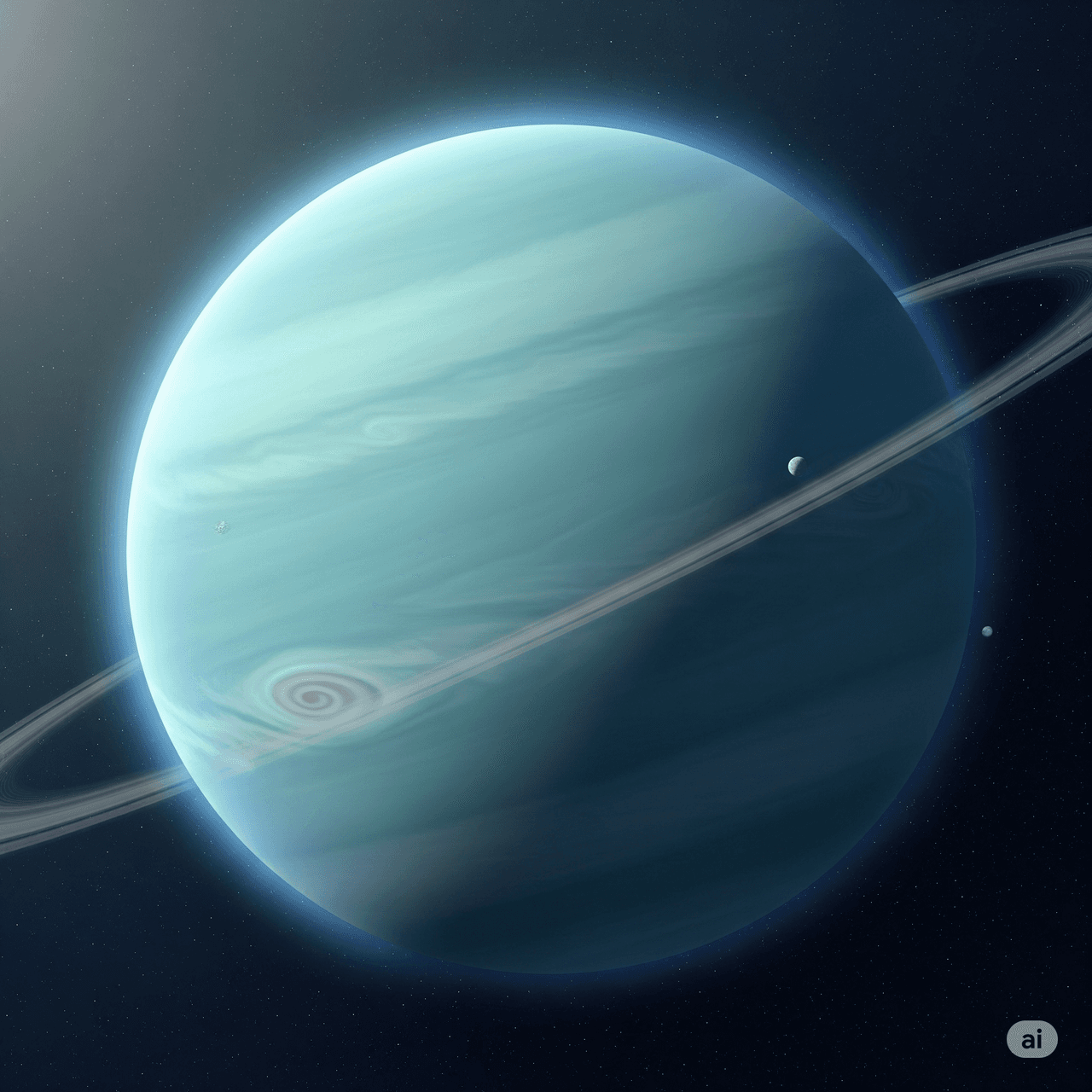




Uranus
Uranus is the seventh planet in the Solar System. It draws attention due to its massive structure, tilted axis of rotation, and blue-green color. It has no solid surface that can be landed on because it is composed entirely of gases.
🧊 What is Uranus?
Uranus is the seventh planet from the Sun. Like Jupiter and Saturn, it is a gas giant, but because it contains a higher proportion of icy materials such as water, ammonia, and methane, it is also classified as an ice giant. For this reason, scientists categorize Uranus separately from the gas giants into its own distinct group.
🔭 Discovery
Uranus is the first planet to be discovered using a telescope. It was discovered in 1781 by William Herschel. Until then, only planets visible to the naked eye were known. Uranus’s discovery through a telescope holds great significance in the history of science.
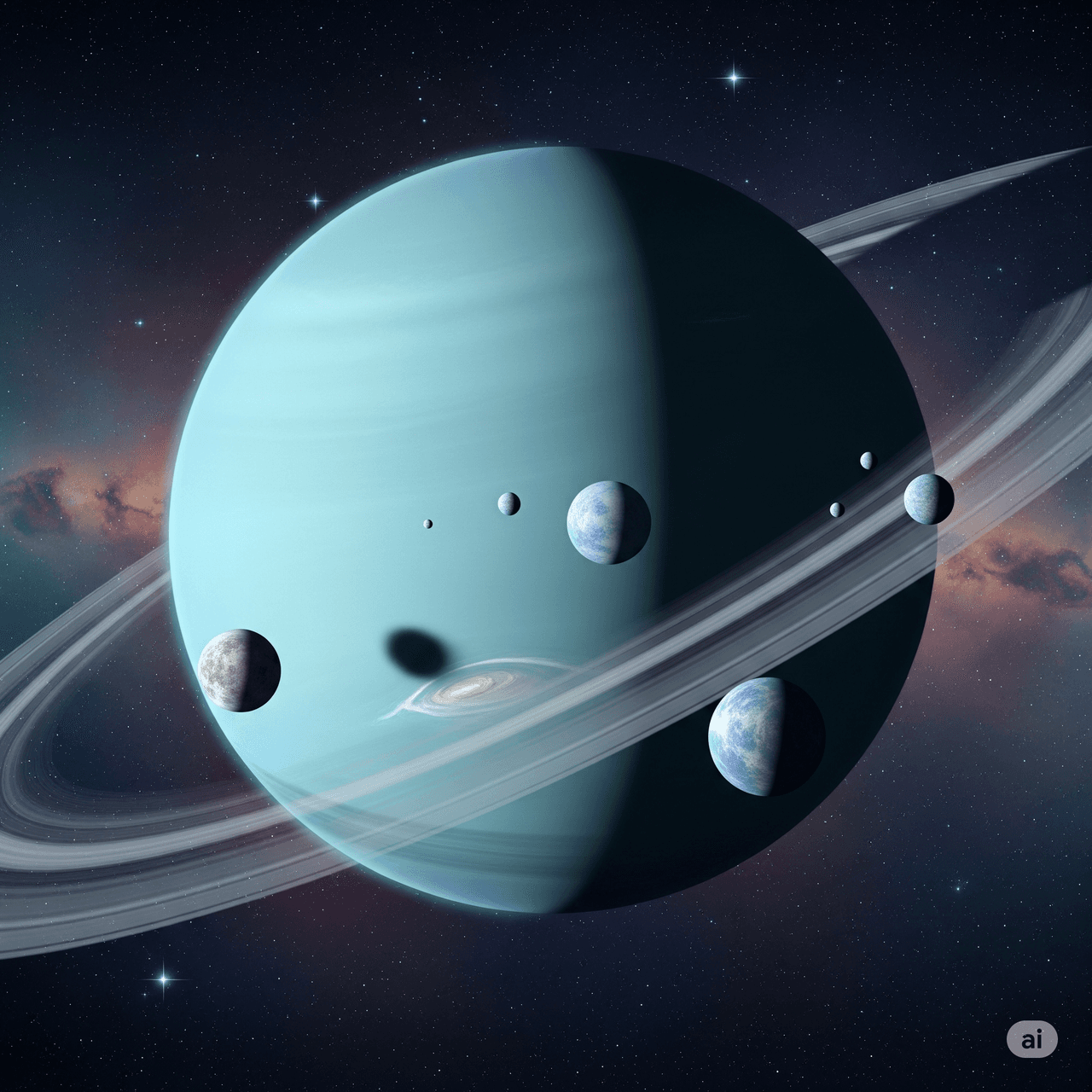
Image of Uranus (generated by artificial intelligence)
🎨 Why Is It Blue-Green?
The blue-green color of Uranus is caused by methane gas in its atmosphere. This gas absorbs the red wavelengths of sunlight and reflects the blue wavelengths, making Uranus appear blue-green to observers.
🔄 Its Strange Rotation
Unlike other planets, Uranus rotates on its side. With an axial tilt of approximately 98 degrees, it essentially rolls around the Sun. Additionally, it rotates in the opposite direction to Earth, meaning it spins clockwise. Due to this unusual motion, each season can last about 42 years, and its poles can point directly toward the Sun at different points in its orbit.

Direction of Uranus’s rotation (generated by artificial intelligence)
🧭 Directions on Uranus
The concept of direction on Uranus is highly unusual because its rotation differs drastically from that of other planets. Due to its extreme axial tilt, scientists must use special definitions to determine which hemisphere is considered north or south.
🛰️ Moons and Rings
Uranus has 27 known moons. These moons are typically named after characters from Shakespeare’s plays. Uranus also has 13 rings, but they are not as prominent or bright as Saturn’s rings.

Image of Uranus (generated by artificial intelligence)
🚀 Has It Been Visited?
To date, only one spacecraft, Voyager 2, has visited Uranus. In 1986, it flew by the planet, capturing images and transmitting valuable data. However, no spacecraft has yet landed on Uranus.
❄️ Extremely Cold!
Because Uranus is so far from the Sun, it receives very little sunlight. As a result, its temperature is extremely low. Uranus’s outer atmosphere, at approximately -224°C, is among the coldest in the Solar System.