This article was automatically translated from the original Turkish version.
Name(s) | Moon (English: Moon / Latin: Luna) | ||||||||
|---|---|---|---|---|---|---|---|---|---|
Type(s) | Natural satellite | ||||||||
Parent Planet | Earth | ||||||||
Satellite Type | Regular satellite (from primary satellites) | ||||||||
Diameter | 3,474.8 km | ||||||||
Surface Area | Approximately 37.9 million km² (7.4% of Earth's surface) | ||||||||
Volume | Approximately 21.9 billion km³ | ||||||||
Mass | 7.342 × 10²² kg (approximately 1.23% of Earth's mass) | ||||||||
Density | 3.344 kg/m³ | ||||||||
Average Orbital Distance (From Earth) | 384,400 km | ||||||||
Apogee (Farthest Point) | ~405,500 km | ||||||||
Perigee (Closest Point) | ~362,600 km | ||||||||
Orbital Period (Synodic Month) | 29.53 days | ||||||||
Orbital Period (Stellar - Sidereal Month) | 27.32 days | ||||||||
Average Orbital Velocity | 1.022 km/s | ||||||||
Axial Tilt | 1.54° | ||||||||
Orbital Inclination (Relative to the Ecliptic) | 5.145° | ||||||||
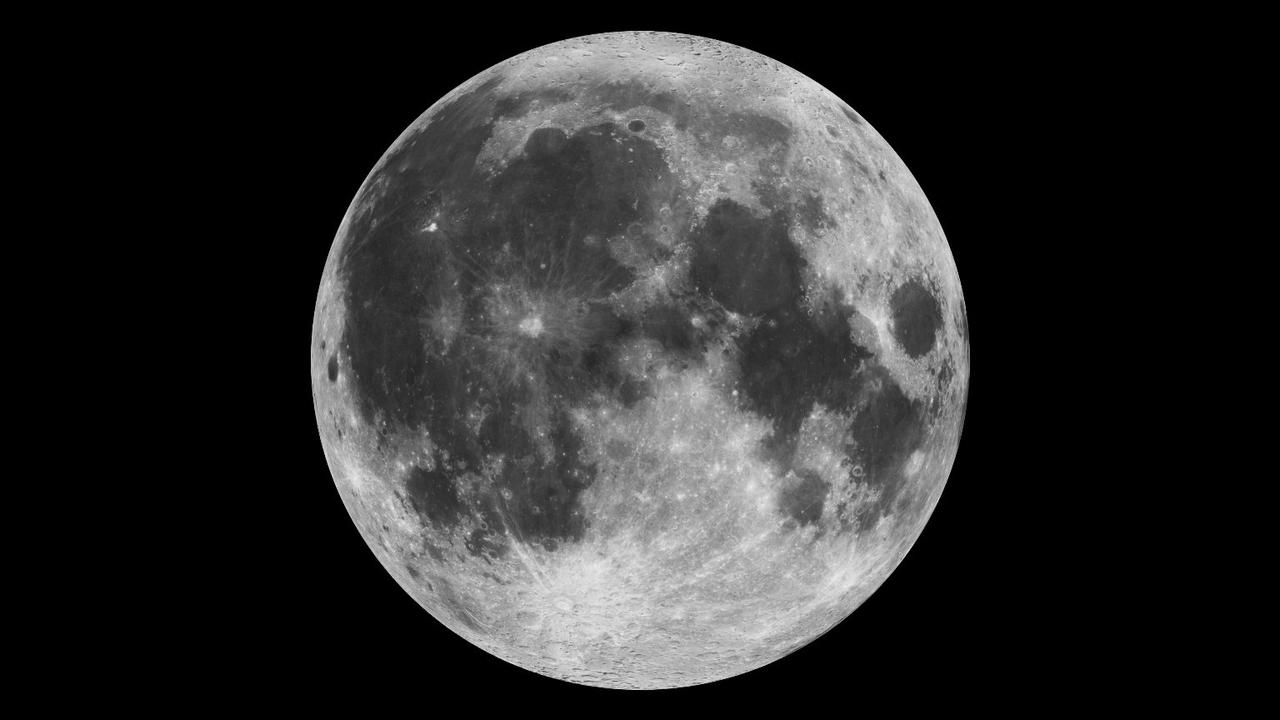
The Moon is Earth’s only natural satellite and ranks as the fifth-largest natural satellite in the Solar System. The Moon has been studied in detail in terms of its diameter, mass and surface features, making it a significant subject of research both for its geological structure and astronomical observations. This celestial body, located at an average distance of 384,400 kilometers from Earth, has been analyzed from numerous technical perspectives including its orbital motion, surface morphology, internal structure and origin.

Moon (NASA)
The Moon possesses a very thin layer of gas, technically termed an “exosphere,” with negligible atmospheric accumulation. As a result, there is no sound transmission, and surface temperatures vary dramatically between day and night.
The Moon orbits Earth with a sidereal period of approximately 27.3 days. However, due to the motion of the Earth-Moon system around the Sun, its synodic period (the time from one new moon to the next) is 29.5 days. The Moon is gravitationally locked to Earth (tidally locked), meaning it always presents the same face toward Earth.
This gravitational locking results in Earth observing only one side of the Moon, except for minor oscillations known as librations.
Moon Phases 2025. (NASA YouTube)
The Moon’s internal structure has been modeled using seismic data and samples returned by the Apollo missions. It generally consists of three layers:
The Moon has a weak magnetic field and lacks a permanent magnetosphere. However, localized, weak permanent magnetic anomalies have been detected on its surface.
The lunar surface is primarily composed of two major geographical features:
The Moon’s surface is largely shaped by meteorite impacts and is covered with thousands of craters. One of the largest impact basins is the South Pole–Aitken Basin, with a diameter of approximately 2,500 km and a depth of about 13 km.

Crater on the Lunar Surface Visualized by Artificial Intelligence.
The layer of dust and fragmented rock covering the lunar surface is called regolith. It has formed through the effects of micrometeorite impacts, solar wind, and cosmic rays. Its thickness varies locally between 2 and 20 meters.

Regolith on the Lunar Surface Visualized by Artificial Intelligence.
The Moon’s geological evolution is divided into four main periods:

Geological Stages of the Moon Visualized by Artificial Intelligence.
The most widely accepted model for the Moon’s origin is the giant impact hypothesis. According to this hypothesis, approximately 4.5 billion years ago, a Mars-sized celestial body named Theia collided with the young Earth, and material ejected from this impact coalesced to form the Moon. This model successfully explains the Moon’s low iron content and its isotopic similarities to Earth.
Alternative hypotheses include:
However, these models do not adequately match the chemical and isotopic evidence.
The Moon is the second-brightest object in the sky. Its apparent brightness varies with its phases and can reach as high as -12.7 magnitude during full moon. The observable phases result from changing geometry between the Sun, Moon and Earth. Lunar and solar eclipses occur during these alignment events.
The Apollo missions conducted between 1969 and 1972 resulted in six crewed landings on the lunar surface. A total of 382 kilograms of rock and regolith samples were returned to Earth, and geological measurements were made on the Moon. These data have provided answers to many questions regarding the Moon’s structure, origin and evolution.

Buzz Aldrin Standing Next to the U.S. Flag on the Moon. (NASA)
NASA. “Astronaut Buzz Aldrin on the Moon, Apollo 11 (AS11-40-5875).” *NASA Science*. Accessed July 7, 2025. https://science.nasa.gov/image-detail/amf-as11-40-5875/.
NASA. “Earthrise from Apollo 8.” *NASA Science*. Accessed July 7, 2025. https://science.nasa.gov/image-detail/amf-gsfc_20171208_archive_e001982/.
NASA. “Moon Facts.” NASA Science: Moon. Accessed July 7, 2025. https://science.nasa.gov/moon/facts/.
NASA. “Moon Formation.” *NASA Science: Moon*. Accessed July 7, 2025. https://science.nasa.gov/moon/formation/.
NASA. “Moon Phases.” NASA Science: Moon. Accessed July 7, 2025. https://science.nasa.gov/moon/moon-phases/.
NASA. “Moon.” *NASA Science: Moon*. Accessed July 7, 2025. https://science.nasa.gov/moon/.
NASA. “Moons of Our Solar System.” *NASA Science: Solar System*. Accessed July 7, 2025. https://science.nasa.gov/solar-system/moons/.

Name(s) | Moon (English: Moon / Latin: Luna) | ||||||||
|---|---|---|---|---|---|---|---|---|---|
Type(s) | Natural satellite | ||||||||
Parent Planet | Earth | ||||||||
Satellite Type | Regular satellite (from primary satellites) | ||||||||
Diameter | 3,474.8 km | ||||||||
Surface Area | Approximately 37.9 million km² (7.4% of Earth's surface) | ||||||||
Volume | Approximately 21.9 billion km³ | ||||||||
Mass | 7.342 × 10²² kg (approximately 1.23% of Earth's mass) | ||||||||
Density | 3.344 kg/m³ | ||||||||
Average Orbital Distance (From Earth) | 384,400 km | ||||||||
Apogee (Farthest Point) | ~405,500 km | ||||||||
Perigee (Closest Point) | ~362,600 km | ||||||||
Orbital Period (Synodic Month) | 29.53 days | ||||||||
Orbital Period (Stellar - Sidereal Month) | 27.32 days | ||||||||
Average Orbital Velocity | 1.022 km/s | ||||||||
Axial Tilt | 1.54° | ||||||||
Orbital Inclination (Relative to the Ecliptic) | 5.145° | ||||||||
Physical Properties
Orbital and Rotational Motion
Internal Structure
Surface Features
Craters
Regolith
Geological Evolution
Origin Theory
Observational Characteristics
Human Exploration