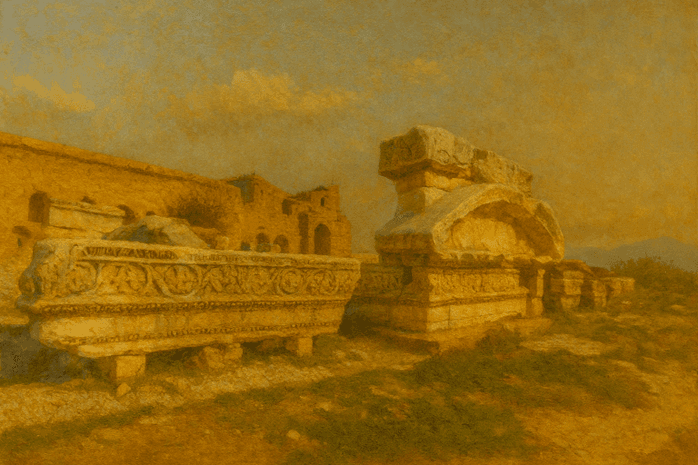




Pamukkale – Hierapolis: The Meeting of the Sacred City and the White Travertines
Pamukkale and Hierapolis, one of the jewels of the Aegean Region, are a unique place where nature and history come together in harmony, unmatched anywhere in the world. This area, inscribed on the UNESCO World Heritage List in 1988, is renowned for its mesmerizing white travertines and magnificent ruins that have survived from antiquity to the present day.

(Generated with Artificial Intelligence)
The Foundation and History of Hierapolis
The ancient city of Hierapolis, located immediately beside the Pamukkale travertines, was founded in the 2nd century BCE by King Eumenes II of Pergamon. It derived its name from Hiera, the wife of Telephus, the legendary founder of Pergamon. Ancient geographers Strabo and Ptolemy noted that the city belonged to the region of Phrygia.
After being destroyed by a major earthquake during the reign of the Roman Emperor Nero in 60 CE, Hierapolis was rebuilt and took on the appearance of a typical Roman city. It retained its significance throughout the Byzantine period. Its greatest sacred importance to the Christian world stems from the martyrdom of Saint Philip, one of the twelve apostles of Jesus, who was crucified here around 80 CE. In the 4th century, a magnificent martyrium was constructed in his honor.
Natural Beauty: The Pamukkale Travertines
Pamukkale consists of pure white terraces and pools formed by the deposition of calcium carbonate from hot springs rising from underground. This natural formation stretches approximately 2.7 kilometers in length and reaches a height of 160 meters. Five different hot spring sources, with temperatures ranging between 35 and 36 °C, have attracted seekers of healing since antiquity and continue to do so today.
The unique landscape of the travertines attracted great interest in ancient times. Thanks to these thermal waters, Hierapolis became essentially a “thermal health center,” drawing people from all corners of Anatolia in search of healing and beauty.

(Generated with Artificial Intelligence)
Important Structures of the Ancient City
Hierapolis offers visitors a journey into the past through its many well-preserved structures:
- Theatre: The grand Roman theatre, built in the 3rd century, is notable for its marble columns and mythological reliefs.
- Roman Baths: Today used as an archaeological museum, it displays statues and artifacts uncovered during excavations.
- Frontinus Street: The city’s main avenue, 14 meters wide, is adorned with impressive gateways.
- Agora: A vast square that served as the commercial heart of the city.
- Temple of Apollo and Ploutonium: A sacred precinct dedicated to Apollo and the mystical entrance known as the “Gate to Hell.”
- Cathedral and Columned Church: Significant Christian structures dating from the Byzantine period.
- Martyrium of Saint Philip: An octagonal, domed and vaulted martyrium structure.
Pamukkale and Hierapolis Today
Every year, millions of tourists visit Denizli to see this region. Visitors explore the ancient city’s historical traces while also cooling off and seeking healing in the warm waters of the travertines. However, due to the extreme fragility of the travertines, walking and swimming are permitted only in designated areas.
Pamukkale and Hierapolis continue to be among the most cherished destinations for travelers fascinated by history and nature, just as they have been for thousands of years.