

This article was automatically translated from the original Turkish version.
+2 More
Location | Eastern Kütahya between Yeni Bosna and Ovacık villages | ||||||||
|---|---|---|---|---|---|---|---|---|---|
Period(s) | 900–600 BCE Phrygians | ||||||||
Feature(s) | Volcanic tuff rock dwellings | ||||||||
Structure(s) | Rock tombs Deliktaş and Penteser castles open-air sanctuaries | ||||||||
Culture | Cybele cult, Byzantine frescoes, Phrygian architecture | ||||||||
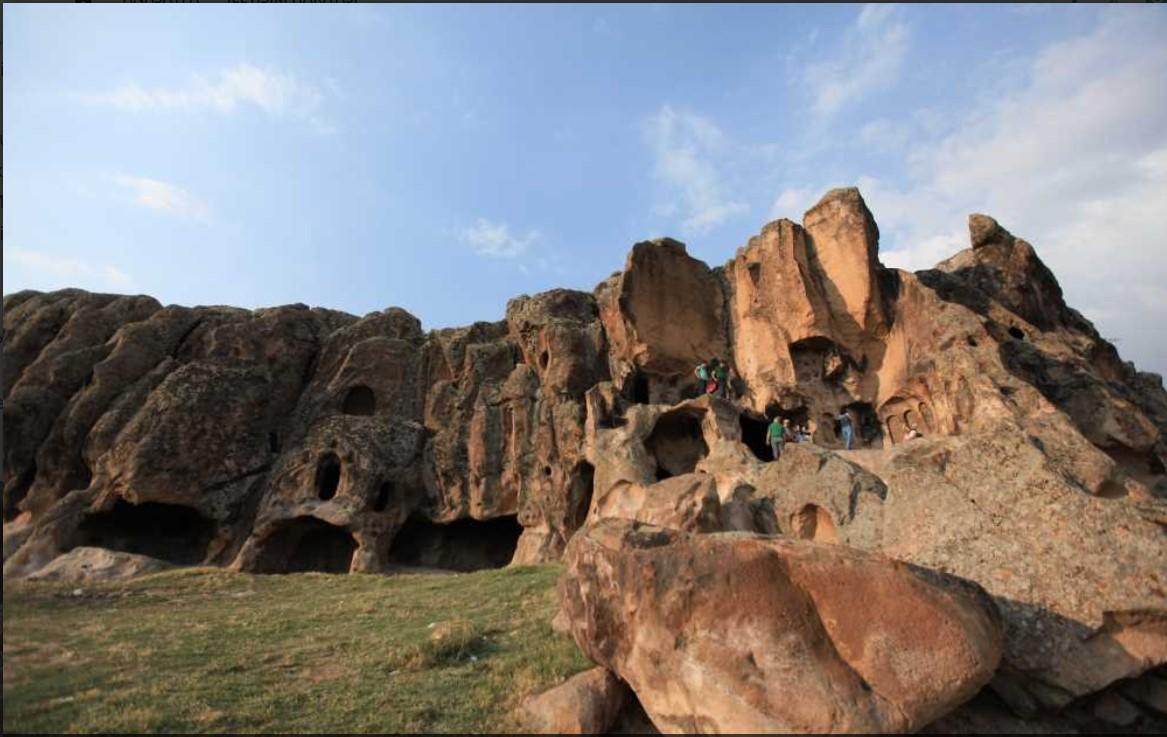
Phrygian Valley is located in the geographical area known in antiquity as “Phrygia Epiktetos” (Lesser Phrygia), where the provinces of Eskişehir, Afyonkarahisar, and Kütahya meet. Within Kütahya’s provincial boundaries, the Phrygian Valley begins at Yeni Bosna Village, 3 km from the center, and extends eastward across the province, ending at Ovacık Village, 55 km away. This region includes the northern section with the caves of Sabuncupınar, Söğüt, İnli, Sökmen, Fındık, and İncik, as well as the southern areas encompassing Ovacık Village, İnlice Neighborhood, and surrounding localities.
%252Ffrigya3.jpg&w=1280&q=75)
Phrygian Valley (Anadolu Agency)
The region consists of Phrygian highlands covered with volcanic tuffs ejected by the ancient volcano Mount Türkmen, located in eastern Kütahya. Due to the ease with which these tuffs can be carved, the area was densely settled by the Phrygians between 900 and 600 BCE. The favorable rock structure enabled the construction of open-air temples, altars, rock-cut tombs, and structures for defense and shelter. Among these constructions are areas dedicated to the cult of Cybele.
Settlement continued during the Roman and Byzantine periods, and traces of crosses painted with charcoal, meander motifs, and fresco fragments can still be observed in churches and chapels from these eras. Natural rock formations such as “Deliktaş Castle” and “Penteser Castle” were shaped by the Phrygians and Byzantines into defensive structures.
%252Ffrigya5.jpg&w=1280&q=75)
Phrygian Valley (Anadolu Agency)
The Phrygians were an Indo-European group that migrated into Anatolia via the Bosporus around the mid-11th century BCE. By the 8th century BCE, they had established a kingdom with its center at Gordion (Polatlı-Yassıhöyük). This civilization developed a distinctive style in ceramics, furniture, metalwork, and textiles. Phrygian weaving, particularly the art of the “Topates” carpet, influenced subsequent Anatolian cultures.
Geometric patterns adorn furniture, while metalwork features bronze vessels with handles, cauldrons, and belts, fibulae, and buckles made of gold and silver. Rock-cut monuments carved into cliff faces reflect the architectural traditions of their temples and constitute significant cultural traces of this civilization.
%252Ffrigya1.jpg&w=1280&q=75)
Phrygian Valley (Anadolu Agency)
The Phrygian Valley has been designated by the Ministry of Culture and Tourism as an alternative tourism destination and is officially named the “Phrygian Way,” covering a 506-kilometer route. This path connects the provinces of Afyonkarahisar, Eskişehir, Ankara, and Kütahya, beginning at Gordion and converging at Yazılıkaya. Along this route, archaeological remains from the Phrygian period—including rock settlements, monumental tombs, churches, and fairy chimneys—represent both natural and cultural heritage.
Yenice Farm in Kütahya, Seydiler in Afyonkarahisar, and Gordion in Polatlı, Ankara, serve as the main access points to the region. Yazılıkaya Neighborhood, part of Han District in Eskişehir, stands out as a religious and monumental center. Important structures in this area include the Midas (Yazılıkaya) Monument, the Unfinished Yazılıkaya Monument, the Gerdekkaya Monumental Tomb, and Kırkgöz Castle.
Anadolu Ajansı. “Alternatif turizmin cazibe merkezi: Frigya Vadileri.” Accessed June 20, 2025. https://www.aa.com.tr/tr/kultur-sanat/alternatif-turizmin-cazibe-merkezi-frigya-vadileri/1227425.
Kütahya Belediyesi. “Frig Vadisi.” *Kutahya.bel.tr*. Accessed June 20, 2025. https://www.kutahya.bel.tr/tarihiyerler.asp?islem=goster&id=22.
T.C. Kültür ve Turizm Bakanlığı. “Frigya Vadileri.” Kulturportali.gov.tr. Accessed June 20, 2025. https://kulturportali.gov.tr/turkiye/kutahya/gezilecekyer/frgya-vadler.

Location | Eastern Kütahya between Yeni Bosna and Ovacık villages | ||||||||
|---|---|---|---|---|---|---|---|---|---|
Period(s) | 900–600 BCE Phrygians | ||||||||
Feature(s) | Volcanic tuff rock dwellings | ||||||||
Structure(s) | Rock tombs Deliktaş and Penteser castles open-air sanctuaries | ||||||||
Culture | Cybele cult, Byzantine frescoes, Phrygian architecture | ||||||||
Geological and Archaeological Features
Phrygian Civilization and Cultural Heritage
Phrygian Way and Tourism Potential